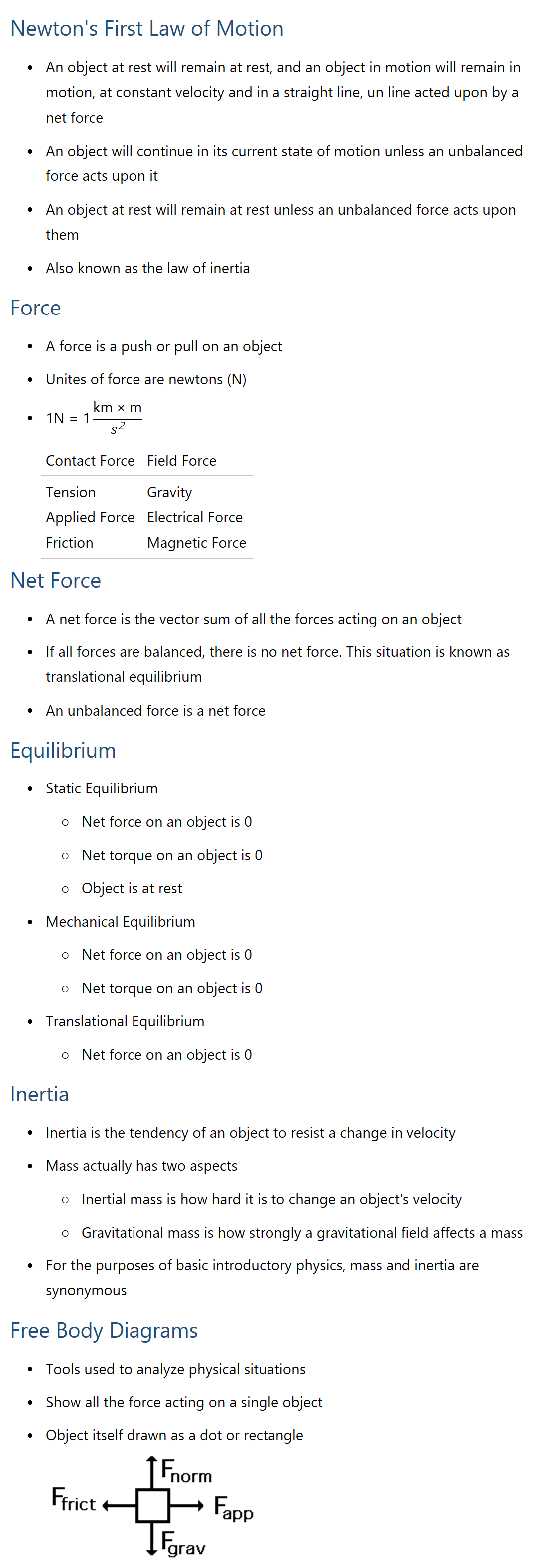
Newtons First Law of Motion • An object at rest will remain at rest, and an object in motion will remain in motion, at constant velocity and in a straight line, un line acted upon by a net force • An object will continue in its current state of motion unless an unbalanced force acts upon it • An object at rest will remain at rest unless an unbalanced force acts upon them • Also known as the law of inertia Force • A force is a push or pull on an object • Unites of force are newtons (N) • 1N=1 (km×m)/s^2 Contact Force Field Force Tension Applied Force Friction Gravity Electrical Force Magnetic Force Net Force • A net force is the vector sum of all the forces acting on an object • If all forces are balanced, there is no net force. This situation is known as translational equilibrium • An unbalanced force is a net force Equilibrium • Static Equilibrium ○ Net force on an object is 0 ○ Net torque on an object is 0 ○ Object is at rest • Mechanical Equilibrium ○ Net force on an object is 0 ○ Net torque on an object is 0 • Translational Equilibrium ○ Net force on an object is 0 Inertia • Inertia is the tendency of an object to resist a change in velocity • Mass actually has two aspects ○ Inertial mass is how hard it is to change an objects velocity ○ Gravitational mass is how strongly a gravitational field affects a mass • For the purposes of basic introductory physics, mass and inertia are synonymous Free Body Diagrams • Tools used to analyze physical situations • Show all the force acting on a single object • Object itself drawn as a dot or rectangle