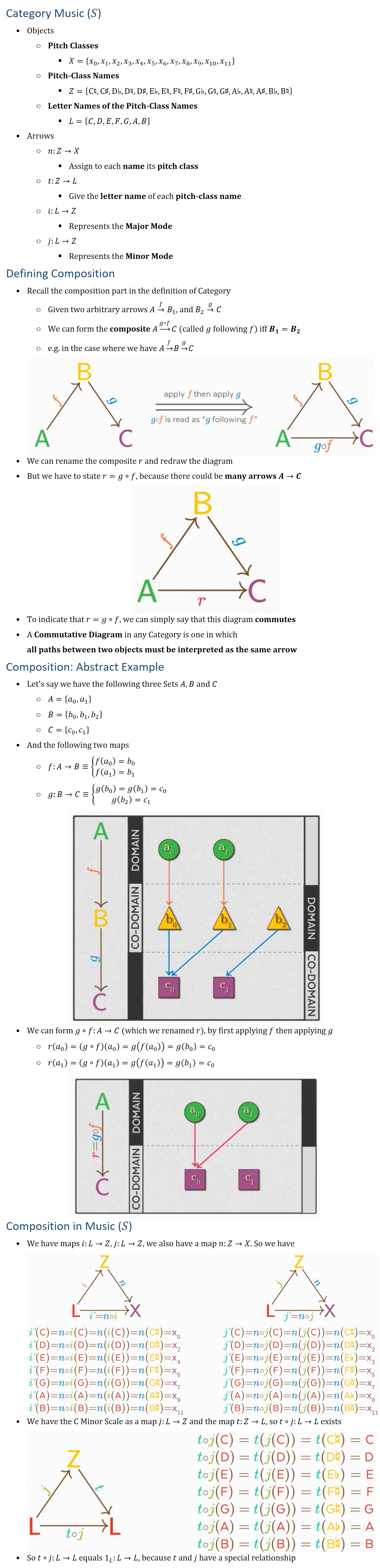
Category Music (S) • Objects ○ Pitch Classes § X={x_0,x_1,x_2,x_3,x_4,x_5,x_6,x_7,x_8,x_9,x_10,x_11 } ○ Pitch-Class Names § Z={C♮,C♯,D♭,D♮,D♯,E♭,E♮,F♮,F♯,G♭,G♮,G♯,A♭,A♮,A♯,B♭,B♮} ○ Letter Names of the Pitch-Class Names § L={C,D,E,F,G,A,B} • Arrows ○ n:Z→X § Assign to each name its pitch class ○ t:Z→L § Give the letter name of each pitch-class name ○ i:L→Z § Represents the Major Mode ○ j:L→Z § Represents the Minor Mode Defining Composition • Recall the composition part in the definition of Category ○ Given two arbitrary arrows A →┴f B_1, and B_2 →┴g C ○ We can form the composite A→┴(g∘f) C (called g following f) iff B_1=B_2 ○ e.g. in the case where we have A→┴f B→┴g C • We can rename the composite r and redraw the diagram • But we have to state r=g∘f, because there could be many arrows A→C • To indicate that r=g∘f, we can simply say that this diagram commutes • A Commutative Diagram in any Category is one in which all paths between two objects must be interpreted as the same arrow Composition: Abstract Example • Let s say we have the following three Sets A,B and C ○ A={a_0,a_1 } ○ B={b_0,b_1,b_2 } ○ C={c_0,c_1 } • And the following two maps ○ f:A→B≡{█(f(a_0 )=b_0@f(a_1 )=b_1 )┤ ○ g:B→C≡{█(g(b_0 )=g(b_1 )=c_0@g(b_2 )=c_1 )┤ • We can form g∘f:A→C (which we renamed r), by first applying f then applying g ○ r(a_0 )=(g∘f)(a_0 )=g(f(a_0 ))=g(b_0 )=c_0 ○ r(a_1 )=(g∘f)(a_1 )=g(f(a_1 ))=g(b_1 )=c_0 Composition in Music (S) • We have maps i:L→Z, j:L→Z, we also have a map n:Z→X. So we have • We have the C Minor Scale as a map j:L→Z and the map t:Z→L, so t∘j:L→L exists • So t∘j:L→L equals 1_L:L→L, because t and j have a special relationship