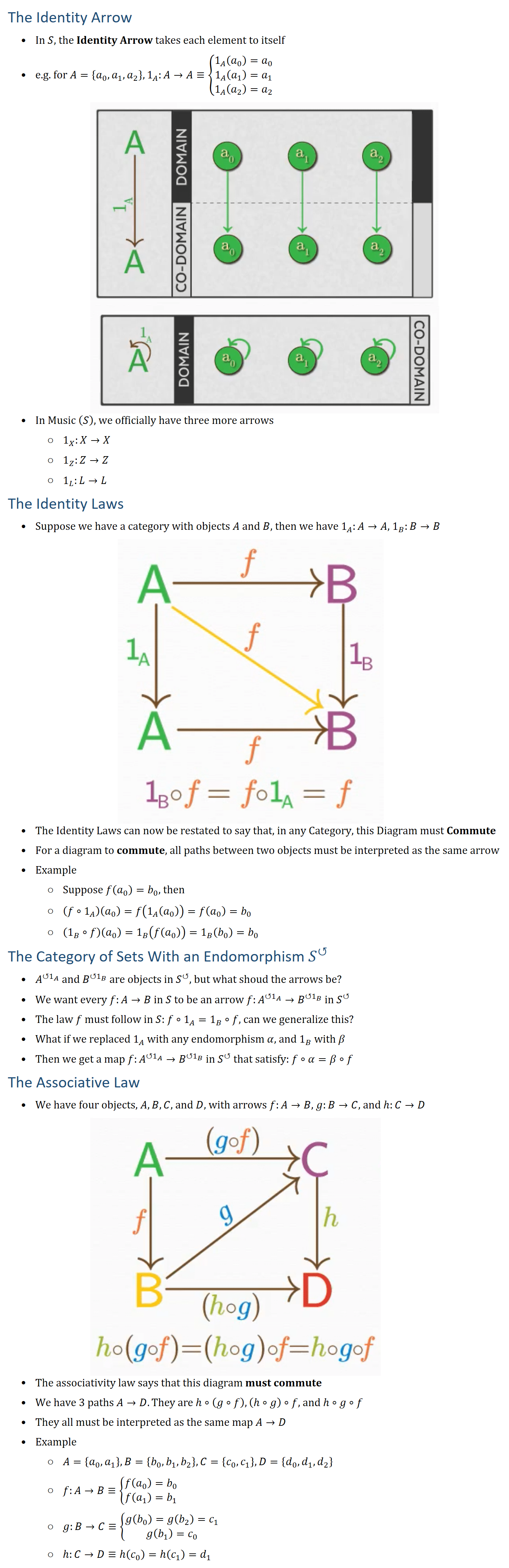
The Identity Arrow • In S, the Identity Arrow takes each element to itself • e.g. for A={a_0,a_1,a_2 },1_A:A→A≡{█(1_A (a_0 )=a_0@1_A (a_1 )=a_1@1_A (a_2 )=a_2 )┤ • In Music (S), we officially have three more arrows ○ 1_X:X→X ○ 1_Z:Z→Z ○ 1_L:L→L The Identity Laws • Suppose we have a category with objects A and B, then we have 1_A:A→A, 1_B:B→B • The Identity Laws can now be restated to say that, in any Category, this Diagram must Commute • For a diagram to commute, all paths between two objects must be interpreted as the same arrow • Example ○ Suppose f(a_0 )=b_0, then ○ (f∘1_A )(a_0 )=f(1_A (a_0 ))=f(a_0 )=b_0 ○ (1_B∘f)(a_0 )=1_B (f(a_0 ))=1_B (b_0 )=b_0 The Category of Sets With an Endomorphism S^↺ • A^(↺1_A ) and B^(↺1_B ) are objects in S^↺, but what shoud the arrows be? • We want every f:A→B in S to be an arrow f:A^(↺1_A )→B^(↺1_B ) in S^↺ • The law f must follow in S: f∘1_A=1_B∘f, can we generalize this? • What if we replaced 1_A with any endomorphism α, and 1_B with β • Then we get a map f:A^(↺1_A )→B^(↺1_B ) in S^↺ that satisfy: f∘α=β∘f The Associative Law • We have four objects, A,B,C, and D, with arrows f:A→B, g:B→C, and h:C→D • The associativity law says that this diagram must commute • We have 3 paths A→D. They are h∘(g∘f),(hg)∘f, and h∘g∘f • They all must be interpreted as the same map A→D • Example ○ A={a_0,a_1 }, B={b_0,b_1,b_2 }, C={c_0,c_1 },D={d_0,d_1,d_2 } ○ f:A→B≡{█(f(a_0 )=b_0@f(a_1 )=b_1 )┤ ○ g:B→C≡{█(g(b_0 )=g(b_2 )=c_1@g(b_1 )=c_0 )┤ ○ h:C→D≡h(c_0 )=h(c_1 )=d_1