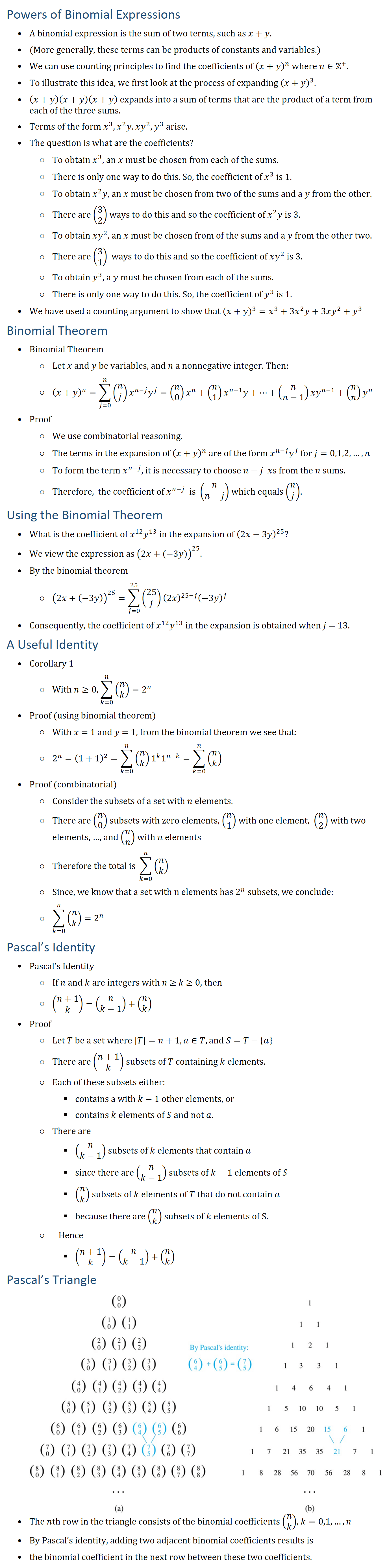
Powers of Binomial Expressions • A binomial expression is the sum of two terms, such as x+y. • (More generally, these terms can be products of constants and variables.) • We can use counting principles to find the coefficients of (x+y)^n where n∈Z+. • To illustrate this idea, we first look at the process of expanding (x+y)^3. • (x+y)(x+y)(x+y) expands into a sum of terms that are the product of a term from each of the three sums. • Terms of the form x3,x2 y.xy2,y3 arise. • The question is what are the coefficients? ○ To obtain x^3, an x must be chosen from each of the sums. ○ There is only one way to do this. So, the coefficient of x^3 is 1. ○ To obtain x^2 y, an x must be chosen from two of the sums and a y from the other. ○ There are (█(3@2)) ways to do this and so the coefficient of x^2 y is 3. ○ To obtain xy^2, an x must be chosen from of the sums and a y from the other two. ○ There are (█(3@1)) ways to do this and so the coefficient of xy^2 is 3. ○ To obtain y^3, a y must be chosen from each of the sums. ○ There is only one way to do this. So, the coefficient of y^3 is 1. • We have used a counting argument to show that (x+y)3=x3+3x^2 y+3xy2+y3 Binomial Theorem • Binomial Theorem ○ Let x and y be variables, and n a nonnegative integer. Then: ○ (x+y)n=∑_(j=0)n▒〖(█(n@j)) x^(n−j) y^j 〗=(█(n@0)) x^n+(█(n@1)) x^(n−1) y+⋯+(█(n@n−1))xy^(n−1)+(█(n@n)) y^n • Proof ○ We use combinatorial reasoning. ○ The terms in the expansion of (x+y)^n are of the form x^(n−j) y^j for j=0,1,2,…,n ○ To form the term x^(n−j), it is necessary to choose n−j xs from the n sums. ○ Therefore, the coefficient of x^(n−j) is (█(n@n−j)) which equals (█(n@j)). Using the Binomial Theorem • What is the coefficient of x^12 y^13 in the expansion of (2x−3y)^25? • We view the expression as (2x+(−3y))^25. • By the binomial theorem ○ (2x+(−3y))25=∑_(j=0)25▒〖(█(25@j)) (2x)^(25−j) (−3y)^j 〗 • Consequently, the coefficient of x^12 y^13 in the expansion is obtained when j = 13. A Useful Identity • Corollary 1 ○ With n≥0, ∑_(k=0)^n▒(█(n@k)) =2^n • Proof (using binomial theorem) ○ With x = 1 and y = 1, from the binomial theorem we see that: ○ 2n=(1+1)2=∑_(k=0)^n▒〖(█(n@k)) 1^k 1^(n−k) 〗=∑_(k=0)^n▒(█(n@k)) • Proof (combinatorial) ○ Consider the subsets of a set with n elements. ○ There are (█(n@0)) subsets with zero elements, (█(n@1)) with one element, (█(n@2)) with two elements, …, and (█(n@n)) with n elements ○ Therefore the total is ∑_(k=0)^n▒(█(n@k)) ○ Since, we know that a set with n elements has 2^n subsets, we conclude: ○ ∑_(k=0)^n▒(█(n@k)) =2^n Pascal’s Identity • Pascal’s Identity ○ If n and k are integers with n ≥ k ≥ 0, then ○ (█(n+1@k))=(█(n@k−1))+(█(n@k)) • Proof ○ Let T be a set where |T|=n+1,a∈T, and S=T−{a} ○ There are (█(n+1@k)) subsets of T containing k elements. ○ Each of these subsets either: § contains a with k−1 other elements, or § contains k elements of S and not a. ○ There are § (█(n@k−1)) subsets of k elements that contain a § since there are (█(n@k−1)) subsets of k − 1 elements of S § (█(n@k)) subsets of k elements of T that do not contain a § because there are (█(n@k)) subsets of k elements of S. ○ Hence § (█(n+1@k))=(█(n@k−1))+(█(n@k)) Pascal’s Triangle • The nth row in the triangle consists of the binomial coefficients (█(n@k)), k=0,1,…,n • By Pascal’s identity, adding two adjacent binomial coefficients results is • the binomial coefficient in the next row between these two coefficients.