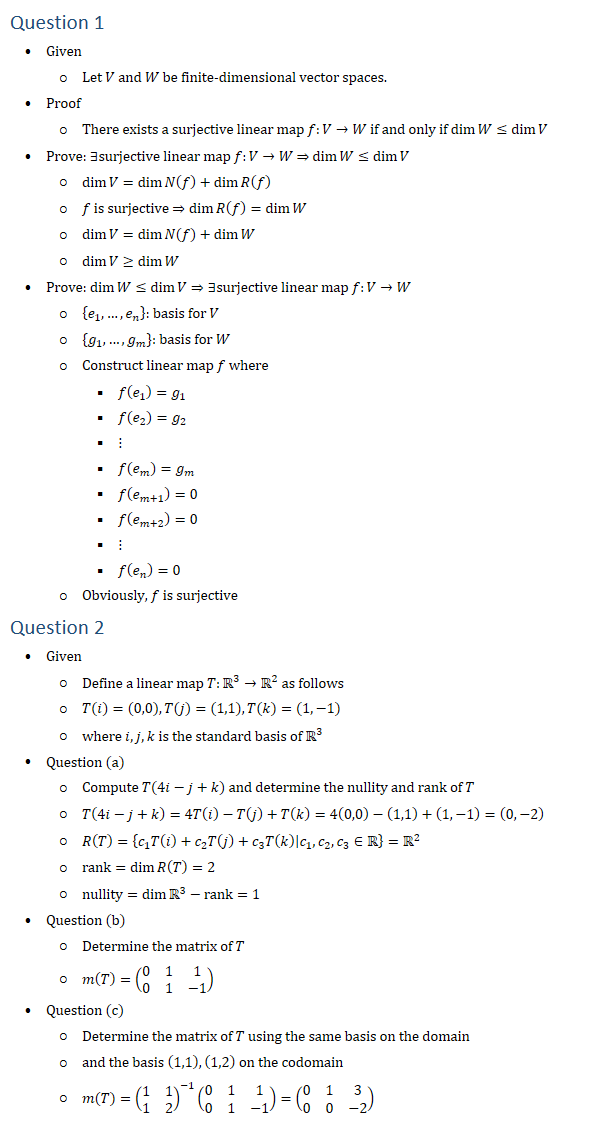
Question 1 • Given ○ Let V and W be finite-dimensional vector spaces. • Proof ○ There exists a surjective linear map f:V→W if and only if dimW≤dimV • Prove: ∃surjective linear map f:V→W ⇒ dimW≤dimV ○ dimV=dimN(f)+dimR(f) ○ f is surjective ⇒dimR(f)=dimW ○ dim〖V=dim〖N(f)〗+dimW 〗 ○ dimV≥dimW • Prove: dimW≤dimV⇒∃surjective linear map f:V→W ○ {e_1,…,e_n }: basis for V ○ {g_1,…,g_m }: basis for W ○ Construct linear map f where § f(e_1 )=g_1 § f(e_2 )=g_2 § ⋮ § f(e_m )=g_m § f(e_(m+1) )=0 § f(e_(m+2) )=0 § ⋮ § f(e_n )=0 ○ Obviously, f is surjective Question 2 • Given ○ Define a linear map T:R3→R2 as follows ○ T(i)=(0,0), T(j)=(1,1), T(k)=(1,−1) ○ where i,j,k is the standard basis of R3 • Question (a) ○ Compute T(4i−j+k) and determine the nullity and rank of T ○ T(4i−j+k)=4T(i)−T(j)+T(k)=4(0,0)−(1,1)+(1,−1)=(0,−2) ○ R(T)={c_1 T(i)+c_2 T(j)+c_3 T(k)│c_1,c_2,c_3∈R=R2 ○ rank=dimR(T)=2 ○ nullity=dim〖R3 〗−rank=1 • Question (b) ○ Determine the matrix of T ○ m(T)=(■8(0&1&1@0&1&−1)) • Question (c) ○ Determine the matrix of T using the same basis on the domain ○ and the basis (1,1), (1,2) on the codomain ○ m(T)=(■8(1&1@1&2))^(−1) (■8(0&1&1@0&1&−1))=(■8(0&1&3@0&0&−2))