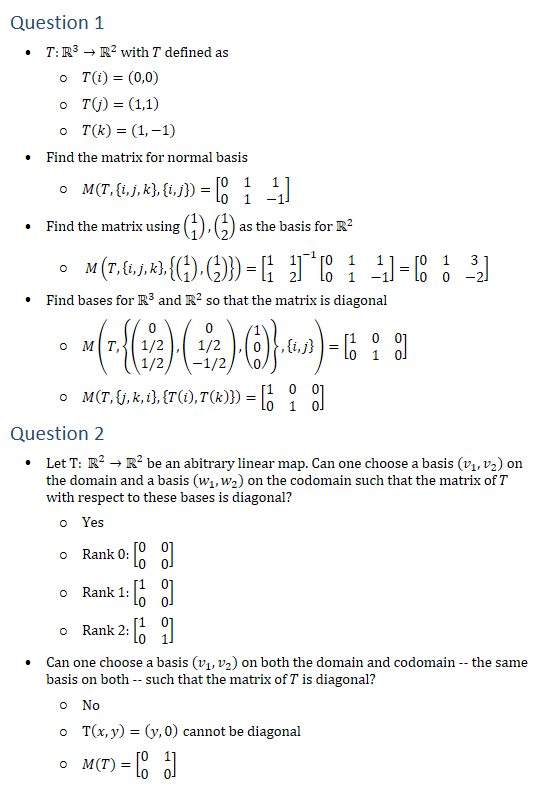
Question 1 • T:R3→R2 with T defined as ○ T(i)=(0,0) ○ T(j)=(1,1) ○ T(k)=(1,−1) • Find the matrix for normal basis ○ M(T,{i,j,k},{i,j})=[■8(0&1&1@0&1&−1)] • Find the matrix using (█(1@1)),(█(1@2)) as the basis for R2 ○ M(T,{i,j,k},{(█(1@1)),(█(1@2))})=[■8(1&1@1&2)]^(−1) [■8(0&1&1@0&1&−1)]=[■8(0&1&3@0&0&−2)] • Find bases for R3 and R2 so that the matrix is diagonal ○ M(T,{(█(0@1/2@1/2)),(█(0@1/2@−1/2)),(█(1@0@0))},{i,j})=[■8(1&0&0@0&1&0)] ○ M(T,{j,k,i},{T(i),T(k)})=[■8(1&0&0@0&1&0)] Question 2 • Let T: R2→R2 be an abitrary linear map. Can one choose a basis (v_1,v_2) on the domain and a basis (w_1,w_2) on the codomain such that the matrix of T with respect to these bases is diagonal? ○ Yes ○ Rank 0: [■8(0&0@0&0)] ○ Rank 1: [■8(1&0@0&0)] ○ Rank 2: [■8(1&0@0&1)] • Can one choose a basis (v_1,v_2) on both the domain and codomain – the same basis on both – such that the matrix of T is diagonal? ○ No ○ T(x,y)=(y,0) cannot be diagonal ○ M(T)=[■8(0&1@0&0)]