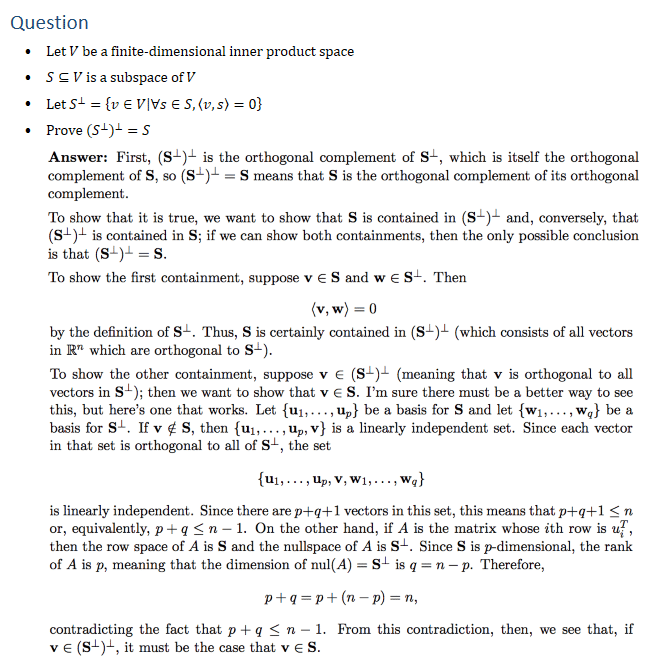
Question • Let V be a finite-dimensional inner product space • S⊆V is a subspace of V • Let S^⊥={v∈V│∀s∈S,⟨v,s⟩=0} Prove (S^⊥ )^⊥=S Answer: First, (S⊥)⊥ is the orthogonal complement of S ⊥, which is itself the orthogonal complement of S, so (S⊥)⊥ = S means that S is the orthogonal complement of its orthogonal complement. To show that it is true, we want to show that S is contained in (S⊥)⊥ and, conversely, that (S⊥)⊥ is contained in S; if we can show both containments, then the only possible conclusion is that (S⊥)⊥ = S. To show the first containment, suppose v ∈ S and w ∈ S ⊥. Then hv, wi = 0 1 by the definition of S ⊥. Thus, S is certainly contained in (S⊥)⊥ (which consists of all vectors in R n which are orthogonal to S ⊥) To show the other containment, suppose v ∈ (S⊥)⊥ (meaning that v is orthogonal to all vectors in S ⊥) then we want to show that v ∈ S. I’m sure there must be a better way to see this, but here’s one that works. Let {u1, . . . , up} be a basis for S and let {w1, . . . , wq} be a basis for S ⊥. If v ∈/ S, then {u1, . . . , up, v} is a linearly independent set. Since each vector in that set is orthogonal to all of S ⊥, the set {u1, . . . , up, v, w1, . . . , wq} is linearly independent. Since there are p+q+1 vectors in this set, this means that p+q+1 ≤ n or, equivalently, p + q ≤ n − 1. On the other hand, if A is the matrix whose ith row is u T i , then the row space of A is S and the nullspace of A is S ⊥. Since S is p-dimensional, the rank of A is p, meaning that the dimension of nul(A) = S ⊥ is q = n − p. Therefore, p + q = p + (n − p) = n, contradicting the fact that p + q ≤ n − 1. From this contradiction, then, we see that, if v ∈ (S⊥)⊥, it must be the case that v ∈ S