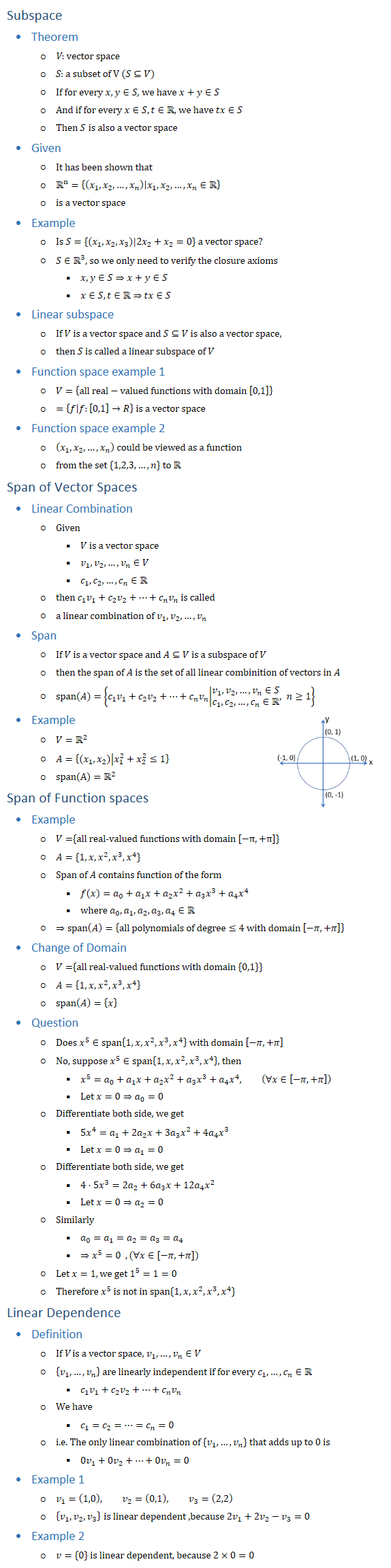
Subspace • Theorem ○ V: vector space ○ S: a subset of V (S⊆V) ○ If for every x,y∈S, we have x+y∈S ○ And if for every x∈S, t∈R, we have tx∈S ○ Then S is also a vector space • Given ○ It has been shown that ○ Rn={(x_1,x_2,…,x_n )│x_1,x_2,…,x_n∈R ○ is a vector space • Example ○ Is S={(x_1,x_2,x_3)│2x_2+x_2=0} a vector space? ○ S∈R3, so we only need to verify the closure axioms § x,y∈S⇒x+y∈S § x∈S, t∈R⇒ tx∈S • Linear subspace ○ If V is a vector space and S⊆V is also a vector space, ○ then S is called a linear subspace of V • Function space example 1 ○ V={all real−valued functions with domain [0,1]} ○ ={f│f:[0,1]→R} is a vector space • Function space example 2 ○ (x_1,x_2,…,x_n ) could be viewed as a function ○ from the set {1,2,3,…,n} to R Span of Vector Spaces • Linear Combination ○ Given § V is a vector space § v_1,v_2,…,v_n∈V § c_1,c_2,…,c_n∈R ○ then c_1 v_1+c_2 v_2+…+c_n v_n is called ○ a linear combination of v_1,v_2,…,v_n • Span ○ If V is a vector space and A⊆V is a subspace of V ○ then the span of A is the set of all linear combinition of vectors in A ○ span(A)={c_1 v_1+c_2 v_2+…+c_n v_n│■8(v_1,v_2,…,v_n∈S@c_1,c_2,…,c_n∈R, n≥1} • Example ○ V=R2 ○ A={(x_1,x_2)│x_12+x_22≤1} ○ span(A)=R2 Span of Function spaces • Example ○ V={all real-valued functions with domain [−π,+π]} ○ A={1,x,x2,x3,x^4 } ○ Span of A contains function of the form § f(x)=a_0+a_1 x+a_2 x^2+a_3 x^3+a_4 x^4 § where a_0,a_1,a_2,a_3,a_4∈R ○ ⇒span(A)={all polynomials of degree≤4 with domain [−π,+π]} • Change of Domain ○ V={all real-valued functions with domain {0,1}} ○ A={1,x,x2,x3,x^4 } ○ span(A)={x} • Question ○ Does x5∈span{1,x,x2,x3,x4 } with domain [−π,+π] ○ No, suppose x5∈span{1,x,x2,x3,x4 }, then § x^5=a_0+a_1 x+a_2 x^2+a_3 x^3+a_4 x^4, (∀x∈[−π,+π]) § Let x=0⇒a_0=0 ○ Differentiate both side, we get § 5x^4=a_1+2a_2 x+3a_3 x^2+4a_4 x^3 § Let x=0⇒a_1=0 ○ Differentiate both side, we get § 4⋅5x^3=2a_2+6a_3 x+12a_4 x^2 § Let x=0⇒a_2=0 ○ Similarly § a_0=a_1=a_2=a_3=a_4 § ⇒x^5=0 , (∀x∈[−π,+π]) ○ Let x=1, we get 1^5=1=0 ○ Therefore x^5 is not in span{1,x,x2,x3,x^4 } Linear Dependence • Definition ○ If V is a vector space, v_1,…,v_n∈V ○ {v_1,…,v_n } are linearly independent if for every c_1,…,c_n∈R § c_1 v_1+c_2 v_2+…+c_n v_n ○ We have § c_1=c_2=…=c_n=0 ○ i.e. The only linear combination of {v_1,…,v_n } that adds up to 0 is § 0v_1+0v_2+…+0v_n=0 • Example 1 ○ v_1=(1,0), v_2=(0,1), v_3=(2,2) ○ {v_1,v_2,v_3 } is linear dependent ,because 2v_1+2v_2−v_3=0 • Example 2 ○ v={0} is linear dependent, because 2×0=0