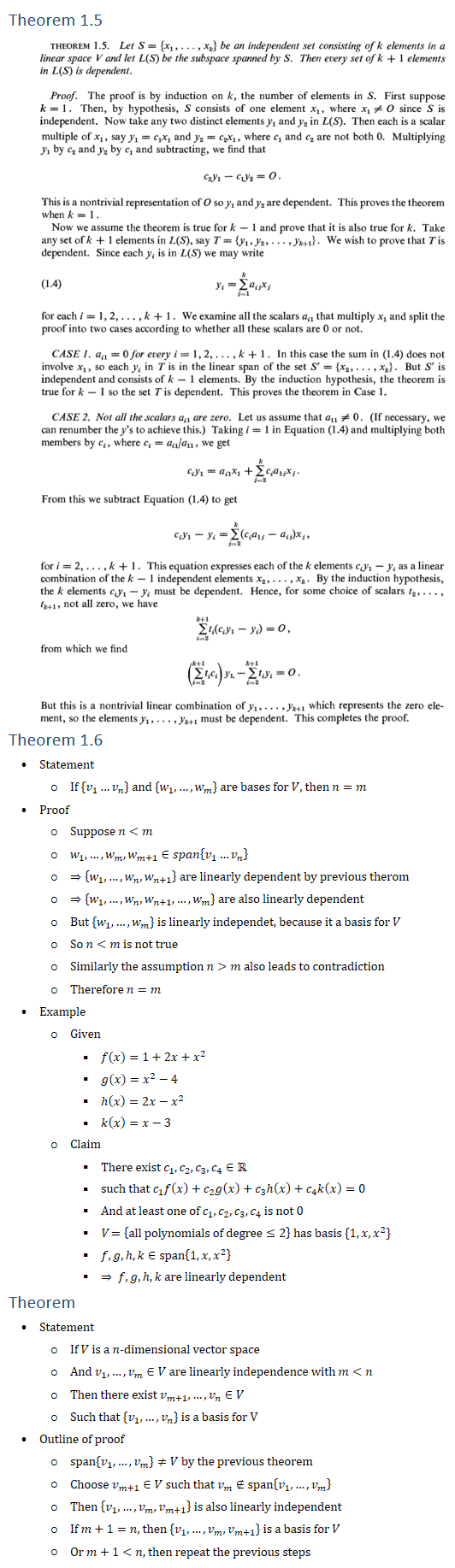
Theorem 1.5 Theorem 1.6 • Statement ○ If {v_1…v_n} and {w_1,…,w_m} are bases for V, then n=m • Proof ○ Suppose n<m ○ w_1,…,w_m,w_(m+1)∈span{v_1…v_n } ○ ⇒{w_1,…,w_n,w_(n+1) } are linearly dependent by previous therom ○ ⇒{w_1,…,w_n,w_(n+1),…,w_m } are also linearly dependent ○ But {w_1,…,w_m} is linearly independet, because it a basis for V ○ So n<m is not true ○ Similarly the assumption n>m also leads to contradiction ○ Therefore n=m • Example ○ Given § f(x)=1+2x+x^2 § g(x)=x^2−4 § h(x)=2x−x^2 § k(x)=x−3 ○ Claim § There exist c_1,c_2,c_3,c_4∈R § such that c_1 f(x)+c_2 g(x)+c_3 h(x)+c_4 k(x)=0 § And at least one of c_1,c_2,c_3,c_4 is not 0 § V ={all polynomials of degree≤2} has basis {1,x,x^2} § f,g,h,k∈span{1,x,x^2 } § ⇒ f,g,h,k are linearly dependent Theorem • Statement ○ If V is a n-dimensional vector space ○ And v_1,…,v_m∈V are linearly independence with m<n ○ Then there exist v_(m+1),…,v_n∈V ○ Such that {v_1,…,v_n} is a basis for V • Outline of proof ○ span{v_1,…,v_m }≠V by the previous theorem ○ Choose v_(m+1)∈V such that v_m∉span{v_1,…,v_m } ○ Then {v_1,…,v_m,v_(m+1) } is also linearly independent ○ If m+1=n, then {v_1,…,v_m,v_(m+1) } is a basis for V ○ Or m+1<n, then repeat the previous steps