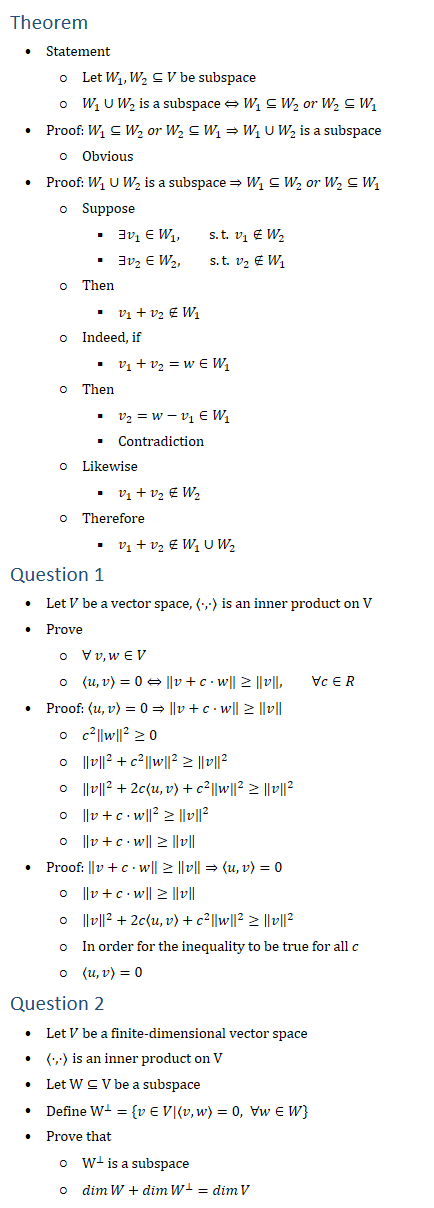
Theorem • Statement ○ Let W_1,W_2⊆V be subspace ○ W_1∪W_2 is a subspace ⇔W_1⊆W_2 or W_2⊆W_1 • Proof: W_1⊆W_2 or W_2⊆W_1⇒W_1∪W_2 is a subspace ○ Obvious • Proof: W_1∪W_2 is a subspace ⇒W_1⊆W_2 or W_2⊆W_1 ○ Suppose § ∃v_1∈W_1, s.t. v_1∉W_2 § ∃v_2∈W_2, s.t. v_2∉W_1 ○ Then § v_1+v_2∉W_1 ○ Indeed, if § v_1+v_2=w∈W_1 ○ Then § v_2=w−v_1∈W_1 § Contradiction ○ Likewise § v_1+v_2∉W_2 ○ Therefore § v_1+v_2∉W_1∪W_2 Question 1 • Let V be a vector space, ⟨⋅,⋅⟩ is an inner product on V • Prove ○ ∀ v,w∈V ○ ⟨u,v⟩=0⇔‖v+c⋅w‖≥‖v‖, ∀c∈R • Proof: ⟨u,v⟩=0⇒‖v+c⋅w‖≥‖v‖ ○ c^2 ‖w‖^2≥0 ○ ‖v‖2+c2 ‖w‖2≥‖v‖2 ○ ‖v‖2+2c⟨u,v⟩+c2 ‖w‖2≥‖v‖2 ○ ‖v+c⋅w‖2≥‖v‖2 ○ ‖v+c⋅w‖≥‖v‖ • Proof: ‖v+c⋅w‖≥‖v‖⇒⟨u,v⟩=0 ○ ‖v+c⋅w‖≥‖v‖ ○ ‖v‖2+2c⟨u,v⟩+c2 ‖w‖2≥‖v‖2 ○ In order for the inequality to be true for all c ○ ⟨u,v⟩=0 Question 2 • Let V be a finite-dimensional vector space • ⟨⋅,⋅⟩ is an inner product on V • Let W⊆V be a subspace • Define W^⊥={v∈V│⟨v,w⟩=0, ∀w∈W} • Prove that ○ W^⊥ is a subspace ○ dimW+dim〖W^⊥=dimV 〗