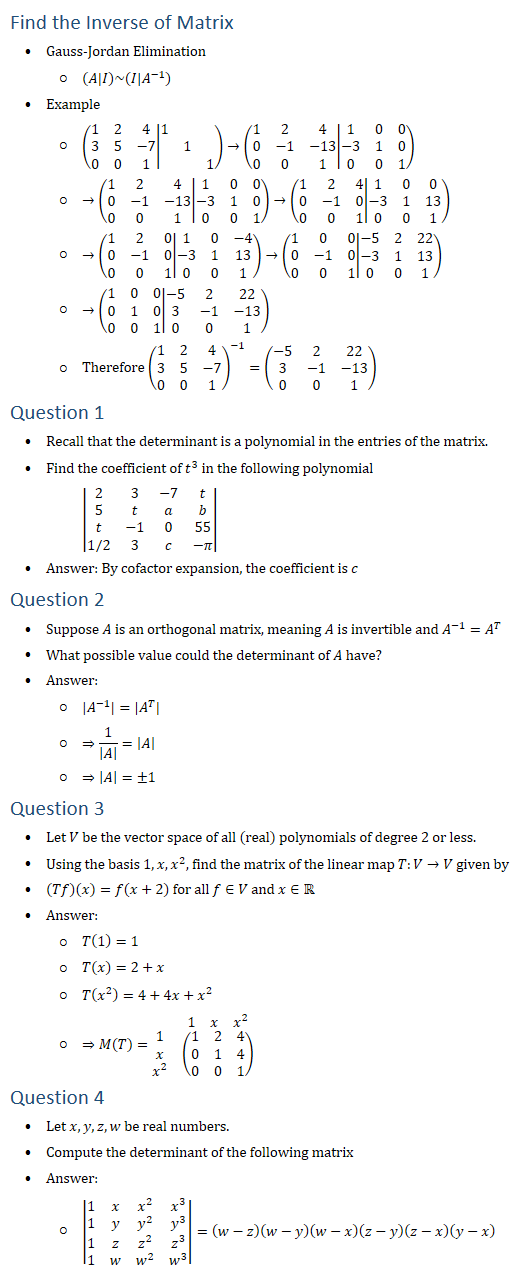
Find the Inverse of Matrix • Gauss-Jordan Elimination ○ (A│I)~(I│A^(−1) ) • Example ○ (■8(1&2&4@3&5&−7@0&0&1)│■(1&&@&1&@&&1))→(■8(1&2&4@0&−1&−13@0&0&1)│■(1&0&0@−3&1&0@0&0&1)) ○ →(■8(1&2&4@0&−1&−13@0&0&1)│■(1&0&0@−3&1&0@0&0&1))→(■8(1&2&4@0&−1&0@0&0&1)│■(1&0&0@−3&1&13@0&0&1)) ○ →(■8(1&2&0@0&−1&0@0&0&1)│■(1&0&−4@−3&1&13@0&0&1))→(■8(1&0&0@0&−1&0@0&0&1)│■(−5&2&22@−3&1&13@0&0&1)) ○ →(■8(1&0&0@0&1&0@0&0&1)│■(−5&2&22@3&−1&−13@0&0&1)) ○ Therefore (■8(1&2&4@3&5&−7@0&0&1))^(−1)=(■(−5&2&22@3&−1&−13@0&0&1)) Question 1 • Recall that the determinant is a polynomial in the entries of the matrix. • Find the coefficient of t^3 in the following polynomial |■8(2&3&−7&t@5&t&a&b@t&−1&0&55@1/2&3&c&−π)| • Answer: By cofactor expansion, the coefficient is c Question 2 • Suppose A is an orthogonal matrix, meaning A is invertible and A(−1)=AT • What possible value could the determinant of A have? • Answer: ○ |A^(−1) |=|A^T | ○ ⇒1/|A| =|A| ○ ⇒|A|=±1 Question 3 • Let V be the vector space of all (real) polynomials of degree 2 or less. • Using the basis 1,x,x^2, find the matrix of the linear map T:V→V given by • (Tf)(x)=f(x+2) for all f∈V and x∈R • Answer: ○ T(1)=1 ○ T(x)=2+x ○ T(x^2 )=4+4x+x^2 ○ ⇒M(T)=■(&■8(1&x&x^2 )@■8(1@x@x^2 )&(■8(1&2&4@0&1&4@0&0&1)) ) Question 4 • Let x,y,z,w be real numbers. • Compute the determinant of the following matrix • Answer: ○ |■8(1&x&x2&x3@1&y&y2&y3@1&z&z2&z3@1&w&w2&w3 )|=(w−z)(w−y)(w−x)(z−y)(z−x)(y−x)