Home
Papers
Projects
Blog
Course Notes
About
Math 375 - 12/13
Math 375
Published
December 13, 2017
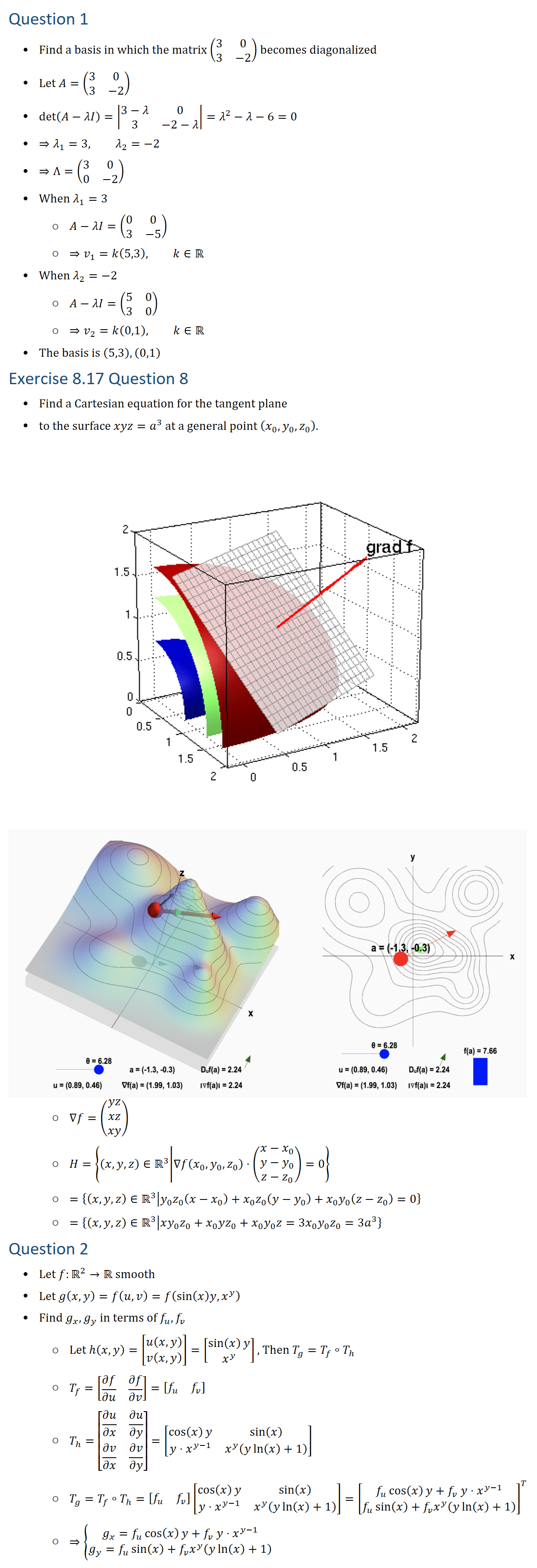
Question 1 • Find a basis in which the matrix (■8(3&0@3&−2)) becomes diagonalized • Let A=(■8(3&0@3&−2)) • det(A−λI)=|■8(3−λ&0@3&−2−λ)|=λ^2−λ−6=0 • ⇒λ_1=3, λ_2=−2 • ⇒Λ=(■8(3&0@0&−2)) • When λ_1=3 ○ A−λI=(■8(0&0@3&−5)) ○ ⇒v_1=k(5,3), k∈R • When λ_2=−2 ○ A−λI=(■8(5&0@3&0)) ○ ⇒v_2=k(0,1), k∈R • The basis is (5,3), (0,1) Exercise 8.17 Question 8 • Find a Cartesian equation for the tangent plane • to the surface xyz=a^3 at a general point (x_0,y_0,z_0 ). ○ ∇f=(█(yz@xz
@xy
)) ○ H={(x,y,z)∈R3│∇f(x_0,y_0,z_0 )⋅(█(x−x_0@y−y_0@z−z_0 ))=0} ○ ={(x,y,z)∈R3│y_0 z_0 (x−x_0 )+x_0 z_0 (y−y_0 )+x_0 y_0 (z−z_0 )=0} ○ ={(x,y,z)∈R3│xy_0 z_0+x_0 yz_0+x_0 y_0 z=3x_0 y_0 z_0=3a^3 } Question 2 • Let f:R2→R smooth • Let g(x,y)=f(u,v)=f(sin〖(x)y,x^y 〗 ) • Find g_x,g_y in terms of f_u,f_v ○ Let h(x,y)=[█(u(x,y)
@v
(x,y) )]=[█(sin(x)y@x^y )], Then T_g=T_f∘T_ℎ ○ T_f=[■8(∂f/∂u&∂f/∂v)]=[■8(f_u&f_v )] ○ T_ℎ=[■8(∂u/∂x&∂u/∂y@∂v/∂x&∂v/∂y)]=[■8(cos(x)y&sin(x)
@y
⋅x
(y−1)&x
y (y ln(x)+1) )] ○ T_g=T_f∘T_ℎ=[■8(f_u&f_v )][■8(cos(x)y&sin(x)
@y
⋅x
(y−1)&x
y (y ln(x)+1) )]=[█(f_u cos(x)y+f_v y⋅x^(y−1)
@f_u
sin(x)+f_v x^y (y ln(x)+1) )]^T ○ ⇒{█(g_x=f_u cos(x)y+f_v y⋅x^(y−1)
@g_y
=f_u sin(x)+f_v x^y (y ln(x)+1) )┤