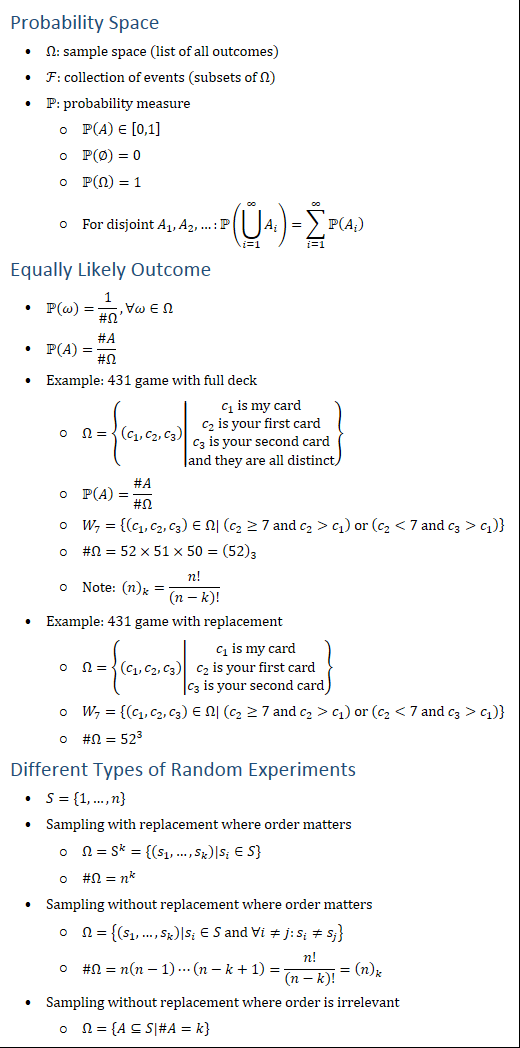
Probability Space • Ω: sample space (list of all outcomes) • F: collection of events (subsets of Ω) • P: probability measure ○ P(A)∈[0,1] ○ P(∅)=0 ○ P(Ω)=1 ○ For disjoint A_1,A_2,…:P(⋃24_(i=1)^∞▒A_i )=∑_(i=1)^∞▒PA_i ) Equally Likely Outcome • P(ω)=1/(#Ω),∀ω∈Ω • P(A)=(#A)/(#Ω) • Example: 431 game with full deck ○ Ω={(c_1,c_2,c_3 )│■8(c_1 is my card@c_2 is your first card@c_3 is your second card@and they are all distinct)} ○ P(A)=(#A)/(#Ω) ○ W_7={(c_1,c_2,c_3 )∈Ω| (c_2≥7 and c_2c_1 ) or (c_27 and c_3c_1 )} ○ #Ω=52×51×50=(52)_3 ○ Note: (n)_k=n!/(n−k)! • Example: 431 game with replacement ○ Ω={(c_1,c_2,c_3 )│■8(c_1 is my card@c_2 is your first card@c_3 is your second card)} ○ W_7={(c_1,c_2,c_3 )∈Ω| (c_2≥7 and c_2c_1 ) or (c_27 and c_3c_1 )} ○ #Ω=〖52〗^3 Different Types of Random Experiments • S={1,…,n} • Sampling with replacement where order matters ○ Ω=S^k={(s_1,…,s_k )|s_i∈S} ○ #Ω=n^k • Sampling without replacement where order matters ○ Ω={(s_1,…,s_k )|s_i∈S and ∀i≠j:s_i≠s_j } ○ #Ω=n(n−1)⋯(n−k+1)=n!/(n−k)!=(n)_k • Sampling without replacement where order is irrelevant ○ Ω={A⊆S|#A=k}