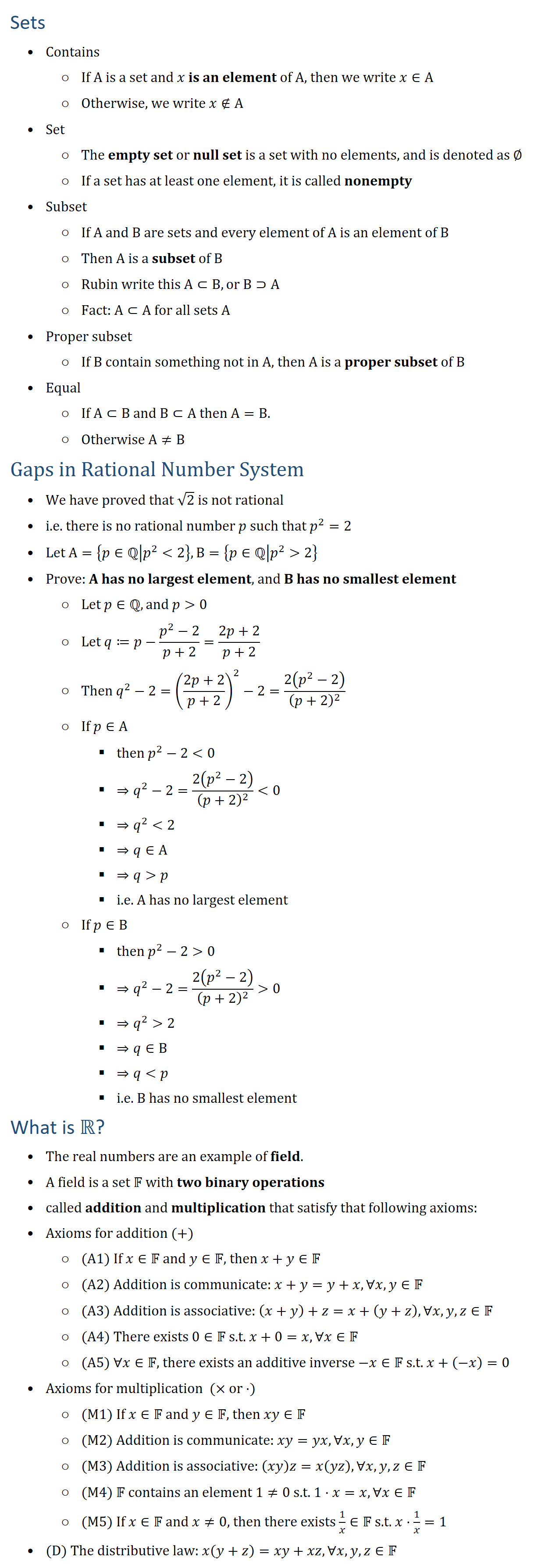
Sets • Contains ○ If A is a set and x is an element of A (an object of A), then we write x∈A ○ Otherwise, we write x∉A • Set ○ The empty set or null set is a set with no elements, and is denoted as ∅ ○ If a set has at least one element, it is called nonempty • Subset ○ If A and B are sets and every element of A is an element of B ○ Then A is a subset of B ○ Rubin write this A⊂B, or B⊃A ○ A⊂A for all sets A • Proper subset ○ If B contain something not in A, then A is a proper subset of B • Equal ○ If A⊂B and B⊂A then A=B. ○ Otherwise A≠B √2 is Not Rational • We proved that √2 is not rational • i.e. there is no rational number p such that p^2=2 • Let A={p∈Qp^2<2}, B={p∈Qp^2>2} • Prove: A has no largest element, and B has no smallest element ○ Let p∈Q, and p>0 ○ Let q≔p−(p^2−2)/(p+2)=(2p+2)/(p+2),then q2−2=((2p+2)/(p+2))2−2=2(p2−2)/(p+2)2 ○ If p∈A § then p^2−2<0 § ⇒q2−2=2(p2−2)/(p+2)^2 <0 § ⇒q^2<2 § ⇒q∈A § ⇒q>p § i.e. A has no largest element ○ If p∈B § then p^2−2>0 § ⇒q2−2=2(p2−2)/(p+2)^2 >0 § ⇒q^2>2 § ⇒q∈B § ⇒q</p> <p § i.e. B has no smallest element What is R? • The real numbers are an example of field. • A field is a set F with two binary operations called addition and multiplication that satisfy that following axioms: • Axioms for addition (+) ○ (A1) If x∈F and y∈F, then x+y∈F ○ (A2) Addition is communicate: x+y=y+x,∀x,y∈F ○ (A3) Addition is associative: (x+y)+z=x+(y+z),∀x,y,z∈F ○ (A4) There exists 0∈F s.t. x+0=x, ∀x∈F ○ (A5) ∀x∈F, there exists an additive inverse −x∈F s.t. x+(−x)=0 • Axioms for multiplication (× or ⋅) ○ (M1) If x∈F and y∈F, then xy∈F ○ (M2) Addition is communicate: xy=yx,∀x,y∈F ○ (M3) Addition is associative: (xy)z=x(yz),∀x,y,z∈F ○ (M4) F contains an element 1≠0 s.t. 1⋅x=x, ∀x∈F ○ (M5) If x∈F and x≠0, then there exists 1/x∈F s.t. x⋅1/x=1 • (D) The distributive law: x(y+z)=xy+xz, ∀x,y,z∈F