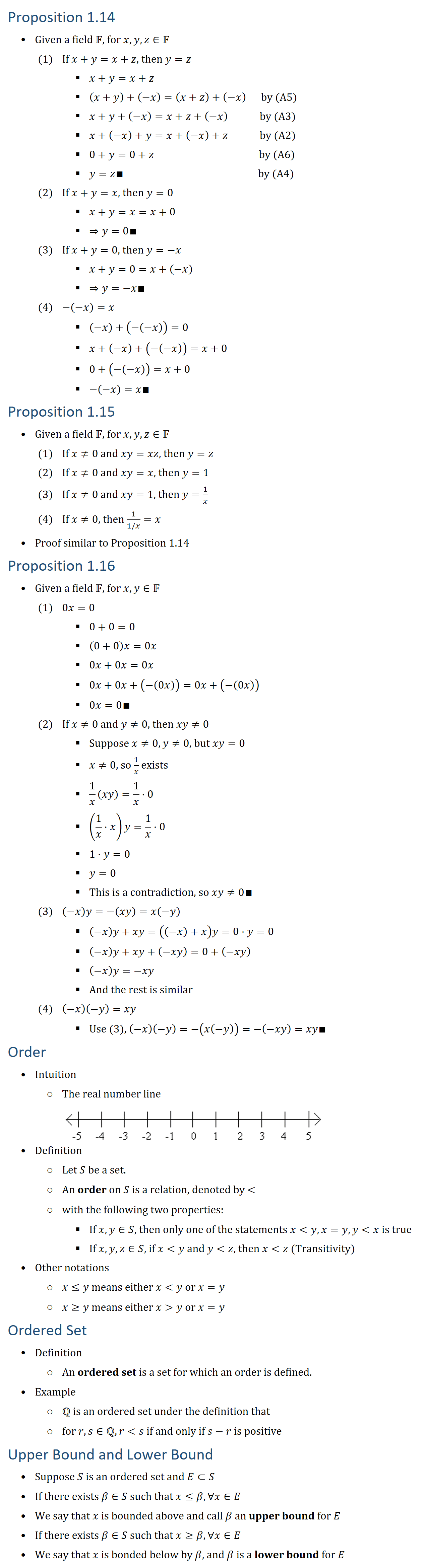
Proposition 1.14 • Given a field F, for x,y,z∈F (1) If x+y=x+z, then y=z (2) If x+y=x, then y=0 (3) If x+y=0, then y=−x (4) −(−x)=x • Proof (1) ○ x+y=x+z ○ (x+y)+(−x)=(x+z)+(−x) by (A5) ○ x+y+(−x)=x+z+(−x) by (A3) ○ x+(−x)+y=x+(−x)+z by (A2) ○ 0+y=0+z by (A6) ○ y=z∎ by (A4) • Proof (2) ○ x+y=x=x+0 ○ ⇒y=0∎ • Proof (3) ○ x+y=0=x+(−x) ○ ⇒y=−x∎ • Proof (4) ○ (−x)+(−(−x))=0 ○ x+(−x)+(−(−x))=x+0 ○ 0+(−(−x))=x+0 ○ −(−x)=x∎ Proposition 1.15 • Given a field F, for x,y,z∈F (1) If x≠0 and xy=xz, then y=z (2) If x≠0 and xy=x, then y=1 (3) If x≠0 and xy=1, then y=1/x (4) If x≠0, then 1/(1/x)=x • Proof similar to Proposition 1.14 Proposition 1.16 • Given a field F, for x,y∈F (1) 0x=0 (2) If x≠0 and y≠0, then xy≠0 (3) (−x)y=−(xy)=x(−y) (4) (−x)(−y)=xy • Proof (1) ○ 0+0=0 ○ (0+0)x=0x ○ 0x+0x=0x ○ 0x+0x+(−(0x))=0x+(−(0x)) ○ 0x=0∎ • Proof (2) ○ Suppose x≠0, y≠0, but xy=0 ○ x≠0, so 1/x exists ○ 1/x (xy)=1/x⋅0 ○ (1/x⋅x)y=1/x⋅0 ○ 1⋅y=0 ○ y=0 ○ This is a contradiction, so xy≠0∎ • Proof (3) ○ (−x)y+xy=((−x)+x)y=0⋅y=0 ○ (−x)y+xy+(−xy)=0+(−xy) ○ (−x)y=−xy ○ And the rest is similar • Proof (4) ○ Use (3), (−x)(−y)=−(x(−y))=−(−xy)=xy∎ Order • Intuition ○ The real number line • Definition ○ Let S be a set. ○ An order on S is a relation, denoted by ,with the following two properties: § If x∈S and y∈S, then one and only one of the statements xy, x=y, yx is true § If x,y,z∈S, if xy and yz, then xz (Transitivity) ○ x≤y means either xy or x=y ○ x≥y means either xy or x=y ○ An ordered set is a set for which an order is defined. • Example ○ Q is an ordered set under the definition that ○ For r,s∈Q, rs, if and only if s−r is positive Upper Bound and Lower Bound • Definition ○ Suppose S is an ordered set and E⊂S. ○ If there exists β∈S such that x≤β, ∀x∈E ○ We say that x is bounded above and call β an upper bound for E ○ Similarly, if x≥β, ∀x∈E. ○ We say that x is bonded below by β, and β is a lower bound for E