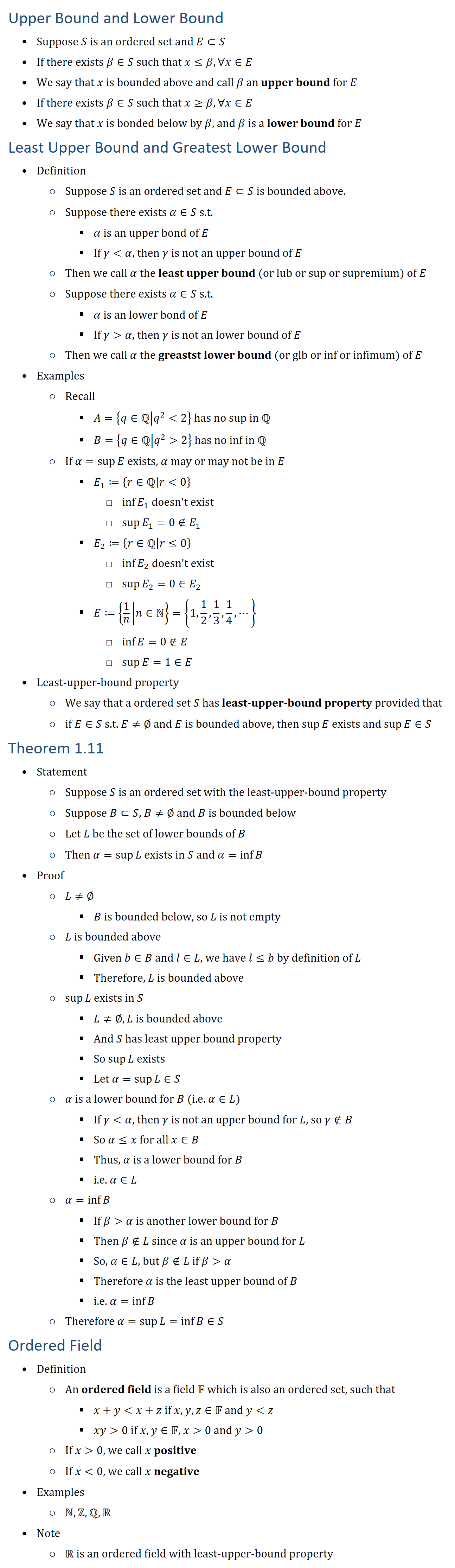
Upper Bound and Lower Bound • Suppose S is an ordered set and E⊂S • If there exists β∈S such that x≤β, ∀x∈E • We say that x is bounded above and call β an upper bound for E • If there exists β∈S such that x≥β, ∀x∈E • We say that x is bonded below by β, and β is a lower bound for E Least Upper Bound and Greatest Lower Bound • Definition ○ Suppose S is an ordered set and E⊂S is bounded above. ○ Suppose there exists α∈S s.t. § α is an upper bond of E § If γ α, then γ is not an upper bound of E ○ Then we call α the least upper bound (or lub or sup or supremium) of E ○ Suppose there exists α∈S s.t. § α is an lower bond of E § If γ α, then γ is not an lower bound of E ○ Then we call α the greastst lower bound (or glb or inf or infimum) of E • Examples ○ Recall § A={q∈Qq^2 2} has no sup in Q § B={q∈Qq^2 2} has no inf in Q ○ If α=supE exists, α may or may not be in E § E_1≔{r∈Qr 0} □ inf〖E_1 〗 doesn t exist □ sup〖E_1 〗=0∉E_1 § E_2≔{r∈Qr≤0} □ inf〖E_2 〗 doesn t exist □ sup〖E_2 〗=0∈E_2 § E≔{1/n│n∈N={1, 1/2,1/3,1/4,⋯} □ infE=0∉E □ supE=1∈E • Least-upper-bound property ○ We say that a ordered set S has least-upper-bound property provided that ○ if E∈S s.t. E≠∅ and E is bounded above, then supE exists and supE∈S Theorem 1.11 • Statement ○ Suppose S is an ordered set with the least-upper-bound property ○ Suppose B⊂S, B≠∅ and B is bounded below ○ Let L be the set of lower bounds of B ○ Then α=supL exists in S and α=infB • Proof ○ L≠∅ § B is bounded below, so L is not empty ○ L is bounded above § Given b∈B and l∈L, we have l≤b by definition of L § Therefore, L is bounded above ○ supL exists in S § L≠∅, L is bounded above § And S has least upper bound property § So supL exists § Let α=supL∈S ○ α is a lower bound for B (i.e. α∈L) § If γ α, then γ is not an upper bound for L, so γ∉B § So α≤x for all x∈B § Thus, α is a lower bound for B § i.e. α∈L ○ α=infB § If β α is another lower bound for B § Then β∉L since α is an upper bound for L § So, α∈L, but β∉L if β α § Therefore α is the least upper bound of B § i.e. α=infB ○ Therefore α=supL=infB∈S Ordered Field • Definition ○ An ordered field is a field F which is also an ordered set, such that § x+y x+z if x,y,z∈F and y z § xy 0 if x,y∈F, x 0 and y 0 ○ If x 0, we call x positive ○ If x 0, we call x negative • Examples ○ N,Z,Q, R • Note ○ R is an ordered field with least-upper-bound property