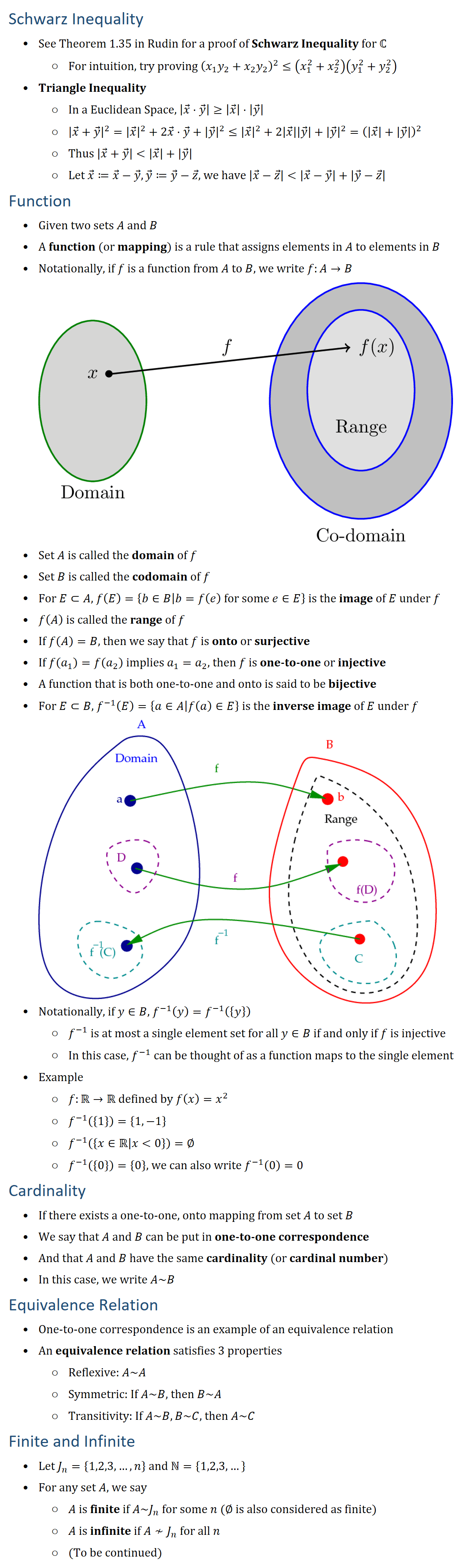
Schwarz Inequality • See Theorem 1.35 in Rudin for a proof of Schwarz Inequality for ℂ ○ For intuition, try proving (x_1 y_2+x_2 y_2 )2≤(x_12+x_2^2 )(y_12+y_22 ) • Triangle Inequality ○ In a Euclidean Space, |x ⃗⋅y ⃗ |≥|x ⃗ |⋅|y ⃗ | ○ |x ⃗+y ⃗^2 |=|x ⃗ |^2+2x ⃗⋅y ⃗+|y ⃗ |^2≤|x ⃗ |^2+2|x ⃗ ||y ⃗ |+|y ⃗ |^2=(|x ⃗ |+|y ⃗ |)^2 ○ Thus |x ⃗+y ⃗ ||x ⃗ |+|y ⃗ | ○ Let x ⃗≔x ⃗−y ⃗, y ⃗≔y ⃗−z ⃗, we have |x ⃗−z ⃗ ||x ⃗−y ⃗ |+|y ⃗−z ⃗ | Function • Given two sets A and B • A function (or mapping) is a rule that assigns elements in A to elements in B • Notationally, if f is a function from A to B, we write f:A→B • Set A is called the domain of f • Set B is called the codomain of f • For E⊂A, f(E)={b∈B│b=f(e) for some e∈E} is the image of E under f • f(A) is called the range of f • If f(A)=B, then we say that f is onto or surjective • If f(a_1 )=f(a_2 ) implies a_1=a_2, then f is one-to-one or injective • A function that is both one-to-one and onto is said to be bijective • For E⊂B, f^(−1) (E)={a∈A│f(a)∈E} is the inverse image of E under f • Notationally, if y∈B, f^(−1) (y)=f^(−1) ({y}) ○ f^(−1) is at most a single element set for all y∈B if and only if f is injective ○ In this case, f^(−1) can be thought of as a function maps to the single element • Example ○ f:R→R defined by f(x)=x^2 ○ f^(−1) ({1})={1,−1} ○ f^(−1) ({x∈Rx0})=∅ ○ f^(−1) ({0})={0}, we can also write f^(−1) (0)=0 Cardinality • If there exists a one-to-one, onto mapping from set A to set B • We say that A and B can be put in one-to-one correspondence • And that A and B have the same cardinality (or cardinal number) • In this case, we write A~B Equivalence Relation • One-to-one correspondence is an example of an equivalence relation • An equivalence relation satisfies 3 properties ○ Reflexive: A~A ○ Symmetric: If A~B, then B~A ○ Transitivity: If A~B, B~C, then A~C Finite and Countable • Let J_n={1,2,3,…,n} and N={1,2,3,…} • For any set A, we say ○ A is finite if A~J_n for some n (∅~J_0 so ∅ is finite) ○ A is infinite if A≁J_n for all n ○ (To be continued)