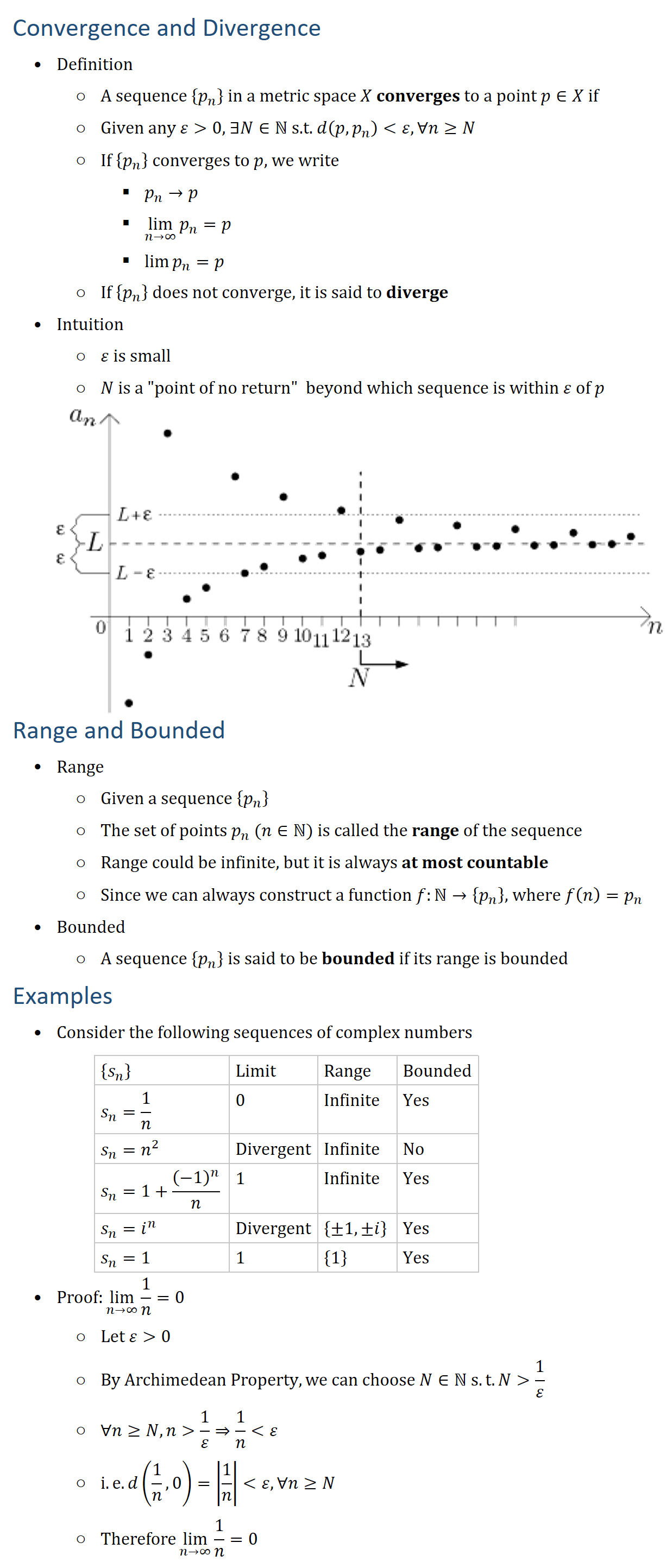
Convergence and Divergence • Definition ○ A sequence {p_n } in a metric space X converges to a point p∈X if ○ Given any ε 0, ∃N∈N s.t. d(p,p_n ) ε, ∀n≥N ○ If {p_n } converges to p, we write § p_n→p § lim_(n→∞)〖p_n 〗=p § lim〖p_n 〗=p ○ If {p_n } does not converge, it is said to diverge • Intuition ○ ε is small ○ N is a “point of no return” beyond which sequence is within ε of p Range and Bounded • Range ○ Given a sequence {p_n } ○ The set of points p_n (n∈N) is called the range of the sequence ○ Range could be infinite, but it is always at most countable ○ Since we can always construct a function f:N→{p_n }, where f(n)=p_n • Bounded ○ A sequence {p_n } is said to be bounded if its range is bounded Examples • Consider the following sequences of complex numbers {s_n } Limit Range Bounded s_n=1/n 0 Infinite Yes s_n=n^2 Divergent Infinite No s_n=1+(−1)^n/n 1 Infinite Yes s_n=i^n Divergent {±1,±i} Yes s_n=1 1 {1} Yes • Proof:lim_(n→∞)〖1/n〗=0 ○ Let ε 0 ○ By Archimedean Property, we can choose N∈N s.t. N 1/ε ○ ∀n≥N, n 1/ε⇒1/n ε ○ i.e. d(1/n,0)=|1/n| ε,∀n≥N ○ Therefore lim_(n→∞)〖1/n〗=0