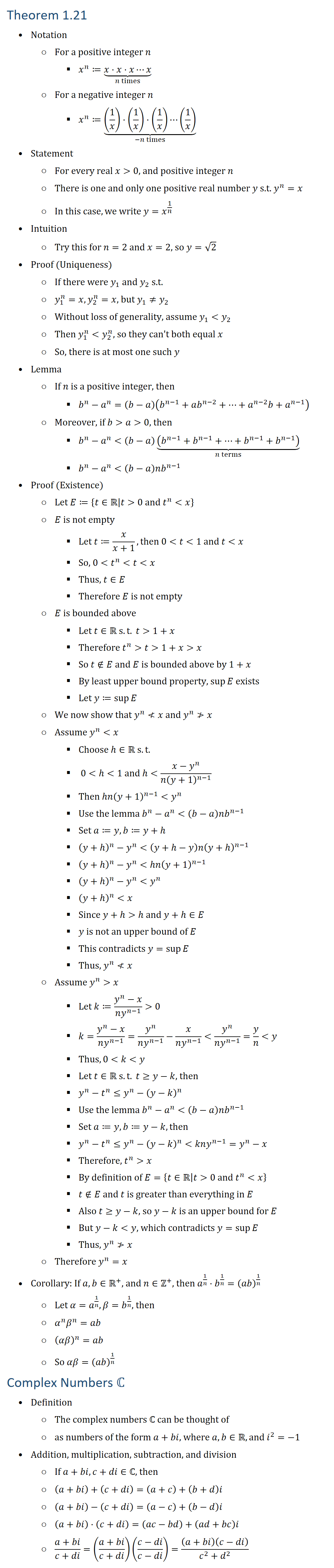
Theorem 1.21 • Notation ○ For a positive integer n § x^n≔⏟(x⋅x⋅x⋯x)┬(n times) ○ For a negative integer n § x^n≔⏟((1/x)⋅(1/x)⋅(1/x)⋯(1/x) )┬(−n times) • Statement ○ For every real x 0, and positive integer n ○ There is one and only one positive real number y s.t. y^n=x ○ In this case, we write y=x^(1/n) • Intuition ○ Try this for n=2 and x=2, so y=√2 • Proof (Uniqueness) ○ If there were y_1 and y_2 s.t. ○ y_1n=x,y_2n=x, but y_1≠y_2 ○ Without loss of generality, assume y_1 y_2 ○ Then y_1^n y_2^n, so they can t both equal x ○ So, there is at most one such y • Lemma ○ If n is a positive integer, then § bn−an=(b−a)(b(n−1)+ab(n−2)+…+a^(n−2) b+a^(n−1) ) ○ Moreover, if b a 0, then § bn−an (b−a) ⏟((b(n−1)+b(n−1)+…+b(n−1)+b(n−1) ) )┬(n terms) § bn−an (b−a)nb^(n−1) § Also, (bn−an)/(nb^(n−1) ) b−a b • Proof (Existence) ○ Let E≔{t∈Rt 0 and t^n x} ○ E is not empty § Let t≔x/(x+1), then 0 t 1 and t x § So, 0 t^n t x § Thus, t∈E § Therefore E is not empty ○ E is bounded above § Let t∈R s.t. t 1+x § Therefore t^n t 1+x x § So t∉E and E is bounded above by 1+x § By least upper bound property, supE exists § Let y≔supE ○ We now show that y^n≮x and y^n≯x ○ Assume y^n x § Choose h∈R s.t. § 0 h 1 and h (x−yn)/(n(y+1)(n−1) ) § Then hn(y+1)^(n−1) y^n § Use the lemma bn−an (b−a)nb^(n−1) § Set a≔y,b≔y+h § (y+hn−yn (y+hy)n(y+h^(n−1) § (y+hn−yn hn(y+1)^(n−1) § (y+hn−yn y^n § (y+h^n x § Since y+h h and y+h∈E § y is not an upper bound of E § This contradicts y=supE § Thus, y^n≮x ○ Assume y^n x § Let k≔(yn−x)/(ny(n−1) ) 0 § Use the lemma (bn−an)/(nb^(n−1) ) b § Set b≔y,a^n≔a, then k=(yn−x)/(ny(n−1) ) y § Thus,0 k y § Let t∈R s.t. t≥y−k, then § yn−tn≤yn−(y−k)n § Use the lemma bn−an (b−a)nb^(n−1) § Set a≔y,b≔y−k, then § yn−tn≤yn−(y−k)n kny(n−1)=yn−x § Therefore, t^n x § By definition of E={t∈Rt 0 and t^n x} § t∉E and t is greater than everything in E § Also t≥y−k, so y−k is an upper bound for E § But y−k y, which contradicts y=supE § Thus, y^n≯x ○ Therefore y^n=x • Corollary: If a,b∈R+, and n∈Z+, then a(1/n)⋅b(1/n)=(ab)^(1/n) ○ Let α=a^(1/n), β=b^(1/n), then ○ α^n β^n=ab ○ (αβ)^n=ab ○ So αβ=(ab)^(1/n) Complex Numbers ℂ • Definition ○ The complex numbers ℂ can be thought of ○ as numbers of the form a+bi, where a,b∈R, and i^2=−1 • Addition, multiplication, subtraction, and division ○ If a+bi, c+di∈ℂ, then ○ (a+bi)+(c+di)=(a+c)+(b+d)i ○ (a+bi)−(c+di)=(a−c)+(b−d)i ○ (a+bi)⋅(c+di)=(ac−bd)+(ad+bc)i ○ (a+bi)/(c+di)=((a+bi)/(c+di))((c−di)/(c−di))=(a+bi)(c−di)/(c2+d2 )