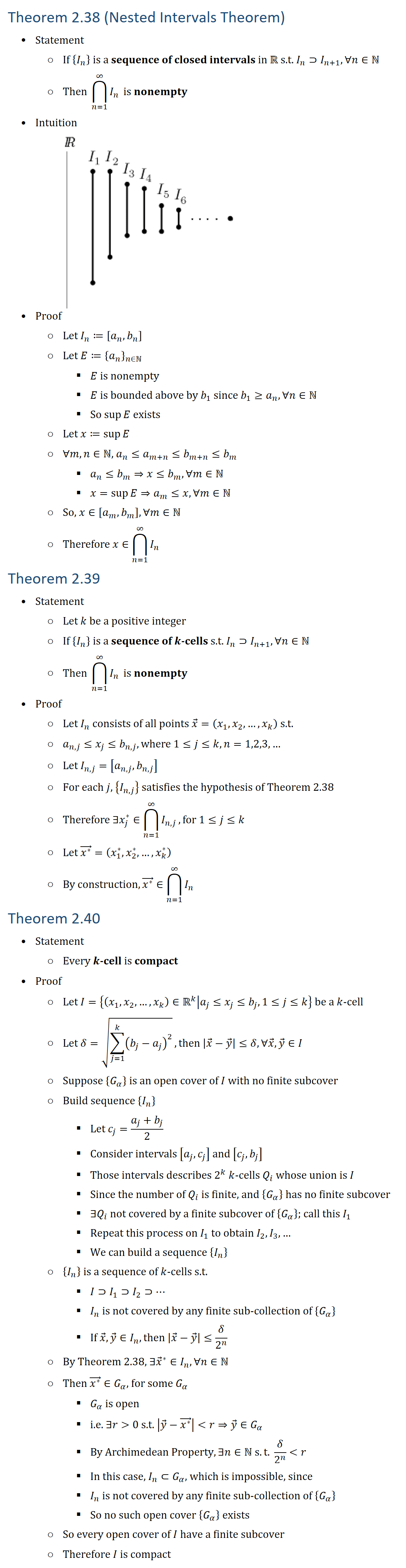
Theorem 2.38 (Nested Intervals Theorem) • Statement ○ If {I_n } is a sequence of closed intervals in R s.t. I_n⊃I_(n+1),∀n∈N ○ Then ⋂24_(n=1)^∞▒I_n is nonempty • Intuition • Proof ○ Let I_n≔[a_n,b_n ] ○ Let E≔{a_n }_(n∈N § E is nonempty § E is bounded above by b_1 since b_1≥a_n,∀n∈N § So supE exists ○ Let x≔supE ○ For m,n∈N, a_n≤a_(m+n)≤b_(m+n)≤b_m § a_n≤b_m⇒x≤b_n,∀m∈N § x=supE⇒a_m≤x,∀m∈N ○ So, x∈[a_m,b_m ],∀m∈N ○ Therefore x∈⋂24_(n=1)^∞▒I_n Theorem 2.39 • Statement ○ Let k be a positive integer ○ If {I_n } is a sequence of k-cells s.t. I_n⊃I_(n+1),∀n∈N ○ Then ⋂24_(n=1)^∞▒I_n is nonempty • Proof ○ Let I_n consists of all points x ⃗=(x_1,x_2,…,x_k ) s.t. ○ a_(n,j)≤x_j≤b_(n,j), where 1≤j≤k,n=1,2,3,… ○ Let I_(n,j)=[a_(n,j),b_(n,j) ] ○ For each j, {I_(n,j) } satisfies the hypothesis of Theorem 2.38 ○ Therefore ∃x_j∗∈⋂24_(n=1)∞▒I_(n,j) , for 1≤j≤k ○ Let (x^∗ ) ⃗=(x_1∗,x_2∗,…,x_k^∗ ) ○ By construction, (x^∗ ) ⃗∈⋂24_(n=1)^∞▒I_n Theorem 2.40 • Statement ○ Every k-cell is compact • Proof ○ Let I={(x_1,x_2,…,x_k )∈Rk│a_j≤x_j≤b_j,1≤j≤k} be a k-cell ○ Let δ=√(∑_(j=1)^k▒(b_j−a_j )^2 ), then |x ⃗−y ⃗ |≤δ,∀x ⃗,y ⃗∈I ○ Suppose {G_α } is an open cover of I with no finite subcover ○ Build sequence {I_n } § Let c_j=(a_j+b_j)/2 § Consider intervals [a_j,c_j ] and [c_j,b_j ] § Those intervals describes 2^k k-cells Q_i whose union is I § Since the number of Q_i is finite, and {G_α } has no finite subcover § ∃Q_i not covered by a finite subcover of {G_α }; call this I_1 § Repeat this process on I_1 to obtain I_2,I_3,… § We can build a sequence {I_n } ○ {I_n } is a sequence of k-cells s.t. § I⊃I_1⊃I_2⊃… § I_n is not covered by any finite sub-collection of {G_α } § If x ⃗,y ⃗∈I_n, then |x ⃗−y ⃗ |≤δ/2^n ○ By Theorem 2.38, ∃x ⃗^∗∈I_n,∀n∈N ○ Then (x^∗ ) ⃗∈G_α, for some G_α § G_α is open § i.e. ∃r 0 s.t. |y ⃗−(x^∗ ) ⃗ | r⇒y ⃗∈G_α § By Archimedean Property, ∃n∈N s.t. δ/2^n r § In this case, I_n⊂G_α, which is impossible, since § I_n is not covered by any finite sub-collection of {G_α } § So no such open cover {G_α } exists ○ So every open cover of I have a finite subcover ○ Therefore I is compact