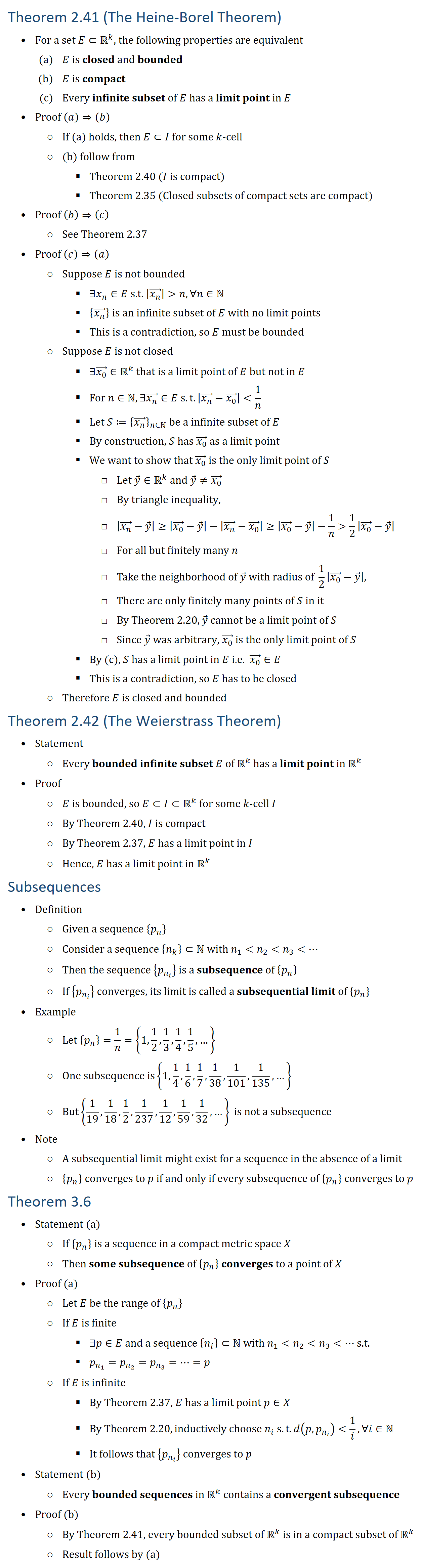
Theorem 2.41 (The Heine-Borel Theorem) • For a set E∈Rk, the following properties are equivalent (a) E is closed and bounded (b) E is compact (c) Every infinite subset of E has a limit point in E • Proof (a)⇒(b) ○ If (a) holds, then E⊂I for some k-cell ○ (b) follow from § Theorem 2.40 (I is compact) § Theorem 2.35 (Closed subsets of compact sets are compact) • Proof (b)⇒(c) ○ See Theorem 2.37 • Proof (c)⇒(a) ○ Suppose E is not bounded § Then E contains points (x_n ) ⃗ s.t. |(x_n ) ⃗ | n, ∀n∈N § {(x_n ) ⃗ } is an infinite subset of E with no limit points § This is a contradiction, so E must be bounded ○ Suppose E is not closed § Then ∃(x_0 ) ⃗∈Rk that is a limit point of E but not in E § For n∈N, ∃(x_n ) ⃗∈E s.t. |(x_n ) ⃗−(x_0 ) ⃗ | 1/n § Let S={(x_n ) ⃗ }_(n∈N □ S is infinite □ S has (x_0 ) ⃗ as a limit point § Let y ⃗∈Rk and y ⃗≠(x_0 ) ⃗ □ By triangle inequality □ |(x_n ) ⃗−y ⃗ |≥|(x_0 ) ⃗−y ⃗ |−|(x_n ) ⃗−(x_0 ) ⃗ | □ |(x_n ) ⃗−y ⃗ | |(x_0 ) ⃗−y ⃗ |−1/n □ |(x_n ) ⃗−y ⃗ | 1/2 |(x_0 ) ⃗−y ⃗ | □ For all but finitely many n □ Therefore y ⃗ cannot be a limit point of S, by Theorem 2.20 § Since y ⃗ was arbitrary, nothing other than (x_0 ) ⃗ is a limit point of S § By (c), (x_0 ) ⃗∈E,which makes a contradiction, so E has to be closed ○ Therefore E is closed and bounded Theorem 2.42 (The Weierstrass Theorem) • Statement ○ Every bounded infinite subset E of Rk has a limit point in Rk • Proof ○ E is bounded, so E⊂I⊂Rk for some k-cell I ○ By Theorem 2.40, I is compact ○ By Theorem 2.37, E has a limit point in I ○ Hence, E has a limit point in Rk Subsequences • Definition ○ Given a sequence {p_n } ○ Consider a sequence {n_k }⊂N with n_1 n_2 n_3 … ○ Then the sequence {p_(n_i ) } is a subsequence of {p_n } ○ If {p_(n_i ) } converges, its limit is called a subsequential limit of {p_n } • Example ○ Let {p_n }=1/n={1, 1/2,1/3,1/4,1/5,…} ○ One subsequence is{1, 1/4,1/6,1/7,1/38,1/101,1/135,…} ○ But{1/19,1/18,1/2,1/237,1/12,1/59,1/32,…} is not a subsequence • Note ○ A subsequential limit might exist for a sequence in the absence of a limit ○ {p_n } converges to p if and only if every subsequence of {p_n } converges to p Theorem 3.6 • Statement (a) ○ If {p_n } is a sequence in a compact metric space X ○ Then some subsequence of {p_n } converges to a point of X • Proof (a) ○ Let E be the range of {p_n } ○ If E is finite § ∃p∈E and a sequence {n_i }⊂N with n_1 n_2 n_3 … s.t. § p_(n_1 )=p_(n_2 )=p_(n_3 )=…=p ○ If E is infinite § By Theorem 2.37, E has a limit point p∈X § By Theorem 2.20, inductively choose n_i s.t. d(p,p_(n_i ) ) 1/i, ∀i∈N § It follows that {p_(n_i ) } converges to p • Statement (b) ○ Every bounded sequences in Rk contains a convergent subsequence • Proof (b) ○ By Theorem 2.41, every bounded subset of Rk is in a compact subset of Rk ○ Result follows by (a)