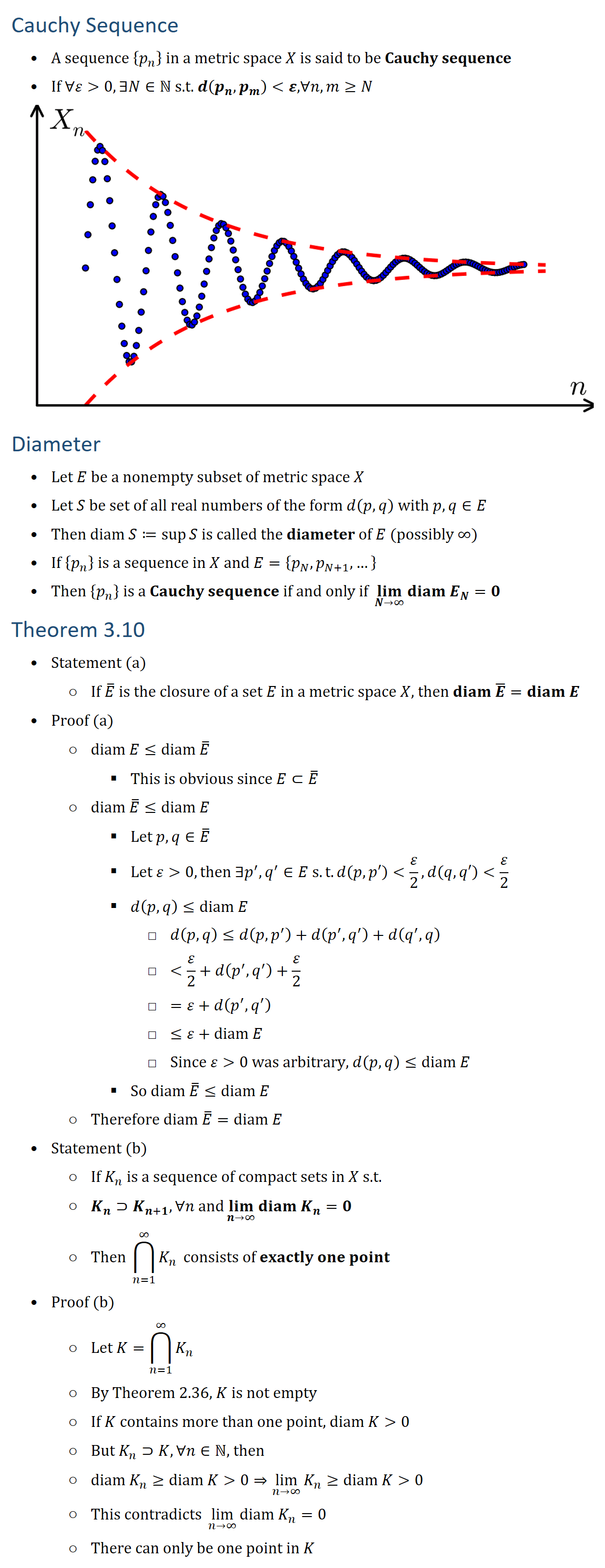
Cauchy Sequence • A sequence {p_n } in a metric space X is said to be Cauchy sequence • If ∀ε 0, ∃N∈N s.t. d(p_n,p_m ) ε,∀n,m≥N Diameter • Let E be a nonempty subset of metric space X • Let S be set of all real numbers of the form d(p,q) with p,q∈E • Then diam S≔supS is called the diameter of E (possibly ∞) • If {p_n } is a sequence in X and E={p_N,p_(N+1),…} • Then {p_n } is a Cauchy sequence if and only if (lim)_(N→∞)〖diam E_N 〗=0 Theorem 3.10 • Statement (a) ○ If E ̅ is the closure of a set E in a metric space X, then diam E ̅=diam E • Proof (a) ○ diam E≤diam E ̅ § This is obvious since E⊂E ̅ ○ diam E ̅≤diam E § Let p,q∈E ̅ § Let ε 0, then ∃p′,q′∈E s.t. d(p,p′) ε/2, d(q,q′) ε/2 § d(p,q)≤diam E □ d(p,q)≤d(p,p^′ )+d(p′,q′ )+d(q^′,q) □ ε/2+d(p′,q′ )+ε/2 □ =ε+d(p′,q′ ) □ ≤ε+diam E □ Since ε 0 was arbitrary, d(p,q)≤diam E § So diam E ̅≤diam E ○ Therefore diam E ̅=diam E • Statement (b) ○ If K_n is a sequence of compact sets in X s.t. ○ K_n⊃K_(n+1),∀n and (lim)_(n→∞)〖diam K_n 〗=0 ○ Then ⋂24_(n=1)^∞▒K_n consists of exactly one point • Proof (b) ○ Let K=⋂24_(n=1)^∞▒K_n ○ By Theorem 2.36, K is not empty ○ If K contains more than one point, diam K 0 ○ But K_n⊃K, ∀n∈N, then ○ diam K_n≥diam K 0⇒lim_(n→∞)〖K_n 〗≥diam K 0 ○ This contradicts lim_(n→∞)〖diam K_n 〗=0 ○ There can only be one point in K