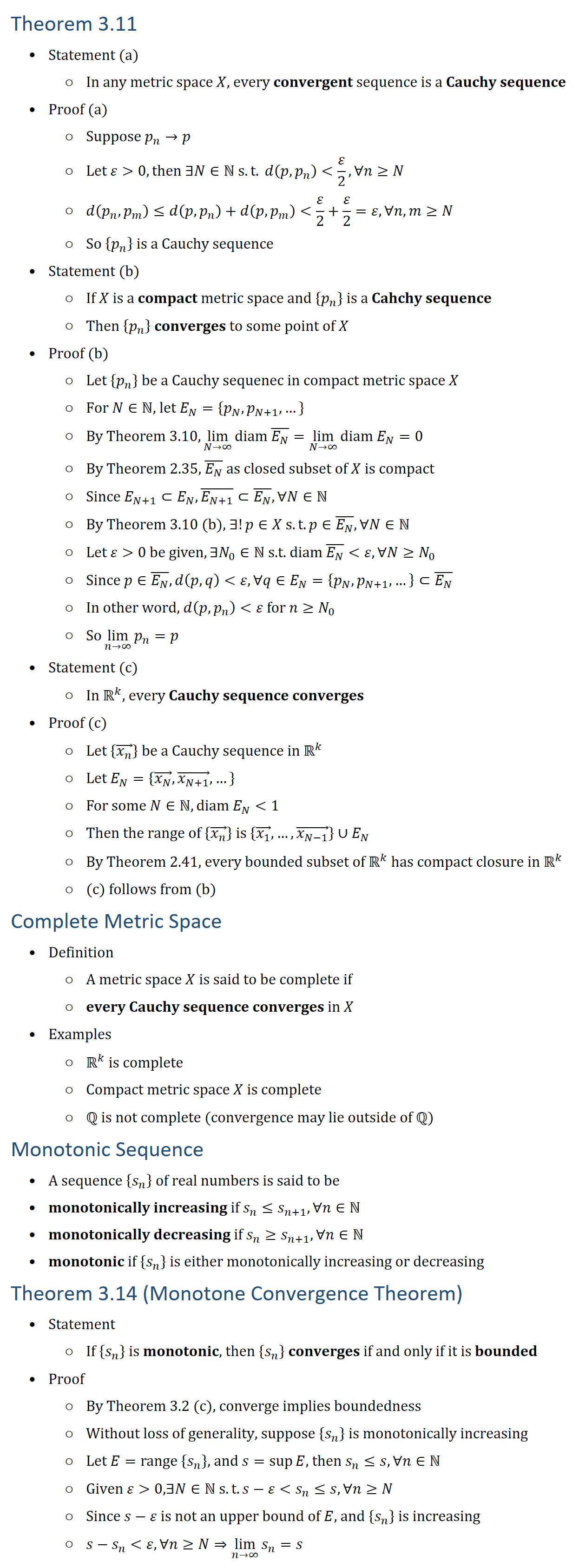
Theorem 3.11 • Statement (a) ○ In any metric space X, every convergent sequence is a Cauchy sequence • Proof (a) ○ Suppose p_n→p ○ Let ε 0,then ∃N∈N s.t. d(p,p_n ) ε/2, ∀n≥N ○ d(p_n,p_m )≤d(p,p_n )+d(p,p_m ) ε/2+ε/2=ε, ∀n,m≥N ○ So {p_n } is a Cauchy sequence • Statement (b) ○ If X is a compact metric space and {p_n } is a Cahchy sequence ○ Then {p_n } converges to some point of X • Proof (b) ○ Let {p_n } be a Cauchy sequenec in compact metric space X ○ For N∈N, let E_N={p_N,p_(N+1),…} ○ By Theorem 3.10,lim_(N→∞)〖diam (E_N ) ̅ 〗=lim_(N→∞)〖diam E_N 〗=0 ○ By Theorem 2.35, (E_N ) ̅ as closed subset of X is compact ○ Since E_(N+1)⊂E_N, (E_(N+1) ) ̅⊂(E_N ) ̅,∀N∈N ○ By Theorem 3.10 (b), ∃!p∈X s.t. p∈(E_N ) ̅, ∀N∈N ○ Let ε 0 be given,∃N_0∈N s.t. diam (E_N ) ̅ ε,∀N≥N_0 ○ Since p∈(E_N ) ̅,d(p,q) ε,∀q∈E_N={p_N,p_(N+1),…}⊂(E_N ) ̅ ○ In other word, d(p,p_n ) ε for n≥N_0 ○ So lim_(n→∞)〖p_n 〗=p • Statement (c) ○ In Rk, every Cauchy sequence converges • Proof (c) ○ Let {(x_n ) ⃗ } be a Cauchy sequence in Rk ○ Let E_N={(x_N ) ⃗,(x_(N+1) ) ⃗,…} ○ For some N∈N,diam E_N 1 ○ Then the range of {(x_n ) ⃗ } is {(x_1 ) ⃗,…,(x_(N−1) ) ⃗ }∪E_N ○ By Theorem 2.41, every bounded subset of Rk has compact closure in Rk ○ (c) follows from (b) Complete Metric Space • Definition ○ A metric space X is said to be complete if ○ every Cauchy sequence converges in X • Examples ○ Rk is complete ○ Compact metric space X is complete ○ Q is not complete (convergence may lie outside of Q) Monotonic Sequence • A sequence {s_n } of real numbers is said to be • monotonically increasing if s_n≤s_(n+1), ∀n∈N • monotonically decreasing if s_n≥s_(n+1), ∀n∈N • monotonic if {s_n } is either monotonically increasing or decreasing Theorem 3.14 (Monotone Convergence Theorem) • Statement ○ If {s_n } is monotonic, then {s_n } converges if and only if it is bounded • Proof ○ By Theorem 3.2 (c), converge implies boundedness ○ Without loss of generality, suppose {s_n } is monotonically increasing ○ Let E=range {s_n }, and s=supE, then s_n≤s,∀n∈N ○ Given ε 0,∃N∈N s.t. s−ε s_n≤s,∀n≥N ○ Since s−ε is not an upper bound of E, and {s_n } is increasing ○ s−s_n ε,∀n≥N⇒lim_(n→∞)〖s_n 〗=s