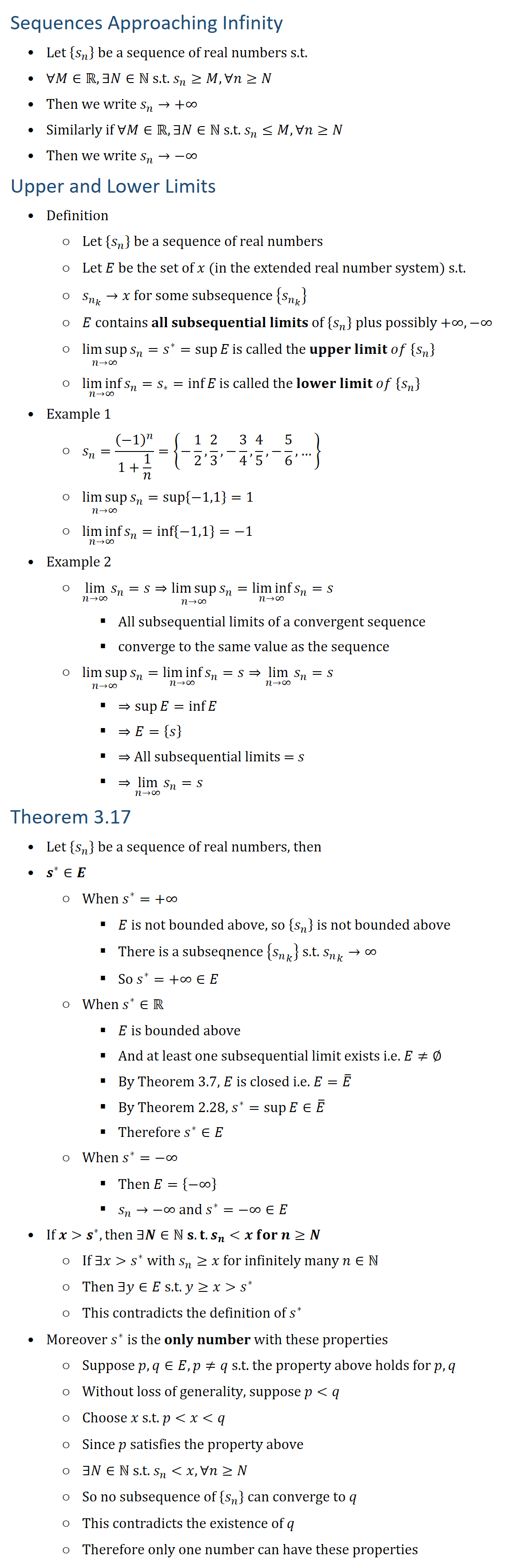
Sequences Approaching Infinity • Let {s_n } be a sequence of real numbers s.t. • ∀M∈R,∃N∈N s.t. s_n≥M,∀n≥N • Then we write s_n→+∞ • Similarly if ∀M∈R,∃N∈N s.t. s_n≤M,∀n≥N • Then we write s_n→−∞ Upper and Lower Limits • Definition ○ Let {s_n } be a sequence of real numbers ○ Let E be the set of x (in the extended real number system) s.t. ○ s_(n_k )→x for some subsequence {s_(n_k ) } ○ E contains all subsequential limits of {s_n } plus possibly +∞,−∞ ○ (limsup)_(n→∞)〖s_n 〗=s^∗=supE is called the upper limit of {s_n } ○ (liminf)_(n→∞)〖s_n 〗=s_∗=infE is called the lower limit of {s_n } • Example 1 ○ s_n=(−1)^n/(1+1/n)={−1/2,2/3,−3/4,4/5,−5/6,…} ○ (limsup)_(n→∞)〖s_n 〗=sup{−1,1}=1 ○ (liminf)_(n→∞)〖s_n 〗=inf{−1,1}=−1 • Example 2 ○ lim_(n→∞)〖s_n 〗=s⇒(limsup)_(n→∞)〖s_n 〗=(liminf)_(n→∞)〖s_n 〗=s § All subsequential limits of a convergent sequence § converge to the same value as the sequence ○ (limsup)_(n→∞)〖s_n 〗=(liminf)_(n→∞)〖s_n 〗=s⇒lim_(n→∞)〖s_n 〗=s § ⇒supE=infE § ⇒E={s} § ⇒ All subsequential limits = s § ⇒lim_(n→∞)〖s_n 〗=s Theorem 3.17 • Let {s_n } be a sequence of real numbers, then • s^∗∈E ○ When s^∗=+∞ § E is not bounded above, so {s_n } is not bounded above § There is a subseqnence {〖s_n〗_k } s.t. 〖s_n〗_k→∞ § So s^∗=+∞∈E ○ When s^∗∈R § E is bounded above § And at least one subsequential limit exists i.e. E≠∅ § By Theorem 3.7, E is closed i.e. E=E ̅ § By Theorem 2.28, s^∗=supE∈E ̅ § Therefore s^∗∈E ○ When s^∗=−∞ § Then E={−∞} § s_n→−∞ and s^∗=−∞∈E • If x s^∗,then ∃N∈N s.t.s_n x for n≥N ○ If ∃x s^∗ with s_n≥x for infinitely many n∈N ○ Then ∃y∈E s.t. y≥x s^∗ ○ This contradicts the definition of s^∗ • Moreover s^∗ is the only number with these properties ○ Suppose p,q∈E,p≠q s.t. the property above holds for p,q ○ Without loss of generality, suppose p q ○ Choose x s.t. p x q ○ Since p satisfies the property above ○ ∃N∈N s.t. s_n x,∀n≥N ○ So no subsequence of {s_n } can converge to q ○ This contradicts the existence of q ○ Therefore only one number can have these properties