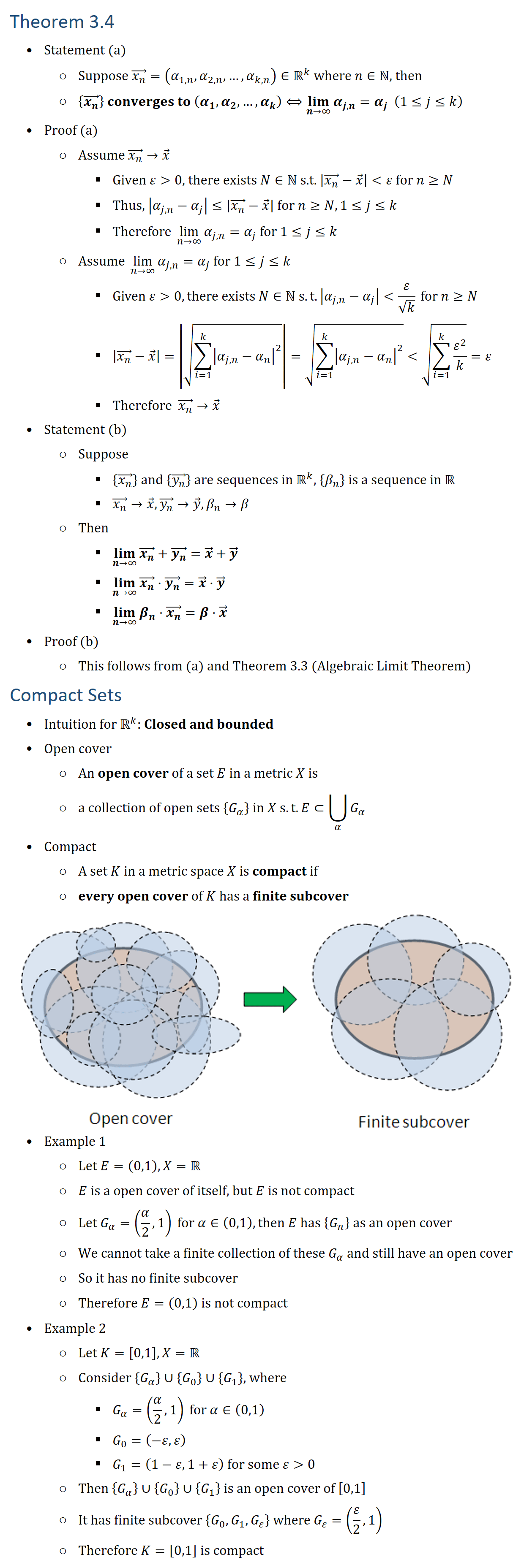
Theorem 3.4 • Statement (a) ○ Suppose (x_n ) ⃗=(α_(1,n),α_(2,n),…,α_(k,n) )∈Rk where n∈N, then ○ {(x_n ) ⃗ } converges to (α_1,α_2,…,α_k )⟺(lim)_(n→∞)〖α_(j,n) 〗=α_j (1≤j≤k) • Proof (a) ○ Assume (x_n ) ⃗→x ⃗ § Given ε 0, there exists N∈N s.t. |(x_n ) ⃗−x ⃗ | ε for n≥N § Thus, |α_(j,n)−α_j |≤|(x_n ) ⃗−x ⃗ | for n≥N,1≤j≤k § Therefore lim_(n→∞)〖α_(j,n) 〗=α_j for 1≤j≤k ○ Assume lim_(n→∞)〖α_(j,n) 〗=α_j for 1≤j≤k § Given ε 0, there exists N∈N s.t. |α_(j,n)−α_j | ε/√k for n≥N § |(x_n ) ⃗−x ⃗ |=|√(∑_(i=1)^k▒|α_(j,n)−α_n |^2 )|=√(∑_(i=1)^k▒|α_(j,n)−α_n |^2 ) √(∑_(i=1)k▒ε2/k)=ε § Therefore (x_n ) ⃗→x ⃗ • Statement (b) ○ Suppose § {(x_n ) ⃗ } and {(y_n ) ⃗ } are sequences in Rk, {β_n } is a sequence in R § (x_n ) ⃗→x ⃗, (y_n ) ⃗→y ⃗, β_n→β ○ Then § (lim)_(n→∞)〖(x_n ) ⃗+(y_n ) ⃗ 〗=x ⃗+y ⃗ § (lim)_(n→∞)〖(x_n ) ⃗⋅(y_n ) ⃗ 〗=x ⃗⋅y ⃗ § (lim)_(n→∞)〖β_n⋅(x_n ) ⃗ 〗=β⋅x ⃗ • Proof (b) ○ This follows from (a) and Theorem 3.3 (Algebraic Limit Theorem) Compact Sets • Intuition for Rk: Closed and bounded • Open cover ○ An open cover of a set E in a metric X is ○ a collection of open sets {G_α } in X s.t. E⊂⋃8_α▒G_α • Compact ○ A set K in a metric space X is compact if ○ every open cover of K has a finite subcover • Example 1 ○ Let E=(0,1), X=R ○ E is a open cover of itself, but E is not compact ○ Let G_α=(α/2,1) for α∈(0,1), then E has {G_n } as an open cover ○ We cannot take a finite collection of these G_α and still have an open cover ○ So it has no finite subcover ○ Therefore E=(0,1) is not compact • Example 2 ○ Let K=[0,1], X=R ○ Consider {G_α }∪{G_0 }∪{G_1 }, where § G_α=(α/2,1) for α∈(0,1) § G_0=(−ε,ε) § G_1=(1−ε,1+ε) for some ε 0 ○ Then {G_α }∪{G_0 }∪{G_1 } is an open cover of [0,1] ○ It has finite subcover {G_0,G_1,G_ε } where G_ε=(ε/2,1) ○ Therefore K=[0,1] is compact