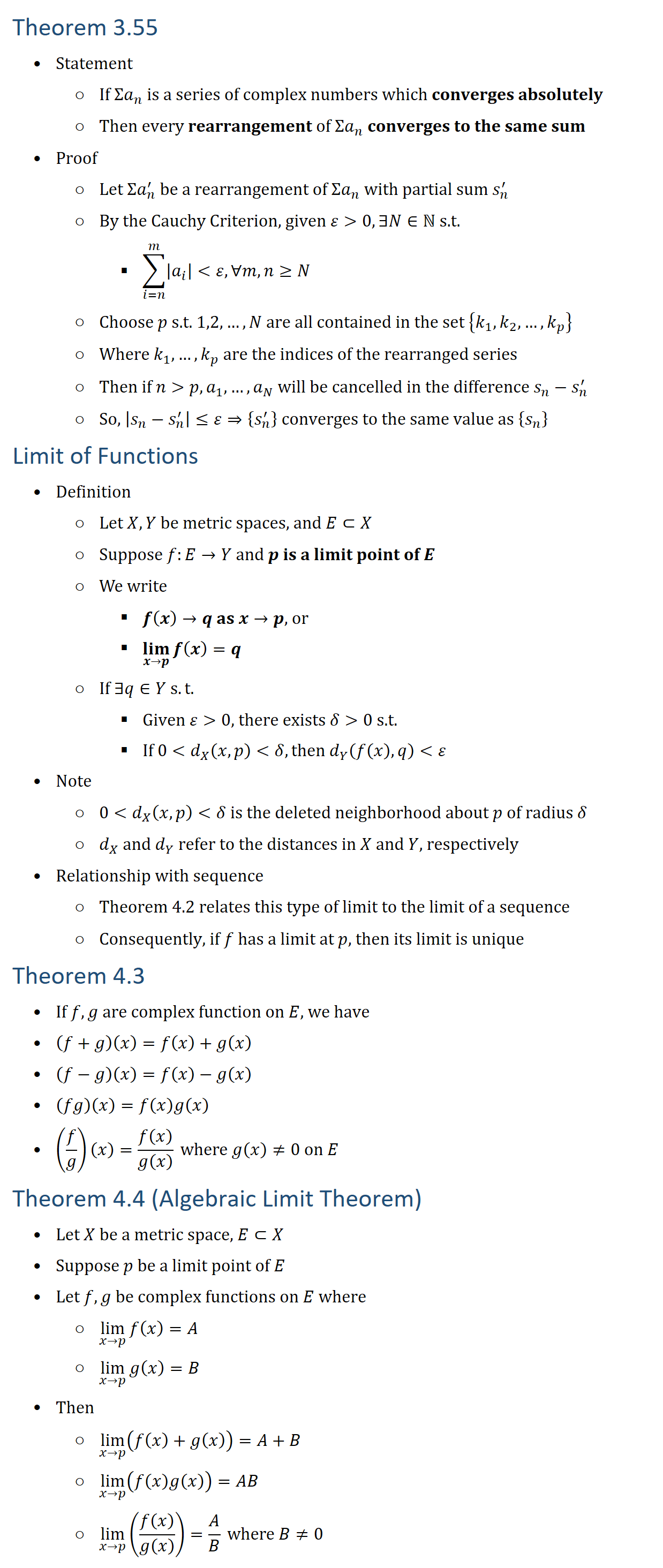
Theorem 3.55 • Statement ○ If Σa_n is a series of complex numbers which converges absolutely ○ Then every rearrangement of Σa_n converges to the same sum • Proof ○ Let Σa_n^′ be a rearrangement of Σa_n with partial sum s_n^′ ○ By the Cauchy Criterion, given ε0, ∃N∈N s.t. § ∑_(i=n)^m▒|a_i | ε,∀m,n≥N ○ Choose p s.t. 1,2,…,N are all contained in the set {k_1,k_2,…,k_p } ○ Where k_1,…,k_p are the indices of the rearranged series ○ Then if np, a_1,…,a_N will be cancelled in the difference s_n−s_n^′ ○ So, |s_n−s_n^′ |≤ε⇒{s_n^′ } converges to the same value as {s_n } Limit of Functions • Definition ○ Let X,Y be metric spaces, and E⊂X ○ Suppose f:E→Y and p is a limit point of E ○ We write § f(x)→q as x→p, or § (lim)_(x→p)f(x)=q ○ If ∃q∈Y s.t. § Given ε0, there exists δ0 s.t. § If 0d_X (x,p)δ, then d_Y (f(x),q)ε • Note ○ 0d_X (x,p)δ is the deleted neighborhood about p of radius δ ○ d_X and d_Y refer to the distances in X and Y, respectively • Relationship with sequence ○ Theorem 4.2 relates this type of limit to the limit of a sequence ○ Consequently, if f has a limit at p, then its limit is unique Theorem 4.3 • If f,g are complex function on E, we have • (f+g)(x)=f(x)+g(x) • (f−g)(x)=f(x)−g(x) • (fg)(x)=f(x)g(x) • (f/g)(x)=f(x)/g(x) where g(x)≠0 on E Theorem 4.4 (Algebraic Limit Theorem) • Let X be a metric space, E⊂X • Suppose p be a limit point of E • Let f,g be complex functions on E where ○ lim_(x→p)f(x)=A ○ lim_(x→p)g(x)=B • Then ○ lim_(x→p)(f(x)+g(x))=A+B ○ lim_(x→p)(f(x)g(x))=AB ○ lim_(x→p)(f(x)/g(x) )=A/B where B≠0