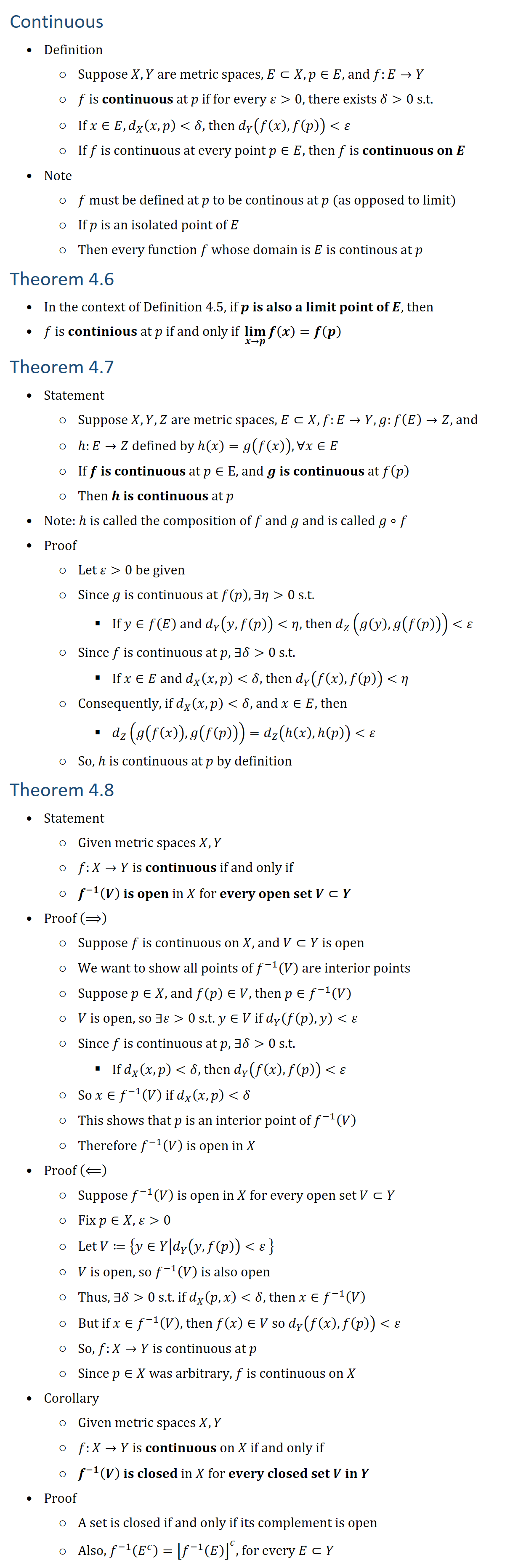
Continuous • Definition ○ Suppose X,Y are metric spaces, E⊂X, p∈E, and f:E→Y ○ f is continuous at p if for every ε 0, there exists δ 0 s.t. ○ If x∈E,d_X (x,p) δ, then d_Y (f(x),f(p)) ε ○ If f is continuous at every point p∈E, then f is continuous on E • Note ○ f must be defined at p to be continous at p (as opposed to limit) ○ If p is an isolated point of E ○ Then every function f whose domain is E is continous at p Theorem 4.6 • In the context of Definition 4.5, if p is also a limit point of E, then • f is continious at p if and only if (lim)_(x→p)f(x)=f(p) Theorem 4.7 • Statement ○ Suppose X,Y,Z are metric spaces, E⊂X,f:E→Y, g:f(E)→Z, and ○ h:E→Z defined by h(x)=g(f(x)),∀x∈E ○ If f is continuous at p∈E, and g is continuous at f(p) ○ Then h is continuous at p • Note: h is called the composition of f and g and is called g∘f • Proof ○ Let ε 0 be given ○ Since g is continuous at f(p),∃η 0 s.t. § If y∈f(E) and d_Y (y,f(p)) η, then d_Z (g(y),g(f(p))) ε ○ Since f is continuous at p, ∃δ 0 s.t. § If x∈E and d_X (x,p) δ, then d_Y (f(x),f(p)) η ○ Consequently, if d_X (x,p) δ, and x∈E, then § d_Z (g(f(x)),g(f(p)))=d_Z (hx),hp)) ε ○ So, h is continuous at p by definition Theorem 4.8 • Statement ○ Given metric spaces X,Y ○ f:X→Y is continuous if and only if ○ f^(−1) (V) is open in X for every open set V⊂Y • Proof (⟹) ○ Suppose f is continuous on X, and V⊂Y is open ○ We want to show all points of f^(−1) (V) are interior points ○ Suppose p∈X, and f(p)∈V, then p∈f^(−1) (V) ○ V is open, so ∃ε 0 s.t. y∈V if d_Y (f(p),y) ε ○ Since f is continuous at p, ∃δ 0 s.t. § If d_X (x,p) δ, then d_Y (f(x),f(p)) ε ○ So x∈f^(−1) (V) if d_X (x,p) δ ○ This shows that p is an interior point of f^(−1) (V) ○ Therefore f^(−1) (V) is open in X • Proof (⟸) ○ Suppose f^(−1) (V) is open in X for every open set V⊂Y ○ Fix p∈X, ε 0 ○ Let V≔{y∈Y│d_Y (y,f(p)) ε } ○ V is open, so f^(−1) (V) is also open ○ Thus, ∃δ 0 s.t. if d_X (p,x) δ, then x∈f^(−1) (V) ○ But if x∈f^(−1) (V), then f(x)∈V so d_Y (f(x),f(p)) ε ○ So, f:X→Y is continuous at p ○ Since p∈X was arbitrary, f is continuous on X • Corollary ○ Given metric spaces X,Y ○ f:X→Y is continuous on X if and only if ○ f^(−1) (V) is closed in X for every closed set V in Y • Proof ○ A set is closed if and only if its complement is open ○ Also, f^(−1) (E^c )=[f^(−1) (E)]^c, for every E⊂Y