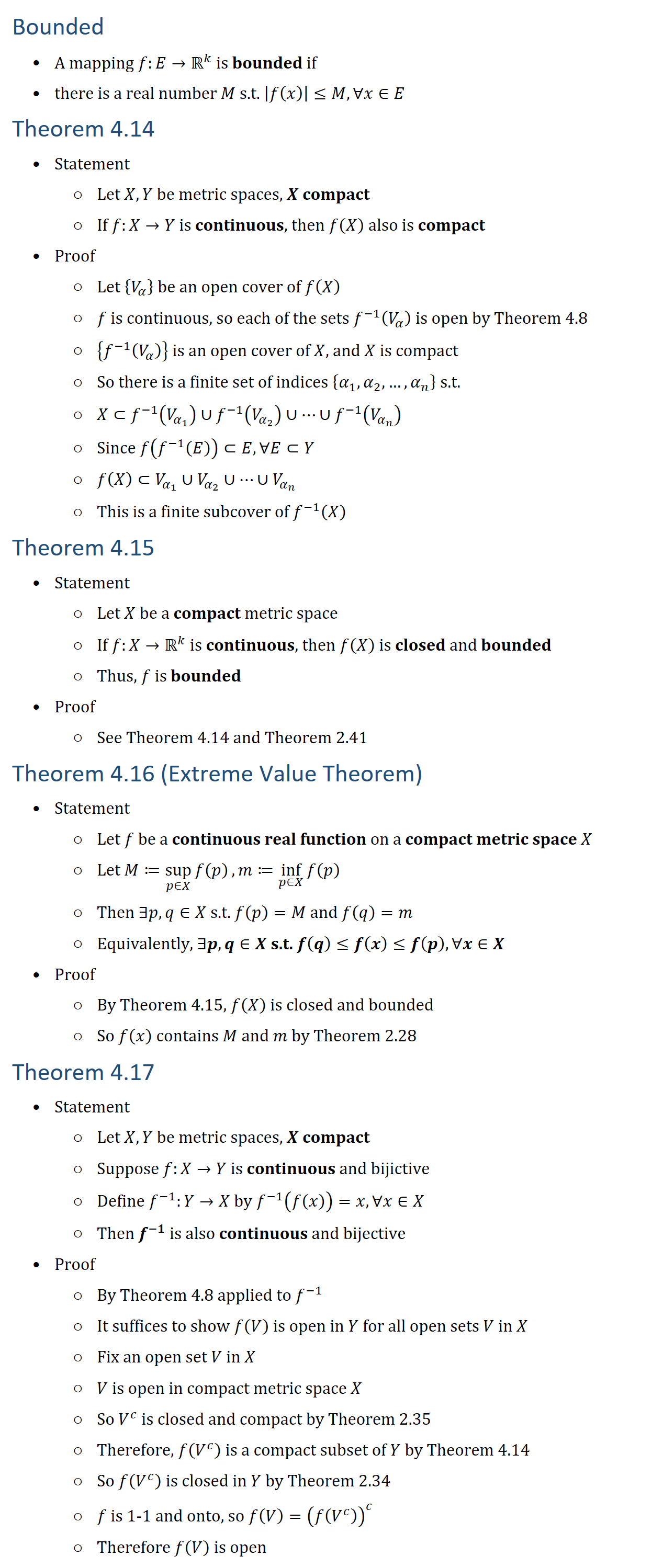
Bounded • A mapping f:E→Rk is bounded if • there is a real number M s.t. |f(x)|≤M,∀x∈E Theorem 4.14 • Statement ○ Let X,Y be metric spaces, X compact ○ If f:X→Y is continuous, then f(X) also is compact • Proof ○ Let {V_α } be an open cover of f(X) ○ f is continuous, so each of the sets f^(−1) (V_α ) is open by Theorem 4.8 ○ {f^(−1) (V_α )} is an open cover of X, and X is compact ○ So there is a finite set of indices {α_1,α_2,…,α_n } s.t. ○ X⊂f^(−1) (V_(α_1 ) )∪f^(−1) (V_(α_2 ) )∪…∪f^(−1) (V_(α_n ) ) ○ Since f(f^(−1) (E))⊂E,∀E⊂Y ○ f(X)⊂V_(α_1 )∪V_(α_2 )∪…∪V_(α_n ) ○ This is a finite subcover of f^(−1) (X) Theorem 4.15 • Statement ○ Let X be a compact metric space ○ If f:X→Rk is continuous, then f(X) is closed and bounded ○ Thus, f is bounded • Proof ○ See Theorem 4.14 and Theorem 2.41 Theorem 4.16 (Extreme Value Theorem) • Statement ○ Let f be a continuous real function on a compact metric space X ○ Let M≔sup┬(p∈X)f(p), m≔inf┬(p∈X)f(p) ○ Then ∃p,q∈X s.t. f(p)=M and f(q)=m ○ Equivalently, ∃p,q∈X s.t. f(q)≤f(x)≤f(p),∀x∈X • Proof ○ By Theorem 4.15, f(X) is closed and bounded ○ So f(x) contains M and m by Theorem 2.28 Theorem 4.17 • Statement ○ Let X,Y be metric spaces, X compact ○ Suppose f:X→Y is continuous and bijictive ○ Define f^(−1):Y→X by f^(−1) (f(x))=x,∀x∈X ○ Then f^(−1) is also continuous and bijective • Proof ○ By Theorem 4.8 applied to f^(−1) ○ It suffices to show f(V) is open in Y for all open sets V in X ○ Fix an open set V in X ○ V is open in compact metric space X ○ So V^c is closed and compact by Theorem 2.35 ○ Therefore, f(V^c ) is a compact subset of Y by Theorem 4.14 ○ So f(V^c ) is closed in Y by Theorem 2.34 ○ f is 1-1 and onto, so f(V)=(f(V^c ))^c ○ Therefore f(V) is open