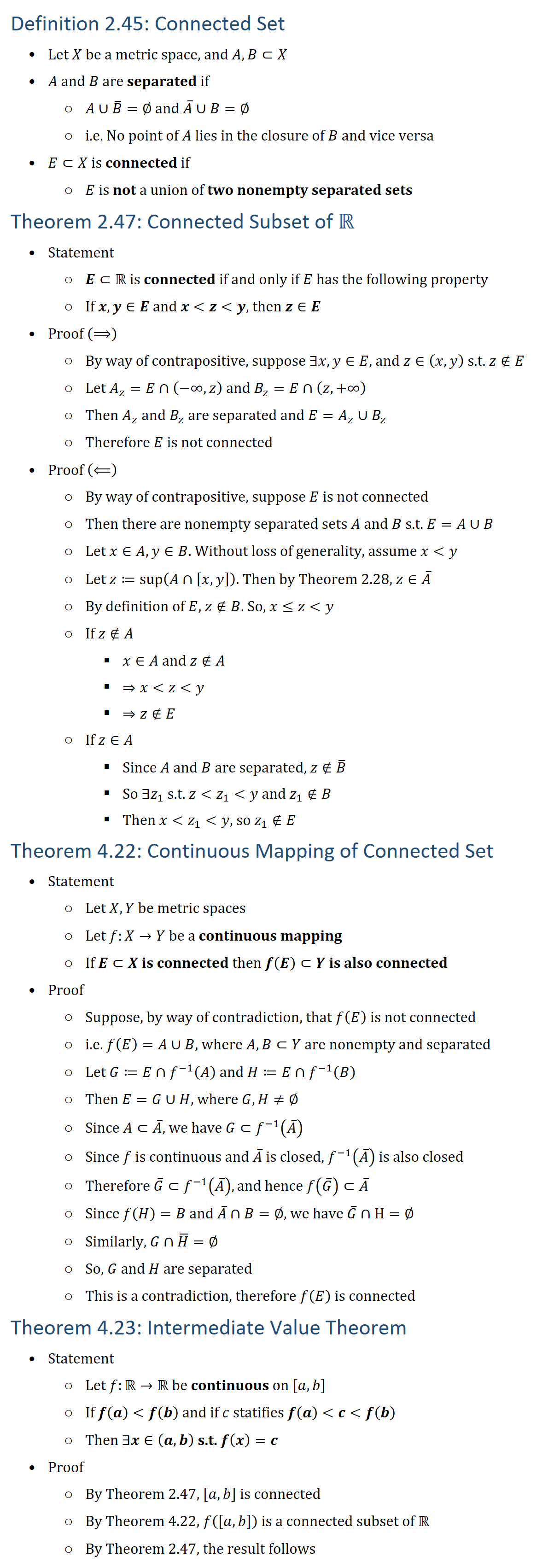
Definition 2.45: Connected Set • Let X be a metric space, and A,B⊂X • A and B are separated if ○ A∪B ̅=∅ and A ̅∪B=∅ ○ i.e. No point of A lies in the closure of B and vice versa • E⊂X is connected if ○ E is not a union of two nonempty separated sets Theorem 2.47: Connected Subset of R • Statement ○ E⊂R is connected if and only if E has the following property ○ If x,y∈E and x z y, then z∈E • Proof (⟹) ○ By way of contrapositive, suppose ∃x,y∈E, and z∈(x,y) s.t. z∉E ○ Let A_z=E∩(−∞,z) and B_z=E∩(z,+∞) ○ Then A_z and B_z are separated and E=A_z∪B_z ○ Therefore E is not connected • Proof (⟸) ○ By way of contrapositive, suppose E is not connected ○ Then there are nonempty separated sets A and B s.t. E=A∪B ○ Let x∈A,y∈B. Without loss of generality, assume x y ○ Let z≔sup(A∩[x,y]). Then by Theorem 2.28, z∈A ̅ ○ By definition of E, z∉B. So, x≤z y ○ If z∉A § x∈A and z∉A § ⇒x z y § ⇒z∉E ○ If z∈A § Since A and B are separated, z∉B ̅ § So ∃z_1 s.t. z z_1 y and z_1∉B § Then x z_1 y, so z_1∉E Theorem 4.22: Continuous Mapping of Connected Set • Statement ○ Let X,Y be metric spaces ○ Let f:X→Y be a continuous mapping ○ If E⊂X is connected then f(E)⊂Y is also connected • Proof ○ Suppose, by way of contradiction, that f(E) is not connected ○ “i.e.” f(E)=A∪B, where A,B⊂Y are nonempty and separated ○ Let G≔E∩f^(−1) (A) and H≔E∩f^(−1) (B) ○ Then E=G∪H, where G,H≠∅ ○ Since A⊂A ̅, we have G⊂f^(−1) (A ̅ ) ○ Since f is continuous and A ̅ is closed, f^(−1) (A ̅ ) is also closed ○ Therefore G ̅⊂f^(−1) (A ̅ ), and hence f(G ̅ )⊂A ̅ ○ Since f(H)=B and A ̅∩B=∅, we have G ̅∩H=∅ ○ Similarly, G∩H ̅=∅ ○ So, G and H are separated ○ This is a contradiction, therefore f(E) is connected Theorem 4.23: Intermediate Value Theorem • Statement ○ Let f:R→R be continuous on [a,b] ○ If f(a) f(b) and if c statifies f(a) c f(b) ○ Then ∃x∈(a,b) s.t. f(x)=c • Proof ○ By Theorem 2.47, [a,b] is connected ○ By Theorem 4.22, f([a,b]) is a connected subset of R ○ By Theorem 2.47, the result follows