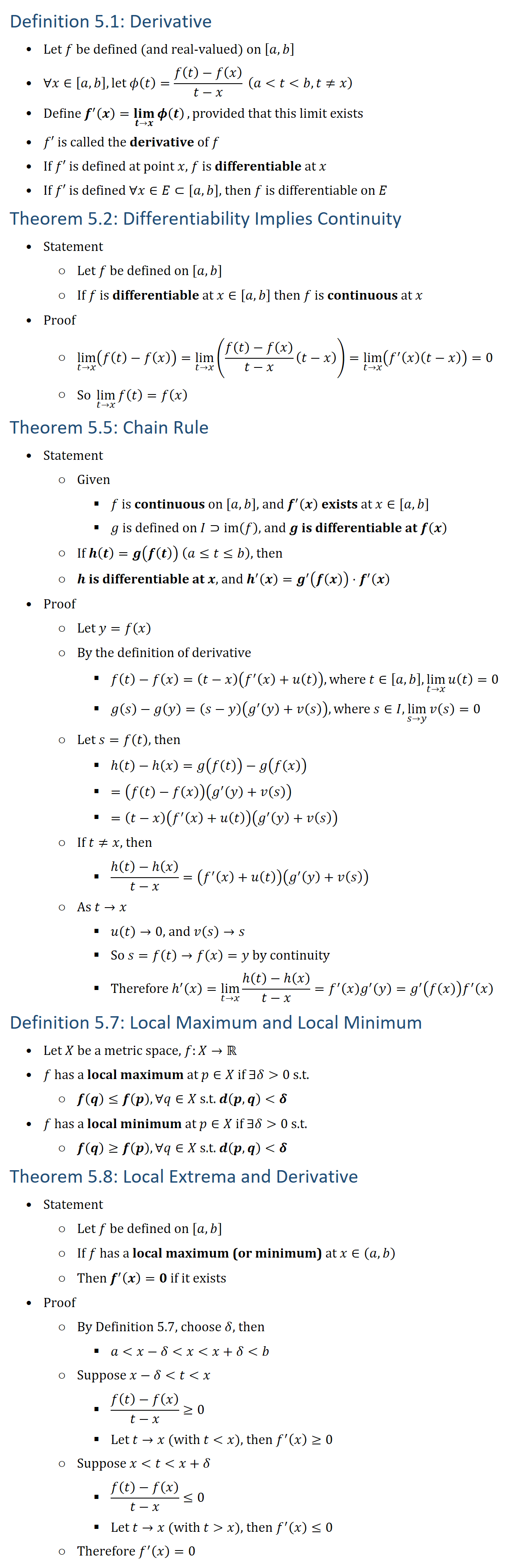
Definition 5.1: Derivative • Let f be defined (and real-valued) on [a,b] • ∀x∈[a,b], let ϕ(t)=(f(t)−f(x))/(t−x) (a t b, t≠x) • Define f^′ (x)=(lim)_(t→x)ϕ(t), provided that this limit exists • f′ is called the derivative of f • If f′ is defined at point x, f is differentiable at x • If f′ is defined ∀x∈E⊂[a,b], then f is differentiable on E Theorem 5.2: Differentiability Implies Continuity • Statement ○ Let f be defined on [a,b] ○ If f is differentiable at x∈[a,b] then f is continuous at x • Proof ○ lim_(t→x)(f(t)−f(x))=lim_(t→x)((f(t)−f(x))/(t−x) (t−x))=lim_(t→x)(f^′ (x)(t−x))=0 ○ So lim_(t→x)f(t)=f(x) Theorem 5.5: Chain Rule • Statement ○ Given § f is continuous on [a,b], and f^′ (x) exists at x∈[a,b] § g is defined on I⊃im(f), and g is differentiable at f(x) ○ If h(t)=g(f(t)) (a≤t≤b), then ○ h is differentiable at x, and h^′ (x)=g^′ (f(x))⋅f^′ (x) • Proof ○ Let y=f(x) ○ By the definition of derivative § f(t)−f(x)=(t−x)(f^′ (x)+u(t)), where t∈[a,b], lim_(t→x)u(t)=0 § g(s)−g(y)=(s−y)(g^′ (y)+v(s)), where s∈I, lim_(s→y)v(s)=0 ○ Let s=f(t), then § h(t)−h(x)=g(f(t))−g(f(x)) § =(f(t)−f(x))(g^′ (y)+v(s)) § =(t−x)(f^′ (x)+u(t))(g^′ (y)+v(s)) ○ If t≠x, then § (ht)−hx))/(t−x)=(f^′ (x)+u(t))(g^′ (y)+v(s)) ○ As t→x § u(t)→0, and v(s)→s § So s=f(t)→f(x)=y by continuity § Therefore h′ (x)=lim_(t→x)〖(ht)−hx))/(t−x)〗=f^′ (x) g^′ (y)=g^′ (f(x)) f^′ (x) Definition 5.7: Local Maximum and Local Minimum • Let X be a metric space, f:X→R • f has a local maximum at p∈X if ∃δ 0 s.t. ○ f(q)≤f(p),∀q∈X s.t. d(p,q) δ • f has a local minimum at p∈X if ∃δ 0 s.t. ○ f(q)≥f(p),∀q∈X s.t. d(p,q) δ Theorem 5.8: Local Extrema and Derivative • Statement ○ Let f be defined on [a,b] ○ If f has a local maximum (or minimum) at x∈(a,b) ○ Then f^′ (x)=0 if it exists • Proof ○ By Definition 5.7, choose δ, then § a x−δ x x+δ b ○ Suppose x−δ t x § (f(t)−f(x))/(t−x)≥0 § Let t→x (with t x), then f^′ (x)≥0 ○ Suppose x t x+δ § (f(t)−f(x))/(t−x)≤0 § Let t→x (with t x), then f^′ (x)≤0 ○ Therefore f^′ (x)=0