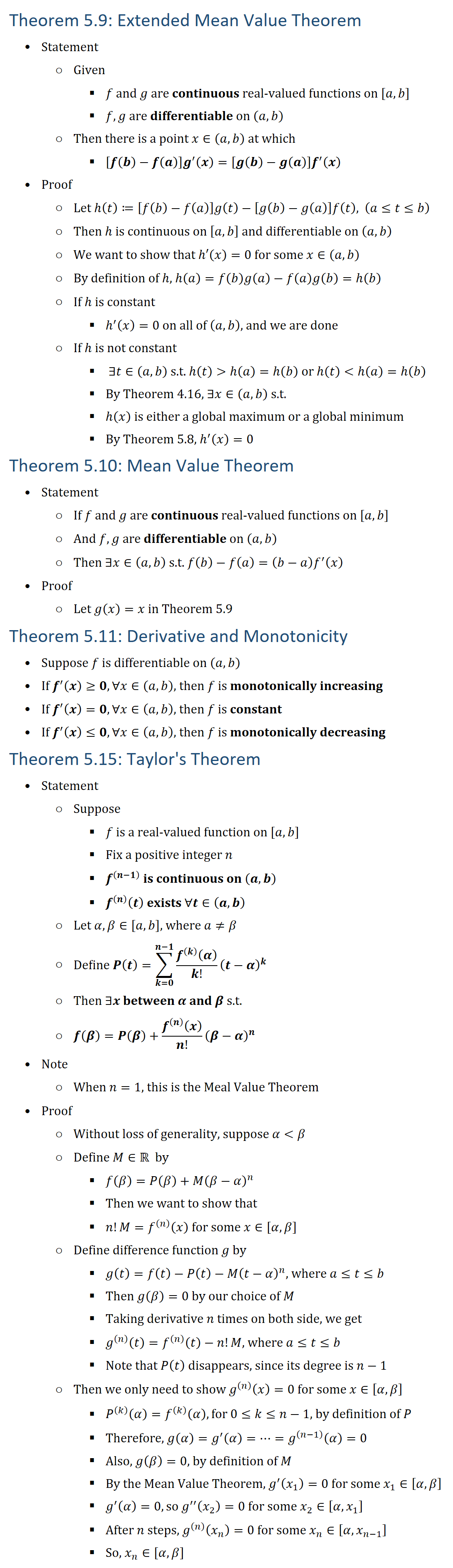
Theorem 5.9: Extended Mean Value Theorem • Statement ○ Given § f and g are continuous real-valued functions on [a,b] § f,g are differentiable on (a,b) ○ Then there is a point x∈(a,b) at which § [f(b)−f(a)] g^′ (x)=[g(b)−g(a)] f^′ (x) • Proof ○ Let h(t)≔[f(b)−f(a)]g(t)−[g(b)−g(a)]f(t), (a≤t≤b) ○ Then h is continuous on [a,b] and differentiable on (a,b) ○ We want to show that h′(x)=0 for some x∈(a,b) ○ By definition of h, h(a)=f(b)g(a)−f(a)g(b)=h(b) ○ If h is constant § h′ (x)=0 on all of (a,b), and we are done ○ If h is not constant § ∃t∈(a,b) s.t. h(t) h(a)=h(b) or h(t) h(a)=h(b) § By Theorem 4.16, ∃x∈(a,b) s.t. § h(x) is either a global maximum or a global minimum § By Theorem 5.8, h′ (x)=0 Theorem 5.10: Mean Value Theorem • Statement ○ If f and g are continuous real-valued functions on [a,b] ○ And f,g are differentiable on (a,b) ○ Then ∃x∈(a,b) s.t. f(b)−f(a)=(b−a) f^′ (x) • Proof ○ Let g(x)=x in Theorem 5.9 Theorem 5.11: Derivative and Monotonicity • Suppose f is differentiable on (a,b) • If f^′ (x)≥0,∀x∈(a,b), then f is monotonically increasing • If f^′ (x)=0,∀x∈(a,b), then f is constant • If f^′ (x)≤0,∀x∈(a,b), then f is monotonically decreasing Theorem 5.15: Taylor s Theorem • Statement ○ Suppose § f is a real-valued function on [a,b] § Fix a positive integer n § f^((n−1) ) is continuous on (a,b) § f^((n) ) (t) exists ∀t∈(a,b) ○ Let α,β∈[a,b], where a≠β ○ Define P(t)=∑_(k=0)(n−1)▒〖(f((k) ) (α))/k! (t−α)^k 〗 ○ Then ∃x between α and β s.t. ○ f(β)=P(β)+(f^((n) ) (x))/n! (β−α)^n • Note ○ When n=1, this is the Meal Value Theorem • Proof ○ Without loss of generality, suppose α β ○ Define M∈R by § f(β)=P(β)+M(β−α)^n § Then we want to show that § n!M=f^((n) ) (x) for some x∈[α,β] ○ Define difference function g by § g(t)=f(t)−P(t)−M(t−α)^n, where a≤t≤b § Then g(β)=0 by our choice of M § Taking derivative n times on both side, we get § g^((n) ) (t)=f^((n) ) (t)−n!M, where a≤t≤b § Note that P(t) disappears, since its degree is n−1 ○ Then we only need to show g^((n) ) (x)=0 for some x∈[α,β] § P^((k) ) (α)=f^((k) ) (α),for 0≤k≤n−1, by definition of P § Therefore, g(α)=g^′ (α)=…=g^((n−1) ) (α)=0 § Also, g(β)=0, by definition of M § By the Mean Value Theorem, g^′ (x_1 )=0 for some x_1∈[α,β] § g^′ (α)=0, so g^′′ (x_2 )=0 for some x_2∈[α,x_1 ] § After n steps, g^((n) ) (x_n )=0 for some x_n∈[α,x_(n−1) ] § So, x_n∈[α,β]