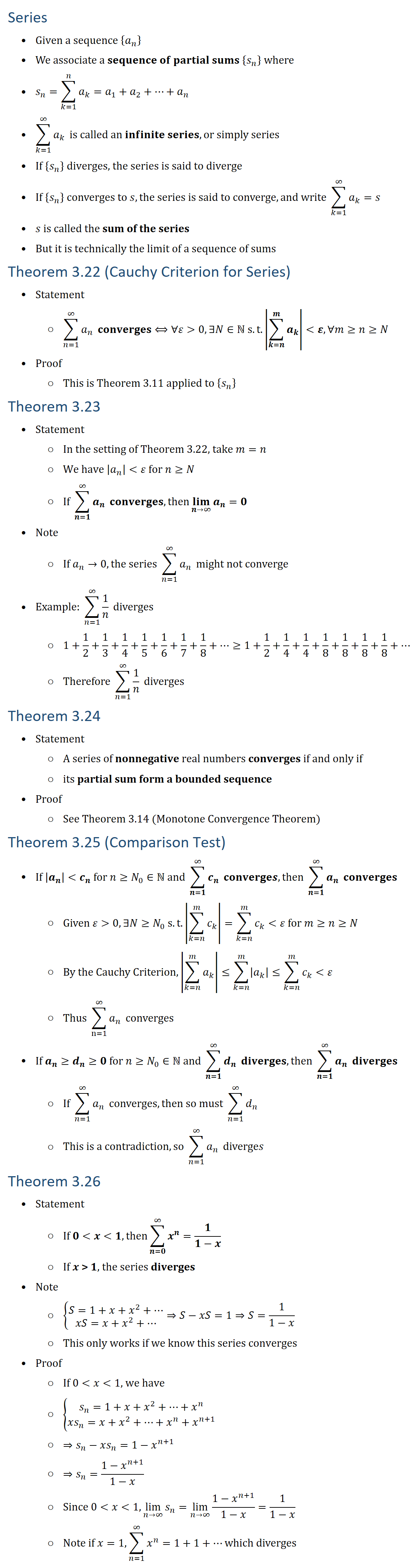
Series • Given a sequence {a_n } • We associate a sequence of partial sums {s_n } where • s_n=∑_(k=1)^n▒a_k =a_1+a_2+…+a_n • ∑_(k=1)^∞▒a_k is called an infinite series, or simply series • If {s_n } diverges, the series is said to diverge • If {s_n } converges to s, the series is said to converge, and write ∑_(k=1)^∞▒a_k =s • s is called the sum of the series • But it is technically the limit of a sequence of sums Theorem 3.22 (Cauchy Criterion for Series) • Statement ○ ∑_(n=1)^∞▒a_n converges⟺∀ε 0, ∃N∈N s.t. |∑_(k=n)^m▒a_k | ε,∀m≥n≥N • Proof ○ This is Theorem 3.11 applied to {s_n } Theorem 3.23 • Statement ○ In the setting of Theorem 3.22, take m=n ○ We have |a_n | ε for n≥N ○ If ∑_(n=1)^∞▒a_n converges, then (lim)_(n→∞)〖a_n 〗=0 • Note ○ If a_n→0, the series ∑_(n=1)^∞▒a_n might not converge • Example: ∑_(n=1)^∞▒1/n diverges ○ 1+1/2+1/3+1/4+1/5+1/6+1/7+1/8+…≥1+1/2+1/4+1/4+1/8+1/8+1/8+1/8+… ○ Therefore ∑_(n=1)^∞▒1/n diverges Theorem 3.24 • Statement ○ A series of nonnegative real numbers converges if and only if ○ its partial sum form a bounded sequence • Proof ○ See Theorem 3.14 (Monotone Convergence Theorem) Theorem 3.25 (Comparison Test) • If |a_n | c_n for n≥N_0∈N and ∑_(n=1)^∞▒c_n converges, then ∑_(n=1)^∞▒a_n converges ○ Given ε 0,∃N≥N_0 s.t. |∑_(k=n)^m▒c_k |=∑_(k=n)^m▒c_k ε for m≥n≥N ○ By the Cauchy Criterion, |∑_(k=n)^m▒a_k |≤∑_(k=n)^m▒|a_k | ≤∑_(k=n)^m▒c_k ε ○ Thus ∑_(n=1)^∞▒a_n converges • If a_n≥d_n≥0 for n≥N_0∈N and ∑_(n=1)^∞▒d_n diverges, then ∑_(n=1)^∞▒a_n diverges ○ If ∑_(n=1)^∞▒a_n converges, then so must ∑_(n=1)^∞▒d_n ○ This is a contradiction, so ∑_(n=1)^∞▒a_n diverges Theorem 3.26 • Statement ○ If 0 x 1, then∑_(n=0)∞▒xn =1/(1−x) ○ If x 1, the series diverges • Note ○ {█(S=1+x+x2+…@xS=x+x2+…)┤⇒S−xS=1⇒S=1/(1−x) ○ This only works if we know this series converges • Proof ○ If 0 x 1, we have ○ {█(s_n=1+x+x2+…+xn@xs_n=x+x2+…+xn+x^(n+1) )┤ ○ ⇒s_n−xs_n=1−x^(n+1) ○ ⇒s_n=(1−x^(n+1))/(1−x) ○ Since 0 x 1,lim_(n→∞)〖s_n 〗=lim_(n→∞)〖(1−x^(n+1))/(1−x)〗=1/(1−x) ○ Note if x=1, ∑_(n=1)∞▒xn =1+1+…which diverges