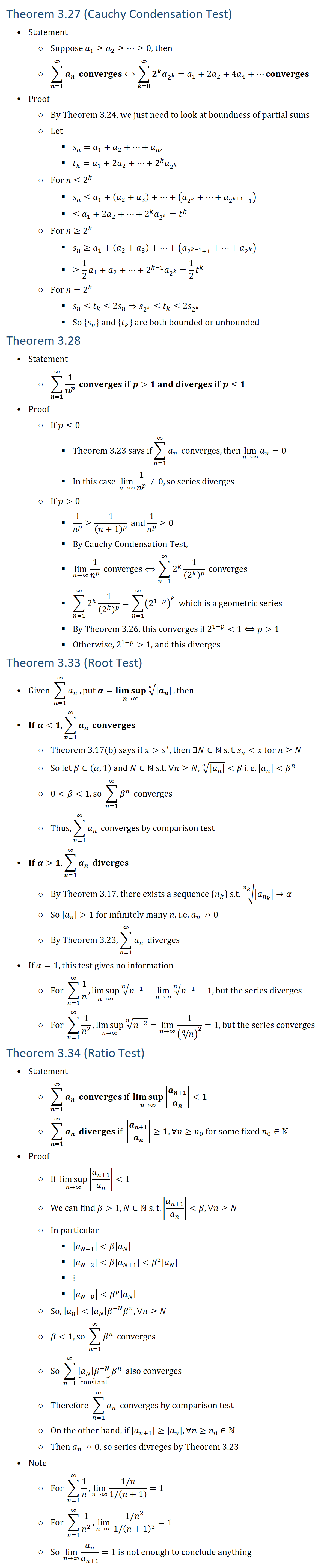
Theorem 3.27 (Cauchy Condensation Test) • Statement ○ Suppose a_1≥a_2≥…≥0, then ○ ∑_(n=1)^∞▒a_n converges⟺∑_(k=0)∞▒〖2k a_(2^k ) 〗=a_1+2a_2+4a_4+…converges • Proof ○ By Theorem 3.24, we just need to look at boundness of partial sums ○ Let § s_n=a_1+a_2+…+a_n, § t_k=a_1+2a_2+…+2^k a_(2^k ) ○ For n≤2^k § s_n≤a_1+(a_2+a_3 )+…+(a_(2^k )+…+a_(2^(k+1)−1) ) § ≤a_1+2a_2+…+2^k a_(2^k )=t^k ○ For n≥2^k § s_n≥a_1+(a_2+a_3 )+…+(a_(2(k−1)+1)+…+a_(2k ) ) § ≥1/2 a_1+a_2+…+2^(k−1) a_(2^k )=1/2 t^k ○ For n=2^k § s_n≤t_k≤2s_n⇒s_(2^k )≤t_k≤2s_(2^k ) § So {s_n } and {t_k } are both bounded or unbounded Theorem 3.28 • Statement ○ ∑_(n=1)∞▒1/np converges if p 1 and diverges if p≤1 • Proof ○ If p≤0 § Theorem 3.23 says if∑_(n=1)^∞▒a_n converges, then lim_(n→∞)〖a_n 〗=0 § In this case lim_(n→∞)〖1/n^p 〗≠0, so series diverges ○ If p 0 § 1/n^p ≥1/(n+1)^p and 1/n^p ≥0 § By Cauchy Condensation Test, § lim_(n→∞)〖1/n^p 〗 converges⟺∑_(n=1)∞▒〖2k 1/(2^k )^p 〗 converges § ∑_(n=1)∞▒〖2k 1/(2^k )^p 〗=∑_(n=1)∞▒(2(1−p) )^k which is a geometric series § By Theorem 3.26, this converges if 2^(1−p) 1⟺p 1 § Otherwise, 2^(1−p) 1, and this diverges Theorem 3.33 (Root Test) • Given ∑_(n=1)^∞▒a_n , put α=(limsup)_(n→∞)√(n&|a_n | ), then • If α 1, ∑_(n=1)^∞▒a_n converges ○ Theorem 3.17(b) says if x s^∗,then ∃N∈N s.t.s_n x for n≥N ○ So let β∈(α,1) and N∈N s.t. ∀n≥N, √(n&|a_n | ) β i.e. |a_n | β^n ○ 0 β 1, so ∑_(n=1)∞▒βn converges ○ Thus, ∑_(n=1)^∞▒a_n converges by comparison test • If α 1, ∑_(n=1)^∞▒a_n diverges ○ By Theorem 3.17, there exists a sequence {n_k } s.t. √(n_k&|a_(n_k ) | )→α ○ So |a_n | 1 for infinitely many n, i.e. a_n↛0 ○ By Theorem 3.23, ∑_(n=1)^∞▒a_n diverges • If α=1, this test gives no information ○ For ∑_(n=1)^∞▒1/n, (limsup)_(n→∞)√(n&n^(−1) )=lim_(n→∞)√(n&n^(−1) )=1, but the series diverges ○ For ∑_(n=1)∞▒1/n2 , (limsup)_(n→∞)√(n&n^(−2) )=lim_(n→∞)〖1/(√(n&n))^2 〗=1, but the series converges Theorem 3.34 (Ratio Test) • Statement ○ ∑_(n=1)^∞▒a_n converges if (limsup)_(n→∞)〖|a_(n+1)/a_n | 1〗 ○ ∑_(n=1)^∞▒a_n diverges if |a_(n+1)/a_n |≥1,∀n≥n_0 for some fixed n_0∈N • Proof ○ If (limsup)_(n→∞)〖|a_(n+1)/a_n | 1〗 ○ We can find β 1, N∈N s.t. |a_(n+1)/a_n | β,∀n≥N ○ In particular § |a_(N+1) | β|a_N | § |a_(N+2) | β|a_(N+1) | β^2 |a_N | § ⋮ § |a_(N+p) | β^p |a_N | ○ So, |a_n | |a_N | β^(−N) β^n, ∀n≥N ○ β 1, so ∑_(n=1)∞▒βn converges ○ So ∑_(n=1)^∞▒〖⏟(|a_N | β^(−N) )┬constant β^n 〗 also converges ○ Therefore ∑_(n=1)^∞▒a_n converges by comparison test ○ On the other hand, if |a_(n+1) |≥|a_n |,∀n≥n_0∈N ○ Then a_n↛0, so series divreges by Theorem 3.23 • Note ○ For ∑_(n=1)^∞▒1/n, lim_(n→∞)〖(1/n)/(1/(n+1) )〗=1 ○ For ∑_(n=1)∞▒1/n2 , lim_(n→∞)〖(1/n2)/(1/(n+1)2 )〗=1 ○ So lim_(n→∞)〖a_n/a_(n+1) 〗=1 is not enough to conclude anything