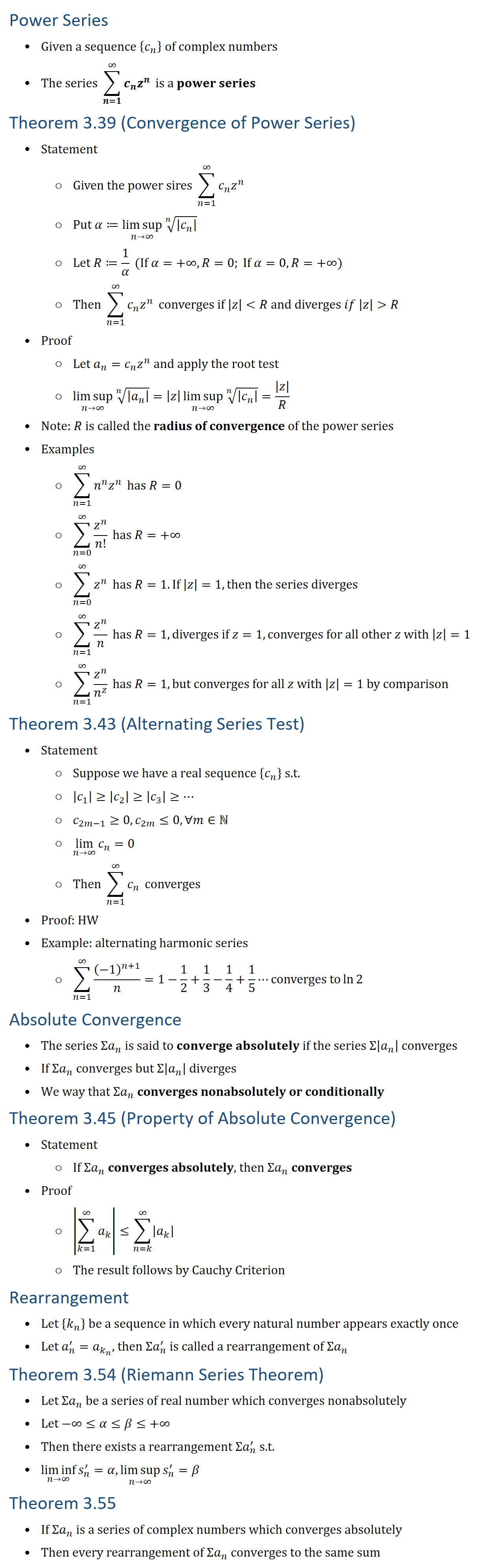
Power Series • Given a sequence {c_n } of complex numbers • The series ∑_(n=1)^∞▒〖c_n z^n 〗 is a power series Theorem 3.39 (Convergence of Power Series) • Statement ○ Given the power sires ∑_(n=1)^∞▒〖c_n z^n 〗 ○ Put α≔(limsup)_(n→∞)√(n&|c_n | ) ○ Let R≔1/α (If α=+∞,R=0; If α=0,R=+∞) ○ Then ∑_(n=1)^∞▒〖c_n z^n 〗 converges if |z| R and diverges if |z| R • Proof ○ Let a_n=c_n z^n and apply the root test ○ (limsup)_(n→∞)√(n&|a_n | )=|z| (limsup)_(n→∞)√(n&|c_n | )=|z|/R • Note: R is called the radius of convergence of the power series • Examples ○ ∑_(n=1)∞▒〖nn z^n 〗 has R=0 ○ ∑_(n=0)∞▒zn/n! has R=+∞ ○ ∑_(n=0)∞▒zn has R=1. If |z|=1, then the series diverges ○ ∑_(n=1)∞▒zn/n has R=1,diverges if z=1, converges for all other z with |z|=1 ○ ∑_(n=1)∞▒zn/n^z has R=1, but converges for all z with |z|=1 by comparison Theorem 3.43 (Alternating Series Test) • Statement ○ Suppose we have a real sequence {c_n } s.t. ○ |c_1 |≥|c_2 |≥|c_3 |≥… ○ c_(2m−1)≥0, c_2m≤0, ∀m∈N ○ lim_(n→∞)〖c_n 〗=0 ○ Then ∑_(n=1)^∞▒c_n converges • Proof: HW • Example: alternating harmonic series ○ ∑_(n=1)∞▒(−1)(n+1)/n=1−1/2+1/3−1/4+1/5⋯converges to ln2 Absolute Convergence • The series Σa_n is said to converge absolutely if the series Σ|a_n | converges • If Σa_n converges but Σ|a_n | diverges • We way that Σa_n converges nonabsolutely or conditionally Theorem 3.45 (Property of Absolute Convergence) • Statement ○ If Σa_n converges absolutely, then Σa_n converges • Proof ○ |∑_(k=1)^∞▒a_k |≤∑_(n=k)^∞▒|a_k | ○ The result follows by Cauchy Criterion Rearrangement • Let {k_n } be a sequence in which every natural number appears exactly once • Let a_n^′=a_(k_n ), then Σa_n^′ is called a rearrangement of Σa_n Theorem 3.54 (Riemann Series Theorem) • Let Σa_n be a series of real number which converges nonabsolutely • Let −∞≤α≤β≤+∞ • Then there exists a rearrangement Σa_n^′ s.t. • (liminf)_(n→∞)〖s_n^′ 〗=α, (limsup)_(n→∞)〖s_n^′ 〗=β Theorem 3.55 • If Σa_n is a series of complex numbers which converges absolutely • Then every rearrangement of Σa_n converges to the same sum