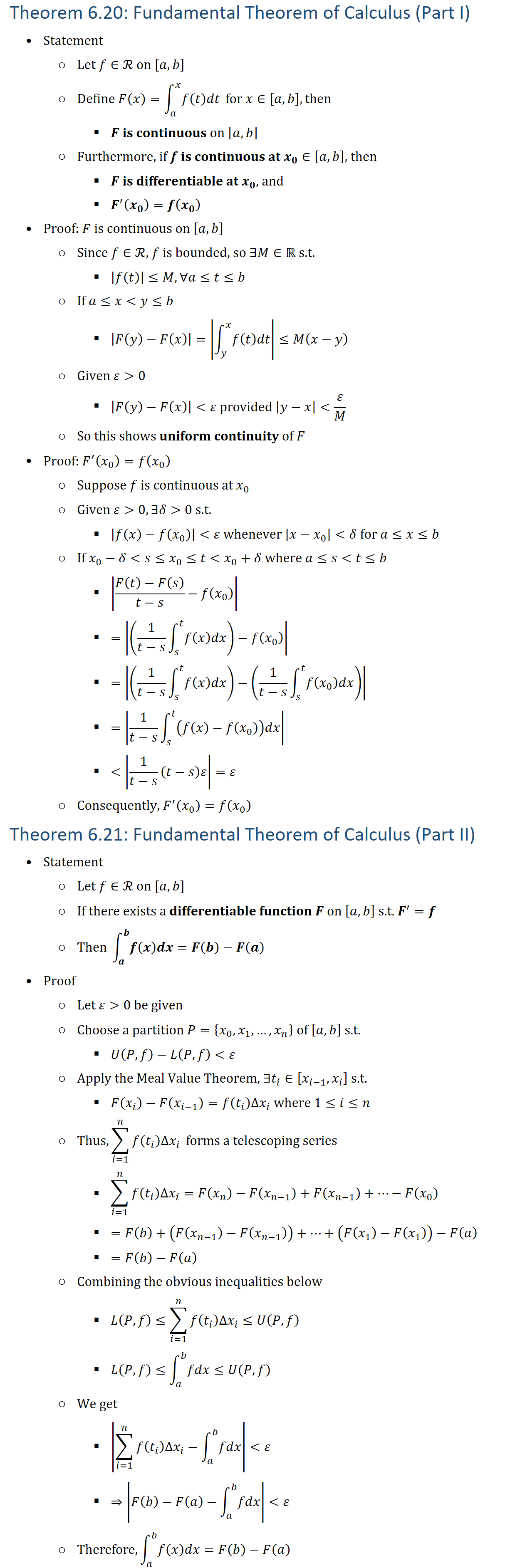
Theorem 6.20: Fundamental Theorem of Calculus (Part I) • Statement ○ Let f∈R on [a,b] ○ Define F(x)=∫_a^x▒f(t)dt for x∈[a,b], then § F is continuous on [a,b] ○ Furthermore, if f is continuous at x_0∈[a,b], then § F is differentiable at x_0, and § F^′ (x_0 )=f(x_0 ) • Proof: F is continuous on [a,b] ○ Since f∈R, f is bounded, so ∃M∈R s.t. § |f(t)|≤M,∀a≤t≤b ○ If a≤x y≤b § |F(y)−F(x)|=|∫_y^x▒f(t)dt|≤M(x−y) ○ Given ε 0 § |F(y)−F(x)| ε provided |y−x| ε/M ○ So this shows uniform continuity of F • Proof: F^′ (x_0 )=f(x_0 ) ○ Suppose f is continuous at x_0 ○ Given ε 0,∃δ 0 s.t. § |f(x)−f(x_0 )| ε whenever |x−x_0 | δ for a≤x≤b ○ If x_0−δ s≤x_0≤t x_0+δ where a≤s t≤b § |(F(t)−F(s))/(t−s)−f(x_0 )| § =|(1/(t−s) ∫_s^t▒f(x)dx)−f(x_0 )| § =|(1/(t−s) ∫_s^t▒f(x)dx)−(1/(t−s) ∫_s^t▒f(x_0 )dx)| § =|1/(t−s) ∫_s^t▒(f(x)−f(x_0 ))dx| § |1/(t−s) (t−s)ε|=ε ○ Consequently, F^′ (x_0 )=f(x_0 ) Theorem 6.21: Fundamental Theorem of Calculus (Part II) • Statement ○ Let f∈R on [a,b] ○ If there exists a differentiable function F on [a,b] s.t. F^′=f ○ Then ∫_a^b▒f(x)dx=F(b)−F(a) • Proof ○ Let ε 0 be given ○ Choose a partition P={x_0,x_1,…,x_n } of [a,b] s.t. § U(P,f)−L(P,f) ε ○ Apply the Meal Value Theorem, ∃t_i∈[x_(i−1),x_i ] s.t. § F(x_i )−F(x_(i−1) )=f(t_i )Δx_i where 1≤i≤n ○ Thus,∑_(i=1)^n▒〖f(t_i )Δx_i 〗 forms a telescoping series § ∑_(i=1)^n▒〖f(t_i )Δx_i 〗=F(x_n )−F(x_(n−1) )+F(x_(n−1) )+…−F(x_0 ) § =F(b)+(F(x_(n−1) )−F(x_(n−1) ))+…+(F(x_1 )−F(x_1 ))−F(a) § =F(b)−F(a) ○ Combining the obvious inequalities below § L(P,f)≤∑_(i=1)^n▒〖f(t_i )Δx_i 〗≤U(P,f) § L(P,f)≤∫_a^b▒fdx≤U(P,f) ○ We get § |∑_(i=1)^n▒〖f(t_i )Δx_i 〗−∫_a^b▒fdx| ε § ⇒|F(b)−F(a)−∫_a^b▒fdx| ε ○ Therefore, ∫_a^b▒f(x)dx=F(b)−F(a)