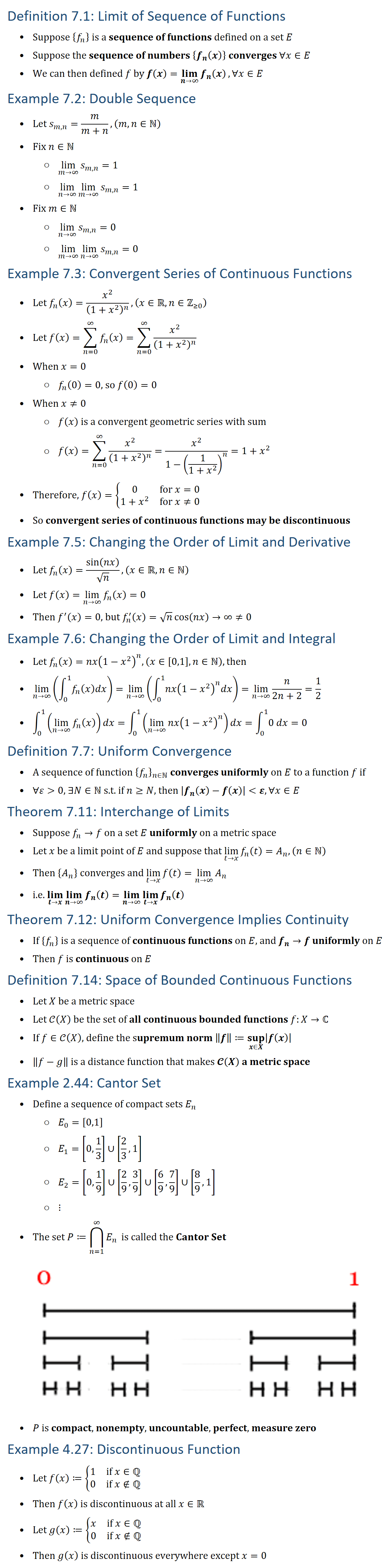
Definition 7.1: Limit of Sequence of Functions • Suppose {f_n } is a sequence of functions defined on a set E • Suppose the sequence of numbers {f_n (x)} converges ∀x∈E • We can then defined f by f(x)=(lim)┬(n→∞)〖f_n (x)〗,∀x∈E Example 7.2: Double Sequence • “Let” s_(m,n)=m/(m+n),(m,n∈N • Fix n∈N ○ lim┬(m→∞)〖s_(m,n) 〗=1 ○ lim┬(n→∞)lim┬(m→∞)〖s_(m,n) 〗 =1 • Fix m∈N ○ lim┬(n→∞)〖s_(m,n) 〗=0 ○ lim┬(m→∞)lim┬(n→∞)〖s_(m,n) 〗 =0 Example 7.3: Convergent Series of Continuous Functions • Let f_n (x)=x2/(1+x2 )^n ,(x∈Rn∈Z(≥0) ) • Let f(x)=∑_(n=0)^∞▒〖f_n (x) 〗=∑_(n=0)∞▒x2/(1+x^2 )^n • When x=0 ○ f_n (0)=0, so f(0)=0 • When x≠0 ○ f(x) is a convergent geometric series with sum ○ f(x)=∑_(n=0)∞▒x2/(1+x^2 )^n =x2/(1−(1/(1+x2 ))^n )=1+x^2 • Therefore, f(x)={■8(0&for x=0@1+x^2&for x≠0)┤ • So convergent series of continuous functions may be discontinuous Example 7.5: Changing the Order of Limit and Derivative • Let f_n (x)=sin(nx)/√n, (x∈Rn∈N • Let f(x)=lim┬(n→∞)〖f_n (x)〗=0 • Then f^′ (x)=0, but f_n^′ (x)=√n cos(nx)→∞≠0 Example 7.6: Changing the Order of Limit and Integral • Let f_n (x)=nx(1−x^2 )^n, (x∈[0,1],n∈N, then • lim┬(n→∞)(∫_0^1▒〖f_n (x)dx〗)=lim┬(n→∞)(∫_01▒〖nx(1−x2 )^n dx〗)=lim┬(n→∞)〖n/(2n+2)〗=1/2 • ∫_0^1▒(lim┬(n→∞)〖f_n (x)〗 ) dx=∫_01▒(lim┬(n→∞)〖nx(1−x2 )^n 〗 ) dx=∫_0^1▒〖0 dx〗=0 Definition 7.7: Uniform Convergence • A sequence of function {f_n }_(n∈N converges uniformly on E to a function f if • ∀ε 0, ∃N∈N s.t. if n≥N, then |f_n (x)−f(x)| ε,∀x∈E Theorem 7.11: Interchange of Limits • Suppose f_n→f on a set E uniformly on a metric space • Let x be a limit point of E and suppose that lim┬(t→x)〖f_n (t)〗=A_n,(n∈N • Then {A_n } converges and lim┬(t→x)f(t)=lim┬(n→∞)〖A_n 〗 • i.e. (lim)┬(t→x)(lim)┬(n→∞)〖f_n (t)〗 =(lim)┬(n→∞)(lim)┬(t→x)〖f_n (t)〗 Theorem 7.12: Uniform Convergence Implies Continuity • If {f_n } is a sequence of continuous functions on E, and f_n→f uniformly on E • Then f is continuous on E Definition 7.14: Space of Bounded Continuous Functions • Let X be a metric space • Let C(X) be the set of all continuous bounded functions f:X→ℂ • If f∈C(X), define the supremum norm ‖f‖≔(sup)┬(x∈X)|f(x)| • ‖f−g‖ is a distance function that makes C(X) a metric space Example 2.44: Cantor Set • Define a sequence of compact sets E_n ○ E_0=[0,1] ○ E_1=[0, 1/3]∪[2/3,1] ○ E_2=[0, 1/9]∪[2/9,3/9]∪[6/9,7/9]∪[8/9,1] ○ ⋮ • The set P≔⋂24_(n=1)^∞▒E_n is called the Cantor Set • P is compact, nonempty, uncountable, perfect, measure zero Example 4.27: Discontinuous Function • Let f(x)≔{■8(1&if x∈Q0&if x∉Q┤ • Then f(x) is discontinuous at all x∈R • Let g(x)≔{■8(x&if x∈Q0&if x∉Q┤ • Then g(x) is discontinuous everywhere except x=0