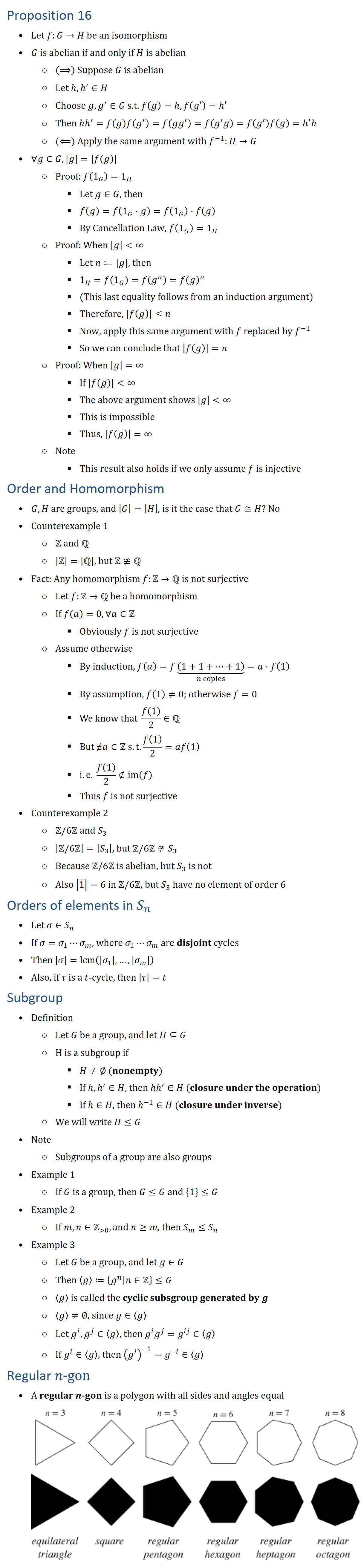
Proposition 16 • Let f:G→H be an isomorphism • G is abelian if and only if H is abelian ○ (⟹) Suppose G is abelian ○ Let h,h′∈H ○ Choose g,g^′∈G s.t. f(g)=h,f(g′)=h′ ○ Then hh′=f(g)f(g^′ )=f(gg^′ )=f(g^′ g)=f(g^′ )f(g)=h′ h ○ (⟸) Apply the same argument with f^(−1):H→G • ∀g∈G, |g|=|f(g)| ○ Proof: f(1_G )=1_H § Let g∈G, then § f(g)=f(1_G⋅g)=f(1_G )⋅f(g) § By Cancellation Law, f(1_G )=1_H ○ Proof: When |g| ∞ § Let n≔|g|, then § 1_H=f(1_G )=f(g^n )=f(g)^n § (This last equality follows from an induction argument) § Therefore, |f(g)|≤n § Now, apply this same argument with f replaced by f^(−1) § So we can conclude that |f(g)|=n ○ Proof: When |g|=∞ § If |f(g)| ∞ § The above argument shows |g| ∞ § This is impossible § Thus, |f(g)|=∞ ○ Note § This result also holds if we only assume f is injective Order and Homomorphism • G,H are groups, and |G|=|H|, is it the case that G≅H? No • Counterexample 1 ○ Z and Q ○ |Z=|Q, but Z≇Q • Fact: Any homomorphism f:Z→Q is not surjective ○ Let f:Z→Q be a homomorphism ○ If f(a)=0,∀a∈Z § Obviously f is not surjective ○ Assume otherwise § By induction, f(a)=f ⏟((1+1+…+1) )┬(n copies)=a⋅f(1) § By assumption, f(1)≠0; otherwise f=0 § We know that f(1)/2∈Q § But ∄a∈Z s.t. f(1)/2=af(1) § i.e. f(1)/2∉im(f) § Thus f is not surjective • Counterexample 2 ○ Z\6Z and S_3 ○ |Z6Z=|S_3 |, but Z\6Z≇S_3 ○ Because Z\6Z is abelian, but S_3 is not ○ Also |1 ̅ |=6 in Z\6Z, but S_3 have no element of order 6 Orders of elements in S_n • Let σ∈S_n • If σ=σ_1⋯σ_m, where σ_1⋯σ_m are disjoint cycles • Then |σ|=lcm(|σ_1 |,…,|σ_m |) • Also, if τ is a t-cycle, then |τ|=t Subgroup • Definition ○ Let G be a group, and let H⊆G ○ H is a subgroup if § H≠∅ (nonempty) § If h,h′∈H, then hh′∈H (closure under the operation) § If h∈H, then h(−1)∈H (closure under inverse) ○ We will write H≤G • Note ○ Subgroups of a group are also groups • Example 1 ○ If G is a group, then G≤G and {1}≤G • Example 2 ○ If m,n∈Z( 0), and n≥m, then S_m≤S_n • Example 3 ○ Let G be a group, and let g∈G ○ Then ⟨g⟩≔{g^n│n∈Z≤G ○ ⟨g⟩ is called the cyclic subsgroup generated by g ○ ⟨g⟩≠∅, since g∈⟨g⟩ ○ Let gi,gj∈⟨g⟩, then g^i gj=gij∈⟨g⟩ ○ If g^i∈⟨g⟩, then (g^i )(−1)=g(−i)∈⟨g⟩ Regular n\gon • A regular n\gon is a polygon with all sides and angles equal