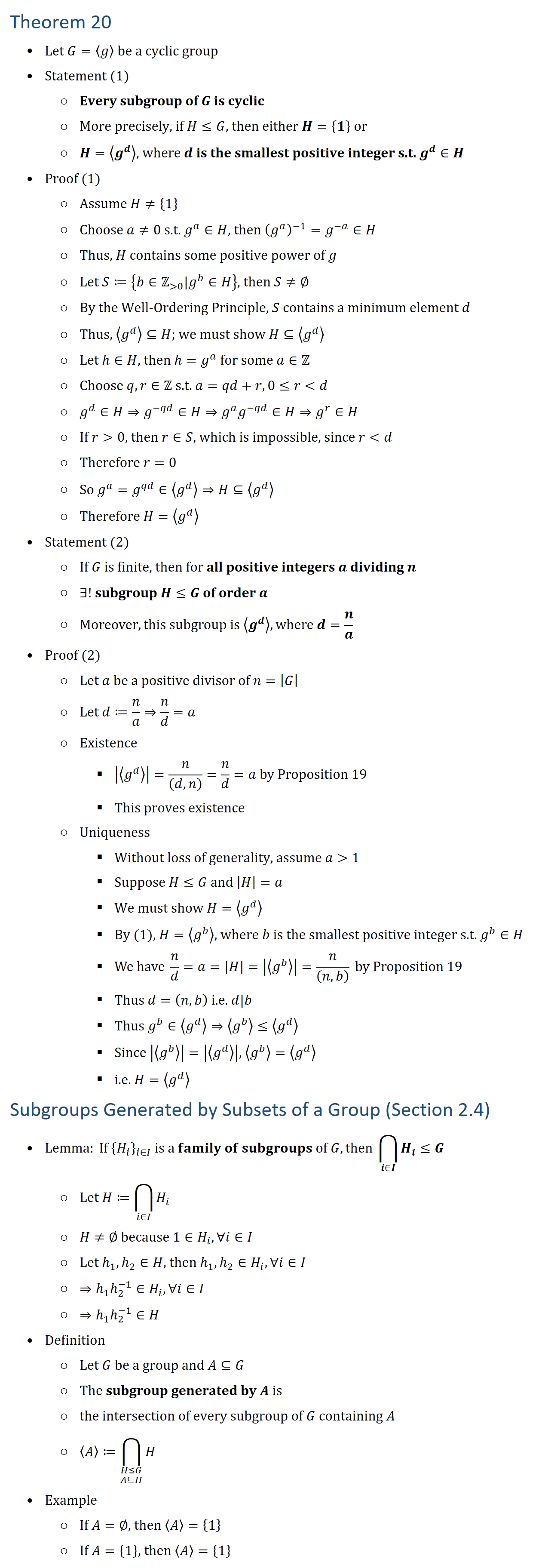
Theorem 20 • Let G=⟨g⟩ be a cyclic group • Statement (1) ○ Every subgroup of G is cyclic ○ More precisely, if H≤G, then either H={1} or ○ H=⟨g^d ⟩, where d is the smallest positive integer s.t. g^d∈H • Proof (1) ○ Assume H≠{1} ○ Choose a≠0 s.t. g^a∈H, then (g^a )(−1)=g(−a)∈H ○ Thus, H contains some positive power of g ○ Let S≔{b∈Z( 0) |g^b∈H}, then S≠∅ ○ By the Well-Ordering Principle, S contains a minimum element d ○ Thus, ⟨g^d ⟩⊆H; we must show H⊆⟨g^d ⟩ ○ Let h∈H, then h=g^a for some a∈Z ○ Choose q,r∈Z s.t. a=qd+r, 0≤r d ○ gd∈H⇒g(−qd)∈H⇒g^a g(−qd)∈H⇒gr∈H ○ If r 0, then r∈S, which is impossible, since r d ○ Therefore r=0 ○ So ga=gqd∈⟨g^d ⟩⇒H⊆⟨g^d ⟩ ○ Therefore H=⟨g^d ⟩ • Statement (2) ○ If G is finite, then for all positive integers a dividing n ○ ∃! subgroup H≤G of order a ○ Moreover, this subgroup is ⟨g^d ⟩, where d=n/a • Proof (2) ○ Let a be a positive divisor of n=|G| ○ Let d≔n/a⇒n/d=a ○ Existence § |⟨g^d ⟩|=n/((d,n) )=n/d=a by Proposition 19 § This proves existence ○ Uniqueness § Without loss of generality, assume a 1 § Suppose H≤G and |H|=a § We must show H=⟨g^d ⟩ § By (1), H=⟨g^b ⟩, where b is the smallest positive integer s.t. g^b∈H § We have n/d=a=|H|=|⟨g^b ⟩|=n/((n,b) ) by Proposition 19 § Thus d=(n,b) i.e. d|b § Thus gb∈⟨gd ⟩⇒⟨g^b ⟩≤⟨g^d ⟩ § Since |⟨g^b ⟩|=|⟨g^d ⟩|, ⟨g^b ⟩=⟨g^d ⟩ § i.e. H=⟨g^d ⟩ Subgroups Generated by Subsets of a Group (Section 2.4) • Lemma: If {H_i }_(i∈I) is a family of subgroups of G, then ⋂136_(i∈I)▒〖H_i≤G〗 ○ Let H≔⋂136_(i∈I)▒H_i ○ H≠∅ because 1∈H_i, ∀i∈I ○ Let h1,h2∈H, then h1,h2∈H_i, ∀i∈I ○ ⇒h1 h2^(−1)∈H_i,∀i∈I ○ ⇒h1 h2^(−1)∈H • Definition ○ Let G be a group and A⊆G ○ The subgroup generated by A is ○ the intersection of every subgroup of G containing A ○ ⟨A⟩≔⋂8_█(H≤G@A⊆H)▒H • Example ○ If A=∅, then ⟨A⟩={1} ○ If A={1}, then ⟨A⟩={1}