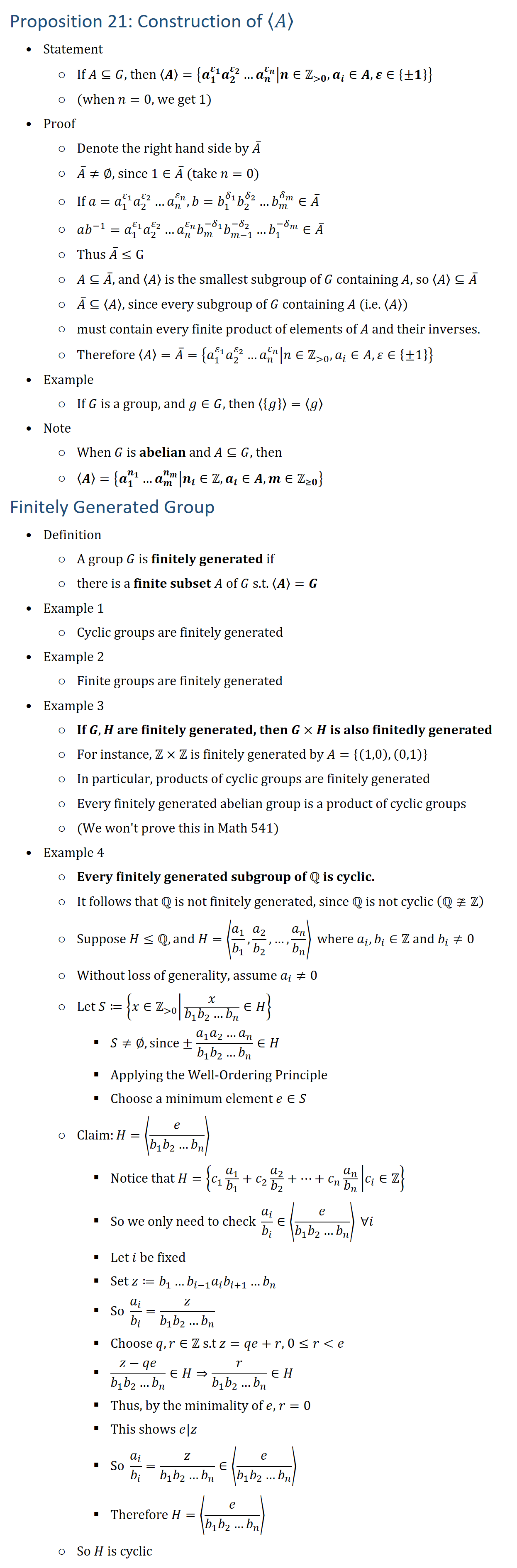
Proposition 21: Construction of ⟨A⟩ • Statement ○ If A⊆G, then ⟨A⟩={a_1^(ε_1 ) a_2^(ε_2 )…a_n^(ε_n )│n∈Z( 0),a_i∈A,ε∈{±1} } ○ (when n=0, we get 1) • Proof ○ Denote the right hand side by A ̅ ○ A ̅≠∅, since 1∈A ̅ (take n=0) ○ If a=a_1^(ε_1 ) a_2^(ε_2 )…a_n^(ε_n ),b=b_1^(δ_1 ) b_2^(δ_2 )…b_m^(δ_m )∈A ̅ ○ ab(−1)=a_1(ε_1 ) a_2^(ε_2 )…a_n^(ε_n ) b_m^(−δ_1 ) b_(m−1)^(−δ_2 )…b_1^(−δ_m )∈A ̅ ○ Thus A ̅≤G ○ A⊆A ̅, and ⟨A⟩ is the smallest subgroup of G containing A, so ⟨A⟩⊆A ̅ ○ A ̅⊆⟨A⟩, since every subgroup of G containing A (i.e. ⟨A⟩) ○ must contain every finite product of elements of A and their inverses. ○ Therefore ⟨A⟩=A ̅={a_1^(ε_1 ) a_2^(ε_2 )…a_n^(ε_n )│n∈Z( 0),a_i∈A,ε∈{±1} } • Example ○ If G is a group, and g∈G, then ⟨{g}⟩=⟨g⟩ • Note ○ When G is abelian and A⊆G, then ○ ⟨A⟩={a_1^(n_1 )…a_m^(n_m )│n_i∈Za_i∈A,m∈Z(≥0) } Finitely Generated Group • Definition ○ A group G is finitely generated if ○ there is a finite subset A of G s.t. ⟨A⟩=G • Example 1 ○ Cyclic groups are finitely generated • Example 2 ○ Finite groups are finitely generated • Example 3 ○ If G,H are finitely generated, then G×H is also finitedly generated ○ For instance, Z×Z is finitely generated by A={(1,0),(0,1)} ○ In particular, products of cyclic groups are finitely generated ○ Every finitely generated abelian group is a product of cyclic groups ○ (We won t prove this in Math 541) • Example 4 ○ Every finitely generated subgroup of Q is cyclic. ○ It follows that Q is not finitely generated, since Q is not cyclic (QZ ○ Suppose H≤Q, and H=⟨a_1/b_1 ,a_2/b_2 ,…,a_n/b_n ⟩ where a_i,b_i∈Z and b_i≠0 ○ Without loss of generality, assume a_i≠0 ○ Let S≔{x∈Z( 0)│x/(b_1 b_2…b_n )∈H} § S≠∅, since±(a_1 a_2…a_n)/(b_1 b_2…b_n )∈H § Applying the Well-Ordering Principle § Choose a minimum element e∈S ○ Claim:H=⟨e/(b_1 b_2…b_n )⟩ § Notice that H={c_1 a_1/b_1 +c_2 a_2/b_2 +…+c_n a_n/b_n │c_i∈Z § So we only need to check a_i/b_i ∈⟨e/(b_1 b_2…b_n )⟩ ∀i § Let i be fixed § Set z≔b_1…b_(i−1) a_i b_(i+1)…b_n § So a_i/b_i =z/(b_1 b_2…b_n ) § Choose q,r∈Z s.t z=qe+r, 0≤r e § (z−qe)/(b_1 b_2…b_n )∈H⇒r/(b_1 b_2…b_n )∈H § Thus, by the minimality of e, r=0 § This shows e|z § So a_i/b_i =z/(b_1 b_2…b_n )∈⟨e/(b_1 b_2…b_n )⟩ § Therefore H=⟨e/(b_1 b_2…b_n )⟩ ○ So H is cyclic