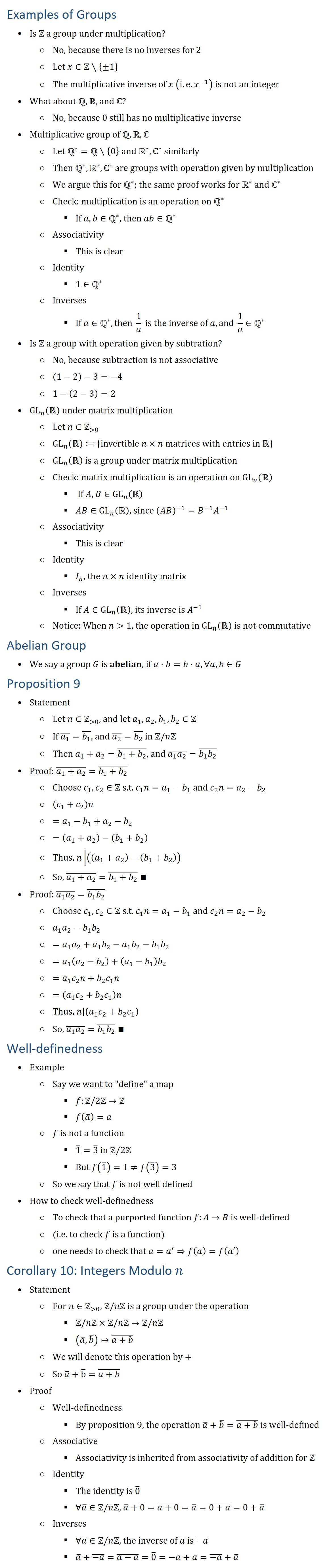
Examples of Groups • Is Z a group under multiplication? ○ No, because there is no inverses for 2 ○ Let x∈Z∖{±1} ○ The multiplicative inverse of x (i.e. 1/x) is not an integer • What about Q,R, and ℂ? ○ No, because 0 still has no multiplicative inverse • Multiplicative group of Q,R,ℂ ○ Let Q∗=Q∖{0} and R∗, ℂ^∗ similarly ○ Then Q∗,R∗,ℂ^∗ are groups with operation given by multiplication ○ We argue this for Q∗; the same proof works for R∗ and ℂ^∗ ○ Check: multiplication is an operation on Q∗ § If a,b∈Q∗, then ab∈Q∗ ○ Associativity § This is clear ○ Identity § 1∈Q∗ ○ Inverses § If a∈Q∗, then 1/a is the inverse of a, and 1/a∈Q∗ • Is Z a group with operation given by subtration? ○ No, because subtraction is not associative ○ (1−2)−3=−4 ○ 1−(2−3)=2 • GL_n (R under matrix multiplication ○ Let n∈Z( 0) ○ GL_n (R≔{invertible n×n matrices with entries in R ○ GL_n (R is a group under matrix multiplication ○ Check: matrix multiplication is an operation on GL_n (R § If A,B∈GL_n (R § AB∈GL_n (R, since (AB)(−1)=B(−1) A^(−1) ○ Associativity § This is clear ○ Identity § I_n, the n×n identity matrix ○ Inverses § If A∈GL_n (R, its inverse is A^(−1) ○ Notice: When n 1, the operation in GL_n (R is not commutative Abelian Group • We say a group G is abelian, if ∀a,b∈G, a⋅b=b⋅a Proposition 9 • Statement ○ Let n∈Z( 0), and let a_1,a_2,b_1,b_2∈Z ○ If (a_1 ) ̅=(b_1 ) ̅, and (a_2 ) ̅=(b_2 ) ̅ in Z\nZ ○ Then (a_1+a_2 ) ̅=(b_1+b_2 ) ̅, and (a_1 a_2 ) ̅=(b_1 b_2 ) ̅ • Proof: (a_1+a_2 ) ̅=(b_1+b_2 ) ̅ ○ Choose c_1,c_2∈Z s.t. c_1 n=a_1−b_1 and c_2 n=a_2−b_2 ○ (c_1+c_2 )n ○ =a_1−b_1+a_2−b_2 ○ =(a_1+a_2 )−(b_1+b_2 ) ○ Thus, ├ n┤|├ ((a_1+a_2 )−(b_1+b_2 ))┤ ○ So, (a_1+a_2 ) ̅=(b_1+b_2 ) ̅ ∎ • Proof: (a_1 a_2 ) ̅=(b_1 b_2 ) ̅ ○ Choose c_1,c_2∈Z s.t. c_1 n=a_1−b_1 and c_2 n=a_2−b_2 ○ a_1 a_2−b_1 b_2 ○ =a_1 a_2+a_1 b_2−a_1 b_2−b_1 b_2 ○ =a_1 (a_2−b_2 )+(a_1−b_1 ) b_2 ○ =a_1 c_2 n+b_2 c_1 n ○ =(a_1 c_2+b_2 c_1 )n ○ Thus, n|(a_1 c_2+b_2 c_1 ) ○ So, (a_1 a_2 ) ̅=(b_1 b_2 ) ̅ ∎ Well-definedness • Example ○ Say we want to “define” a map § f:Z\2Z→Z § f(a ̅ )=a ○ f is not a function § 1 ̅=3 ̅ in Z\2Z § But f(1 ̅ )=1≠f(3 ̅ )=3 ○ So we say that f is not well defined • How to check well-definedness ○ To check that a purported function f:A→B is well-defined ○ (i.e. to check f is a function) ○ one needs to check that a=a^′⇒f(a)=f(a′) Corollary 10 (Integers Modulo n) • Statement ○ If n∈Z( 0), Z\nZ is a group under the operation § Z\nZ×Z\nZ→Z\nZ § (a ̅,b ̅ )↦(a+b) ̅ ○ We will denote this operation by + ○ So a ̅+b ̅=(a+b) ̅ • Proof ○ Well-definedness § By proposition 9, the operation a ̅+b ̅=(a+b) ̅ is well-defined ○ Associative § Associativity is inherited from associativity of addition for Z ○ Identity § The identity is 0 ̅ § ∀a ̅∈Z\nZ, a ̅+0 ̅=(a+0) ̅=a ̅=(0+a) ̅=0 ̅+a ̅ ○ Inverses § ∀a ̅∈Z\nZ, the inverse of a ̅ is (−a) ̅ § a ̅+(−a) ̅=(a−a) ̅=0 ̅=(−a+a) ̅=(−a) ̅+a ̅