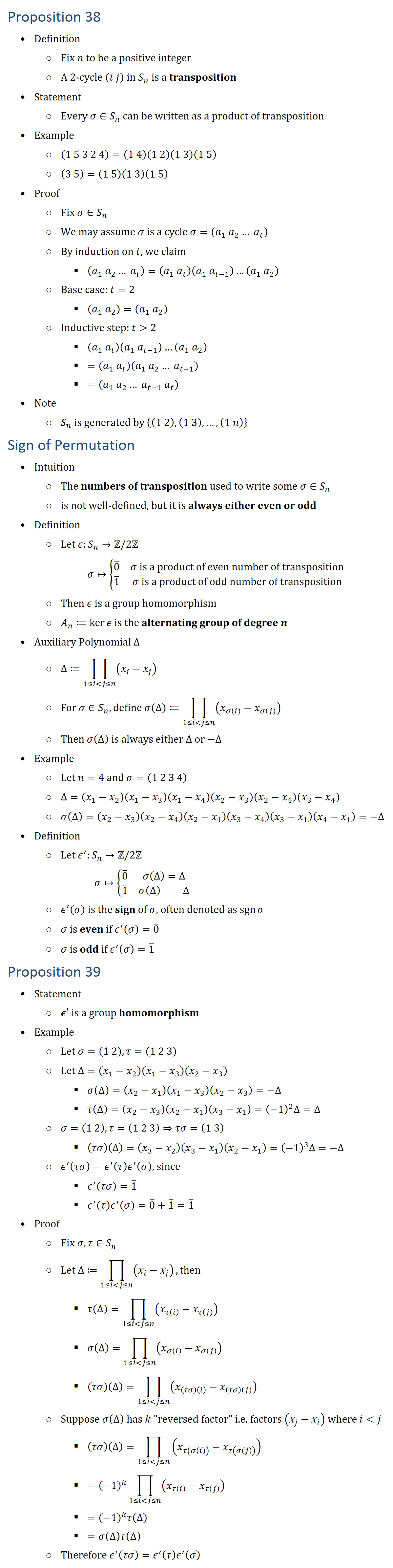
Proposition 38 • Definition ○ Fix n to be a positive integer ○ A 2\cycle (i j) in S_n is a transposition • Statement ○ Every σ∈S_n can be written as a product of transposition • Example ○ (1 5 3 2 4)=(1 4)(1 2)(1 3)(1 5) ○ (3 5)=(1 5)(1 3)(1 5) • Proof ○ Fix σ∈S_n ○ We may assume σ is a cycle σ=(a_1 a_2… a_t ) ○ By induction on t, we claim § (a_1 a_2… a_t )=(a_1 a_t )(a_1 a_(t−1) )…(a_1 a_2 ) ○ Base case: t=2 § (a_1 a_2 )=(a_1 a_2 ) ○ Inductive step: t 2 § (a_1 a_t )(a_1 a_(t−1) )…(a_1 a_2 ) § =(a_1 a_t )(a_1 a_2… a_(t−1) ) § =(a_1 a_2… a_(t−1) a_t ) • Note ○ S_n is generated by {(1 2),(1 3),…,(1 n)} Sign of Permutation • Intuition ○ The numbers of transposition used to write some σ∈S_n ○ is not well-defined, but it is always either even or odd • Definition ○ Let ϵ:S_n→Z\2Z σ↦{■8(0 ̅&σ is a product of even number of transposition@1 ̅&σ is a product of odd number of transposition)┤ ○ Then ϵ is a group homomorphism ○ A_n≔kerϵ is the alternating group of degree n • Auxiliary Polynomial Δ ○ Δ≔∏_(1≤i j≤n)▒(x_i−x_j ) ○ For σ∈S_n, define σ(Δ)≔∏_(1≤i j≤n)▒(x_σ(i) −x_σ(j) ) ○ Then σ(Δ) is always either Δ or −Δ • Example ○ Let n=4 and σ=(1 2 3 4) ○ Δ=(x_1−x_2 )(x_1−x_3 )(x_1−x_4 )(x_2−x_3 )(x_2−x_4 )(x_3−x_4 ) ○ σ(Δ)=(x_2−x_3 )(x_2−x_4 )(x_2−x_1 )(x_3−x_4 )(x_3−x_1 )(x_4−x_1 )=−Δ • Definition ○ Let ϵ^′:S_n→Z\2Z σ↦{■8(0 ̅&σ(Δ)=Δ@1 ̅&σ(Δ)=−Δ)┤ ○ ϵ^′ (σ) is the sign of σ, often denoted as sgnσ ○ σ is even if ϵ^′ (σ)=0 ̅ ○ σ is odd if ϵ^′ (σ)=1 ̅ Proposition 39 • Statement ○ ϵ′ is a group homomorphism • Example ○ Let σ=(1 2), τ=(1 2 3) ○ Let Δ=(x_1−x_2 )(x_1−x_3 )(x_2−x_3 ) § σ(Δ)=(x_2−x_1 )(x_1−x_3 )(x_2−x_3 )=−Δ § τ(Δ)=(x_2−x_3 )(x_2−x_1 )(x_3−x_1 )=(−1)^2 Δ=Δ ○ σ=(1 2), τ=(1 2 3)⇒τσ=(1 3) § (τσ)(Δ)=(x_3−x_2 )(x_3−x_1 )(x_2−x_1 )=(−1)^3 Δ=−Δ ○ ϵ^′ (τσ)=ϵ^′ (τ) ϵ^′ (σ), since § ϵ^′ (τσ)=1 ̅ § ϵ^′ (τ) ϵ^′ (σ)=0 ̅+1 ̅=1 ̅ • Proof ○ Fix σ,τ∈S_n ○ Let Δ≔∏_(1≤i j≤n)▒(x_i−x_j ) , then § τ(Δ)=∏_(1≤i j≤n)▒(x_τ(i) −x_τ(j) ) § σ(Δ)=∏_(1≤i j≤n)▒(x_σ(i) −x_σ(j) ) § (τσ)(Δ)=∏_(1≤i j≤n)▒(x_(τσ)(i) −x_(τσ)(j) ) ○ Suppose σ(Δ) has k “reversed factor” i.e. factors (x_j−x_i ) where i j § (τσ)(Δ)=∏_(1≤i j≤n)▒(x_τ(σ(i)) −x_τ(σ(j)) ) § =(−1)^k ∏_(1≤i j≤n)▒(x_τ(i) −x_τ(j) ) § =(−1)^k τ(Δ) § =σ(Δ)τ(Δ) ○ Therefore ϵ^′ (τσ)=ϵ^′ (τ) ϵ^′ (σ)