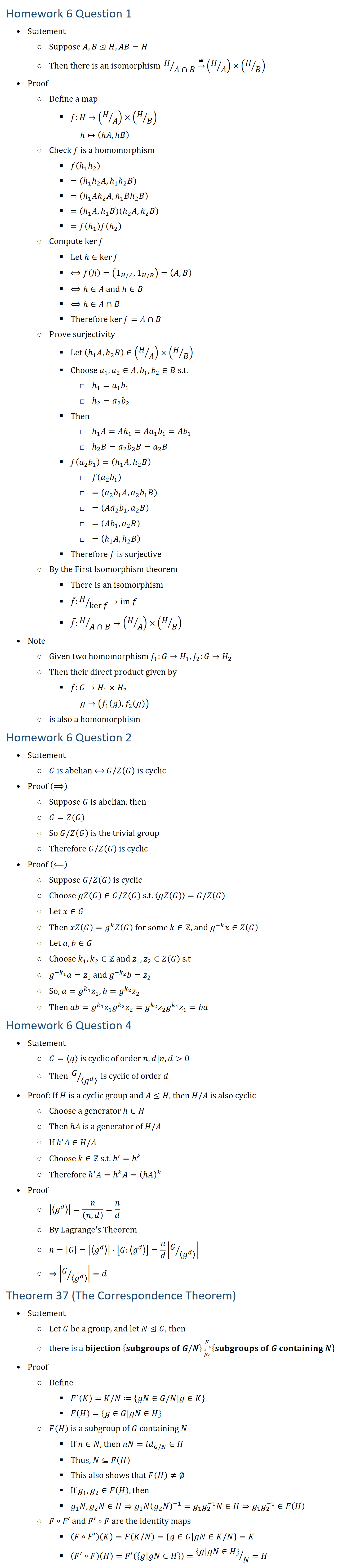
Homework 6 Question 1 • Statement ○ Suppose A,B⊴H, AB=H ○ Then there is an isomorphism H⁄(A∩B) →┴≅ (H⁄A)×(H⁄B) • Proof ○ Define a map § f:H→(H⁄A)×(H⁄B) h↦(h�,h�) ○ Check f is a homomorphism § f(h1 h2 ) § =(h1 h2 A,h1 h2 B) § =(h1 Ah2 A,h1 Bh2 B) § =(h1 A,h1 B)(h2 A,h2 B) § =f(h1 )f(h2 ) ○ Compute kerf § Let h∈kerf § ⟺f(h=(1_(H\A),1_(H\B) )=(A,B) § ⟺h∈A and h∈B § ⟺h∈A∩B § Therefore kerf=A∩B ○ Prove surjectivity § Let (h1 A,h2 B)∈(H⁄A)×(H⁄B) § Choose a_1,a_2∈A, b_1,b_2∈B s.t. □ h1=a_1 b_1 □ h2=a_2 b_2 § Then □ h1 A=Ah1=Aa_1 b_1=Ab_1 □ h2 B=a_2 b_2 B=a_2 B § f(a_2 b_1 )=(h1 A,h2 B) □ f(a_2 b_1 ) □ =(a_2 b_1 A,a_2 b_1 B) □ =(Aa_2 b_1,a_2 B) □ =(Ab_1,a_2 B) □ =(h1 A,h2 B) § Therefore f is surjective ○ By the First Isomorphism theorem § There is an isomorphism § f ̅:H⁄kerf →im f § f ̅:H⁄(A∩B)→(H⁄A)×(H⁄B) • Note ○ Given two homomorphism f_1:G→H_1, f_2:G→H_2 ○ Then their direct product given by § f:G→H_1×H_2 g→(f_1 (g),f_2 (g)) ○ is also a homomorphism Homework 6 Question 2 • Statement ○ G is abelian ⟺ G\Z(G) is cyclic • Proof (⟹) ○ Suppose G is abelian, then ○ G=Z(G) ○ So G\Z(G) is the trivial group ○ Therefore G\Z(G) is cyclic • Proof (⟸) ○ Suppose G\Z(G) is cyclic ○ Choose gZ(G)∈G\Z(G) s.t. ⟨gZ(G)⟩=G\Z(G) ○ Let x∈G ○ Then xZ(G)=g^k Z(G) for some k∈Z, and g^(−k) x∈Z(G) ○ Let a,b∈G ○ Choose k_1,k_2∈Z and z_1,z_2∈Z(G) s.t ○ g^(−k_1 ) a=z_1 and g^(−k_2 ) b=z_2 ○ So, a=g^(k_1 ) z_1, b=g^(k_2 ) z_2 ○ Then ab=g^(k_1 ) z_1 g^(k_2 ) z_2=g^(k_2 ) z_2 g^(k_1 ) z_1=ba Homework 6 Question 4 • Statement ○ G=⟨g⟩ is cyclic of order n, d|n, d 0 ○ Then G⁄⟨g^d ⟩ is cyclic of order d • Proof: If H is a cyclic group and A≤H, then H\A is also cyclic ○ Choose a generator h∈H ○ Then hA is a generator of H\A ○ If h′ A∈H\A ○ Choose k∈Z s.t. h′=hk ○ Therefore h′ A=hk A=(h�)^k • Proof ○ |⟨g^d ⟩|=n/((n,d) )=n/d ○ By Lagrange s Theorem ○ n=|G|=|⟨g^d ⟩|⋅[G:⟨g^d ⟩]=n/d |G⁄⟨g^d ⟩ | ○ ⇒|G⁄⟨g^d ⟩ |=d Theorem 37 (The Correspondence Theorem) • Statement ○ Let G be a group, and let N⊴G, then ○ there is a bijection {subgroups of G\N} (⇄┴F)┬F′ {subgroups of G containing N} • Proof ○ Define § F^′ (K)=K\N≔{gN∈G\N│g∈K} § F(H)={g∈G│gN∈H} ○ F(H) is a subgroup of G containing N § If n∈N, then nN=id_(G\N)∈H § Thus, N⊆F(H) § This also shows that F(H)≠∅ § If g_1,g_2∈F(H), then § g_1 N,g_2 N∈H⇒g_1 N(g_2 N)^(−1)=g_1 g_2^(−1) N∈H⇒g_1 g_2^(−1)∈F(H) ○ F∘F′ and F^′∘F are the identity maps § (F∘F^′ )(K)=F(K\N)={g∈G│gN∈K\N}=K § (F′∘F)(H)=F′ ({g│gN∈H})={g│gN∈H}⁄N=H