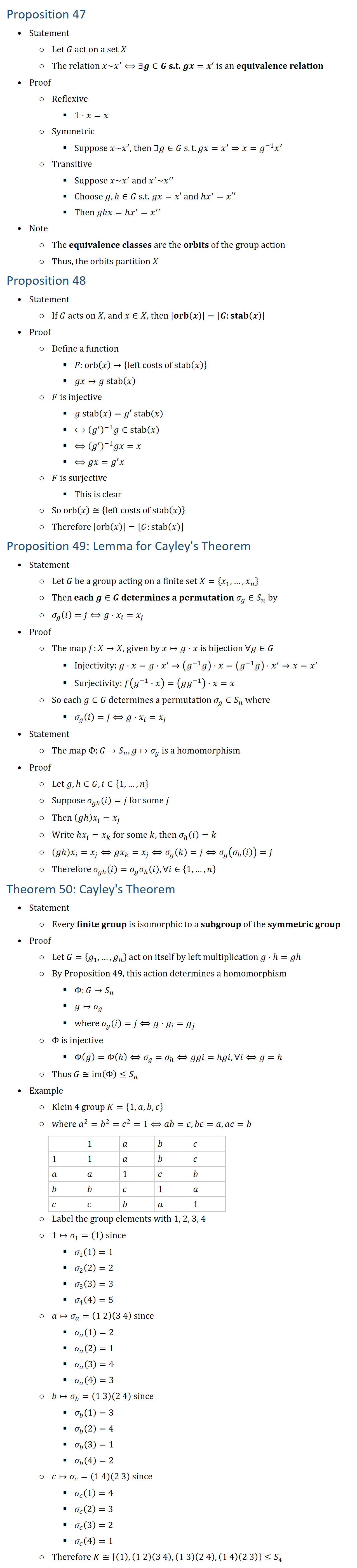
Proposition 47 • Statement ○ Let G act on a set X ○ The relation x~x^′⟺∃g∈G s.t. gx=x′ is an equivalence relation • Proof ○ Reflexive § 1⋅x=x ○ Symmetric § Suppose x~x^′, then ∃g∈G s.t. gx=x′⇒x=g(−1) x^′ ○ Transitive § Suppose x~x^′ and x′~x′′ § Choose g,h∈G s.t. gx=x′ and hx^′=x′′ § Then ghx=hx′=x′′ • Note ○ The equivalence classes are the orbits of the group action ○ Thus, the orbits partition X Proposition 48 • Statement ○ If G acts on X, and x∈X, then |orb(x)|=[G:stab(x)] • Proof ○ Define a function § F:orb(x)→{left costs of stab(x)} § gx↦g stab(x) ○ F is injective § g stab(x)=g′ stab(x) § ⟺(g^′ )^(−1) g∈stab(x) § ⟺(g^′ )^(−1) gx=x § ⟺gx=g^′ x ○ F is surjective § This is clear ○ So orb(x)≅{left costs of stab(x)} ○ Therefore |orb(x)|=[G:stab(x)] Proposition 49: Lemma for Cayley s Theorem • Statement ○ Let G be a group acting on a finite set X={x_1,…,x_n } ○ Then each g∈G determines a permutation σ_g∈S_n by ○ σ_g (i)=j⟺g⋅x_i=x_j • Proof ○ The map f:X→X, given by x↦g⋅x is bijection ∀g∈G § Injectivity: g⋅x=g⋅x′⇒(g(−1) g)⋅x=(g^(−1) g)⋅x′⇒x=x′ § Surjectivity: f(g(−1)⋅x)=(gg(−1) )⋅x=x ○ So each g∈G determines a permutation σ_g∈S_n where § σ_g (i)=j⟺g⋅x_i=x_j • Statement ○ The map Φ:G→S_n,g↦σ_g is a homomorphism • Proof ○ Let g,h∈G,i∈{1,…,n} ○ Suppose σ_gh(i)=j for some j ○ Then (gh x_i=x_j ○ Write hx_i=x_k for some k, then σ_h(i)=k ○ (gh x_i=x_j⟺gx_k=x_j⟺σ_g (k)=j⟺σ_g (σ_h(i))=j ○ Therefore σ_gh(i)=σ_g σ_h(i),∀i∈{1,…,n} Theorem 50: Cayley s Theorem • Statement ○ Every finite group is isomorphic to a subgroup of the symmetric group • Proof ○ Let G={g_1,…,g_n } act on itself by left multiplication g⋅h=gh ○ By Proposition 49, this action determines a homomorphism § Φ:G→S_n § g↦σ_g § where σ_g (i)=j⟺g⋅g_i=g_j ○ Φ is injective § Φ(g)=Φ(h⟺σ_g=σ_ℎ⟺ggi=hgi,∀i⟺g=h ○ Thus G≅im(Φ)≤S_n • Example ○ Klein 4 group K={1,a,b,c} ○ where a2=b2=c^2=1⟺ab=c,bc=a,ac=b 1 a b c 1 1 a b c a a 1 c b b b c 1 a c c b a 1 ○ Label the group elements with 1, 2, 3, 4 ○ 1↦σ_1=(1) since § σ_1 (1)=1 § σ_2 (2)=2 § σ_3 (3)=3 § σ_4 (4)=5 ○ a↦σ_a=(1 2)(3 4) since § σ_a (1)=2 § σ_a (2)=1 § σ_a (3)=4 § σ_a (4)=3 ○ b↦σ_b=(1 3)(2 4) since § σ_b (1)=3 § σ_b (2)=4 § σ_b (3)=1 § σ_b (4)=2 ○ c↦σ_c=(1 4)(2 3) since § σ_c (1)=4 § σ_c (2)=3 § σ_c (3)=2 § σ_c (4)=1 ○ Therefore K≅{(1),(1 2)(3 4),(1 3)(2 4),(1 4)(2 3)}≤S_4