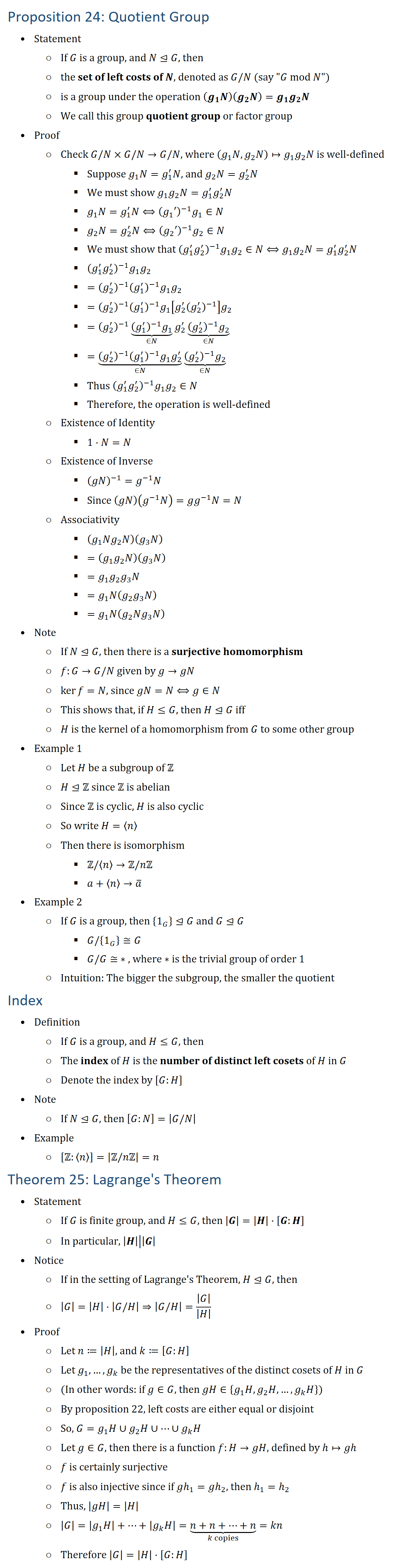
Proposition 24: Quotient Group • Statement ○ If G is a group, and N⊴G, then ○ the set of left costs of N, denoted as G\N (say “G mod N”) ○ is a group under the operation (g_1 N)(g_2 N)=g_1 g_2 N ○ We call this group quotient group or factor group • Proof ○ Check G\N×G\N→G\N, where (g_1 N,g_2 N)↦g_1 g_2 N is well-defined § Suppose g_1 N=g_1^′ N, and g_2 N=g_2^′ N § We must show g_1 g_2 N=g_1^′ g_2^′ N § g_1 N=g_1^′ N⟺(g_1′)^(−1) g_1∈N § g_2 N=g_2^′ N⟺(g_2′)^(−1) g_2∈N § We must show that (g_1^′ g_2^′ )^(−1) g_1 g_2∈N⟺g_1 g_2 N=g_1^′ g_2^′ N § (g_1^′ g_2^′ )^(−1) g_1 g_2 § =(g_2^′ )^(−1) (g_1^′ )^(−1) g_1 g_2 § =(g_2^′ )^(−1) (g_1^′ )^(−1) g_1 [g_2^′ (g_2^′ )^(−1) ] g_2 § =(g_2^′ )^(−1) ⏟((g_1^′ )^(−1) g_1 )┬(∈N) g_2^′ ⏟((g_2^′ )^(−1) g_2 )┬(∈N) § =⏟((g_2^′ )^(−1) (g_1^′ )^(−1) g_1 g_2^′ )┬(∈N) ⏟((g_2^′ )^(−1) g_2 )┬(∈N) § Thus (g_1^′ g_2^′ )^(−1) g_1 g_2∈N § Therefore, the operation is well-defined ○ Existence of Identity § 1⋅N=N ○ Existence of Inverse § (gN)(−1)=g(−1) N § Since (gN)(g^(−1) N)=gg^(−1) N=N ○ Associativity § (g_1 Ng_2 N)(g_3 N) § =(g_1 g_2 N)(g_3 N) § =g_1 g_2 g_3 N § =g_1 N(g_2 g_3 N) § =g_1 N(g_2 Ng_3 N) • Note ○ If N⊴G, then there is a surjective homomorphism ○ f:G→G\N given by g→gN ○ kerf=N, since gN=N⟺g∈N ○ This shows that, if H≤G, then H⊴G iff ○ H is the kernel of a homomorphism from G to some other group • Example 1 ○ Let H be a subgroup of Z ○ H⊴Z since Z is abelian ○ Since Z is cyclic, H is also cyclic ○ So write H=⟨n⟩ ○ Then there is isomorphism § Z\⟨n⟩→Z\nZ § a+⟨n⟩→a ̅ • Example 2 ○ If G is a group, then {1_G }⊴G and G⊴G § G\{1_G }≅G § G\G≅ ∗ , where ∗ is the trivial group of order 1 ○ Intuition: The bigger the subgroup, the smaller the quotient Index • Definition ○ If G is a group, and H≤G, then ○ The index of H is the number of distinct left cosets of H in G ○ Denote the index by [G:H] • Note ○ If N⊴G, then [G:N]=|G/N| • Example ○ [Z⟨n⟩]=|ZnZ=n Theorem 25: Lagranges Theorem • Statement ○ If G is finite group, and H≤G, then |G|=|H|⋅[G:H] ○ In particular, ├ |H|┤|├ |G|┤ • Notice ○ If in the setting of Lagranges Theorem, H⊴G, then ○ |G|=|H|⋅|G/H|⇒|G/H|=|G|/|H| • Proof ○ Let n≔|H|, and k≔[G:H] ○ Let g_1,…,g_k be the representatives of the distinct cosets of H in G ○ (In other words: if g∈G, then gH∈{g_1 H,g_2 H,…,g_k H}) ○ By proposition 22, left costs are either equal or disjoint ○ So, G=g_1 H∪g_2 H∪…∪g_k H ○ Let g∈G, then there is a function f:H→gH, defined by h↦gh ○ f is certainly surjective ○ f is also injective since if gh1=gh2, then h1=h2 ○ Thus, |gH|=|H| ○ |G|=|g_1 H|+…+|g_k H|=⏟(n+n+…+n)┬(k copies)=kn ○ Therefore |G|=|H|⋅[G:H]