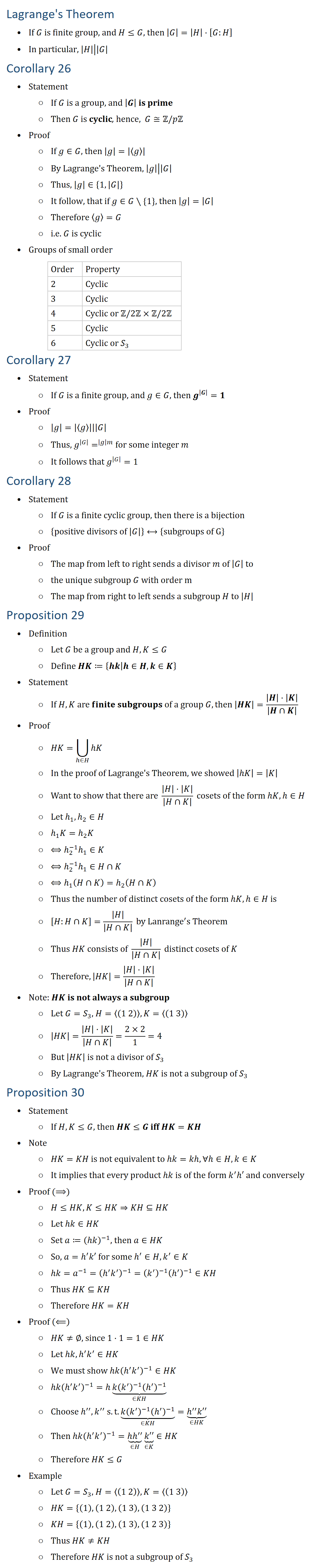
Lagrange s Theorem • If G is finite group, and H≤G, then |G|=|H|⋅[G:H] • In particular, ├ |H|┤|├ |G|┤ Corollary 26 • Statement ○ If G is a group, and |G| is prime ○ Then G is cyclic, hence, G≅Z\pZ • Proof ○ If g∈G, then |g|=|⟨g⟩| ○ By Lagrange s Theorem, ├ |g|┤|├ |G|┤ ○ Thus, |g|∈{1,|G|} ○ It follow, that if g∈G∖\1}, then |g|=|G| ○ Therefore ⟨g⟩=G ○ i.e. G is cyclic • Groups of small order Order Property 2 Cyclic 3 Cyclic 4 Cyclic or Z\2Z×Z\2Z 5 Cyclic 6 Cyclic or S_3 Corollary 27 • Statement ○ If G is a finite group, and g∈G, then g^|G| =1 • Proof ○ ├ |g|=|⟨g⟩|┤|├ |G|┤ ○ Thus, g^|G| =^|g|m for some integer m ○ It follows that g^|G| =1 Corollary 28 • Statement ○ If G is a finite cyclic group, then there is a bijection ○ {positive divisors of |G|}⟷{subgroups of G} • Proof ○ The map from left to right sends a divisor m of |G| to ○ the unique subgroup G with order m ○ The map from right to left sends a subgroup H to |H| Proposition 29 • Definition ○ Let G be a group and H,K≤G ○ Define HK≔{hk│h∈H,k∈K} • Statement ○ If H,K are finite subgroups of a group G, then |HK|=(|H|⋅|K|)/|H∩K| • Proof ○ HK=⋃8_(hH)▒h� ○ In the proof of Lagrange s Theorem, we showed |h�|=|K| ○ Want to show that there are (|H|⋅|K|)/|H∩K| cosets of the form hK, h∈H ○ Let h1,h2∈H ○ h1 K=h2 K ○ ⟺h2^(−1) h1∈K ○ ⟺h2^(−1) h1∈H∩K ○ ⟺h1 (H∩K)=h2 (H∩K) ○ Thus the number of distinct cosets of the form hK,h∈H is ○ [H:H∩K]=|H|/|H∩K| by Lanrange^′ s Theorem ○ Thus HK consists of |H|/|H∩K| distinct cosets of K ○ Therefore, |HK|=(|H|⋅|K|)/|H∩K| • Note: HK is not always a subgroup ○ Let G=S_3, H=⟨(1 2)⟩, K=⟨(1 3)⟩ ○ |HK|=(|H|⋅|K|)/|H∩K| =(2×2)/1=4 ○ But |HK| is not a divisor of S_3 ○ By Lagrange s Theorem, HK is not a subgroup of S_3 Proposition 30 • Statement ○ If H,K≤G, then HK≤G iff HK=KH • Note ○ HK=KH is not equivalent to hk=kh, ∀h∈H,k∈K ○ It implies that every product hk is of the form k^′ h′ and conversely • Proof (⟹) ○ H≤HK, K≤HK⇒KH⊆HK ○ Let hk∈HK ○ Set a≔(h�)^(−1), then a∈HK ○ So, a=h′ k′ for some h′∈H,k^′∈K ○ hk=a^(−1)=(h′ k^′ )(−1)=(k′ )^(−1) (h′ )^(−1)∈KH ○ Thus HK⊆KH ○ Therefore HK=KH • Proof (⟸) ○ HK≠∅, since 1⋅1=1∈HK ○ Let hk,h′ k^′∈HK ○ We must show hk(h′ k^′ )^(−1)∈HK ○ hk(h′ k^′ )^(−1)=h ⏟(k(k^′ )^(−1) (h′ )^(−1) )┬(∈KH) ○ Choose h′′,k^′′ s.t. ⏟(k(k^′ )^(−1) (h′ )^(−1) )┬(∈KH)=⏟(h′′ k′′)┬(∈HK) ○ Then hk(h′ k^′ )(−1)=⏟(h′′ )┬(∈H) ⏟(k′′)┬(∈K)∈HK ○ Therefore HK≤G • Example ○ Let G=S_3, H=⟨(1 2)⟩, K=⟨(1 3)⟩ ○ HK={(1),(1 2),(1 3),(1 3 2)} ○ KH={(1),(1 2),(1 3),(1 2 3)} ○ Thus HK≠KH ○ Therefore HK is not a subgroup of S_3