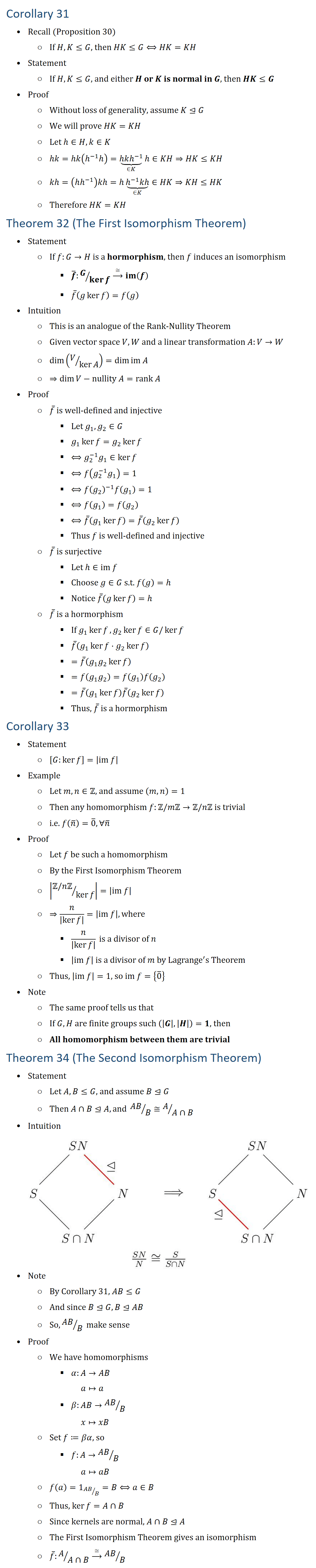
Corollary 31 • Recall (Proposition 30) ○ If H,K≤G, then HK≤G⟺HK=KH • Statement ○ If H,K≤G, and either H or K is normal in G, then HK≤G • Proof ○ Without loss of generality, assume K⊴G ○ We will prove HK=KH ○ Let h∈H,k∈K ○ hk=hk(h(−1) h=⏟(h�h(−1) )┬(∈K) h∈KH⇒HK≤KH ○ kh=(h^(−1) )kh=h ⏟(h(−1) kh┬(∈K)∈HK⇒KH≤HK ○ Therefore HK=KH Theorem 32 (The First Isomorphism Theorem) • Statement ○ If f:G→H is a hormorphism, then f induces an isomorphism § f ̅:G⁄kerf ⟶┴≅ im(f) § f ̅(g kerf )=f(g) • Intuition ○ This is an analogue of the Rank-Nullity Theorem ○ Given vector space V,W and a linear transformation A:V→W ○ dim(V⁄kerA )=dim〖im A〗 ○ ⇒dimV−nullity A=rank A • Proof ○ f ̅ is well-defined and injective § Let g_1,g_2∈G § g_1 kerf=g_2 kerf § ⟺g_2^(−1) g_1∈kerf § ⟺f(g_2^(−1) g_1 )=1 § ⟺f(g_2 )^(−1) f(g_1 )=1 § ⟺f(g_1 )=f(g_2 ) § ⟺f ̅(g_1 kerf )=f ̅(g_2 kerf ) § Thus f is well-defined and injective ○ f ̅ is surjective § Let h∈im f § Choose g∈G s.t. f(g)=h § Notice f ̅(g kerf )=h ○ f ̅ is a hormorphism § If g_1 kerf,g_2 kerf∈G\kerf § f ̅(g_1 kerf⋅g_2 kerf ) § =f ̅(g_1 g_2 kerf ) § =f(g_1 g_2 )=f(g_1 )f(g_2 ) § =f ̅(g_1 kerf ) f ̅(g_2 kerf ) § Thus, f ̅ is a hormorphism Corollary 33 • Statement ○ [G:kerf ]=|im f| • Example ○ Let m,n∈Z, and assume (m,n)=1 ○ Then any homomorphism f:Z\mZ→Z\nZ is trivial ○ i.e. f(n ̅ )=0 ̅, ∀n ̅ • Proof ○ Let f be such a homomorphism ○ By the First Isomorphism Theorem ○ |(ZnZ⁄kerf |=|im f| ○ ⇒n/|kerf | =|im f|, where § n/|kerf | is a divisor of n § |im f| is a divisor of m by Lagrange^′ s Theorem ○ Thus, |im f|=1, so im f={0 ̅ } • Note ○ The same proof tells us that ○ If G,H are finite groups such (|G|,|H|)=1, then ○ All homomorphism between them are trivial Theorem 34 (The Second Isomorphism Theorem) • Statement ○ Let A,B≤G, and assume B⊴G ○ Then A∩B⊴A, and AB⁄B≅A⁄(A∩B) • Intuition • Note ○ By Corollary 31, AB≤G ○ And since B⊴G, B⊴AB ○ So, AB⁄B make sense • Proof ○ We have homomorphisms § α:A→AB a↦a § β:AB→AB⁄B x↦xB ○ Set f≔βα, so § f:A→AB⁄B a↦aB ○ f(a)=1_(AB⁄B)=B⟺a∈B ○ Thus, kerf=A∩B ○ Since kernels are normal, A∩B⊴A ○ The First Isomorphism Theorem gives an isomorphism ○ f ̅:A⁄(A∩B) ⟶┴≅ AB⁄B