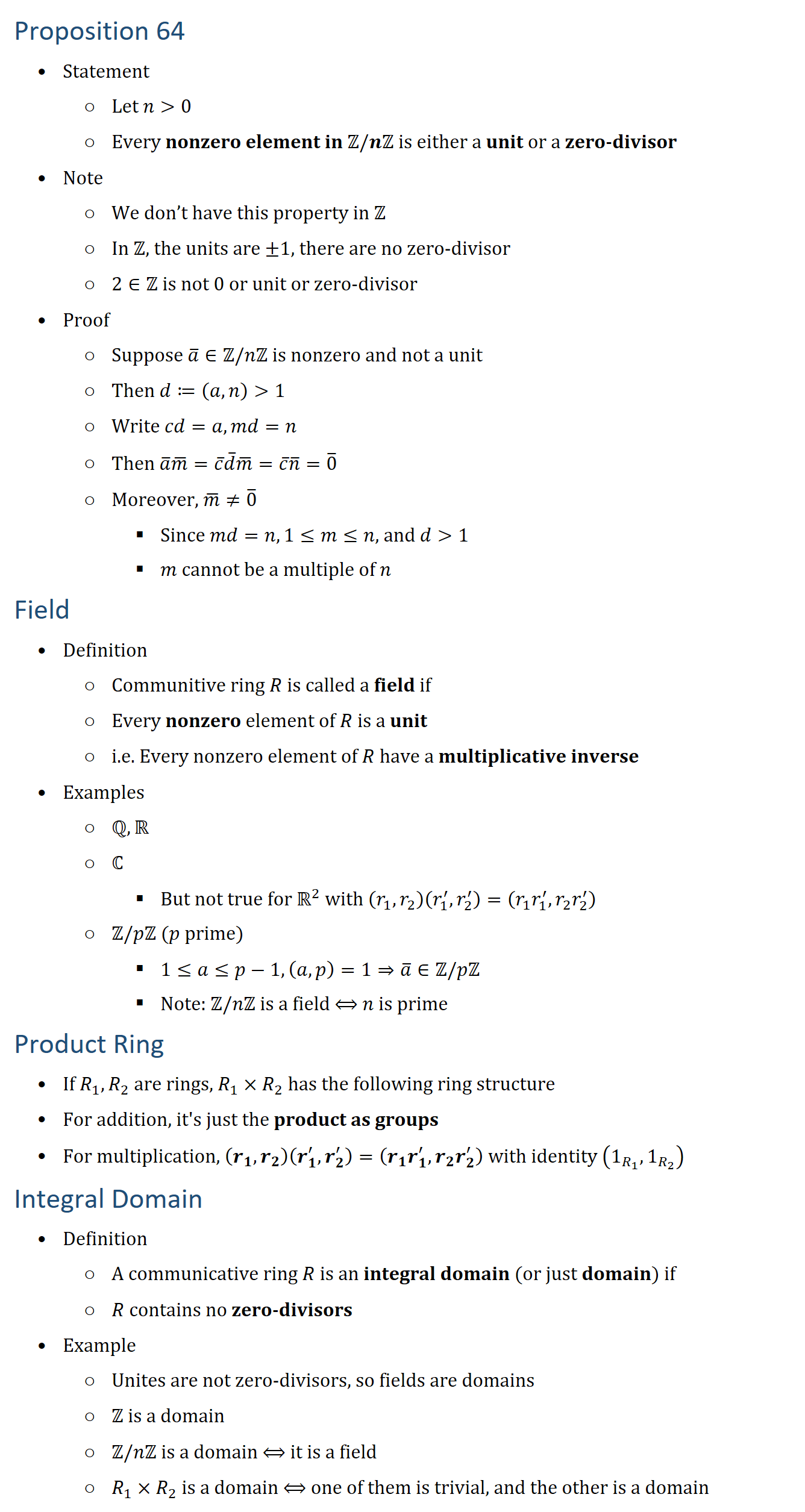
Proposition 64 • Statement ○ Let n 0 ○ Every nonzero element in Z\nZ is either a unit or a zero-divisor • Note ○ We don’t have this property in Z ○ In Z, the units are ±1, there are no zero-divisor ○ 2∈Z is not 0 or unit or zero-divisor • Proof ○ Suppose a ̅∈Z\nZ is nonzero and not a unit ○ Then d≔(a,n) 1 ○ Write cd=a,md=n ○ Then a ̅m ̅=c ̅d ̅m ̅=c ̅n ̅=0 ̅ ○ Moreover, m ̅≠0 ̅ § Since md=n,1≤m≤n, and d 1 § m cannot be a multiple of n Field • Definition ○ Communitive ring R is called a field if ○ Every nonzero element of R is a unit ○ i.e. Every nonzero element of R have a multiplicative inverse • Examples ○ Q,R ○ ℂ § But not true for R2 with (r_1,r_2 )(r_1′,r_2′ )=(r_1 r_1^′,r_2 r_2^′ ) ○ Z\pZ (p prime) § 1≤a≤p−1,(a,p)=1⇒a ̅∈Z\pZ § Note: Z\nZ is a field ⟺ n is prime Product Ring • If R_1,R_2 are rings, R_1×R_2 has the following ring structure • For addition, it s just the product as groups • For multiplication, (r_1,r_2 )(r_1′,r_2′ )=(r_1 r_1^′,r_2 r_2^′ ) with identity (1_(R_1 ),1_(R_2 ) ) Integral Domain • Definition ○ A communicative ring R is an integral domain (or just domain) if ○ R contains no zero-divisors • Example ○ Unites are not zero-divisors, so fields are domains ○ Z is a domain ○ Z\nZ is a domain ⟺ it is a field ○ R_1×R_2 is a domain ⟺ one of them is trivial, and the other is a domain