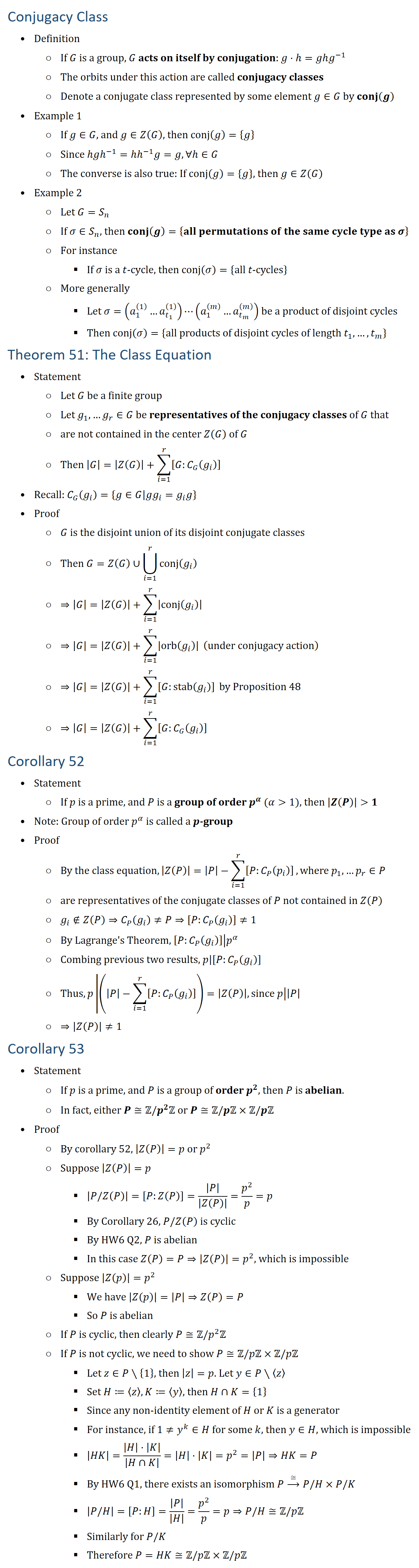
Conjugacy Class • Definition ○ If G is a group, G acts on itself by conjugation: g⋅h=ghg^(−1) ○ The orbits under this action are called conjugacy classes ○ Denote a conjugate class represented by some element g∈G by conj(g) • Example 1 ○ If g∈G, and g∈Z(G), then conj(g)={g} ○ Since hgh(−1)=hh(−1) g=g, ∀h∈G ○ The converse is also true: If conj(g)={g}, then g∈Z(G) • Example 2 ○ Let G=S_n ○ If σ∈S_n, then conj(g)={all permutations of the same cycle type as σ} ○ For instance § If σ is a t-cycle, then conj(σ)={all t-cycles} ○ More generally § Let σ=(a_1^((1) )…a_(t_1)^((1) ) )⋯(a_1^((m) )…a_(t_m)^((m) ) ) be a product of disjoint cycles § Then conj(σ)={all products of disjoint cycles of length t_1,…,t_m } Theorem 51: The Class Equation • Statement ○ Let G be a finite group ○ Let g_1,…g_r∈G be representatives of the conjugacy classes of G that ○ are not contained in the center Z(G) of G ○ Then |G|=|Z(G)|+∑_(i=1)^r▒[G:C_G (g_i )] • Recall: C_G (g_i )={g∈G│gg_i=g_i g} • Proof ○ G is the disjoint union of its disjoint conjugate classes ○ Then G=Z(G)∪⋃24_(i=1)^r▒conj(g_i ) ○ ⇒|G|=|Z(G)|+∑_(i=1)^r▒|conj(g_i )| ○ ⇒|G|=|Z(G)|+∑_(i=1)^r▒|orb(g_i )| (under conjugacy action) ○ ⇒|G|=|Z(G)|+∑_(i=1)^r▒[G:stab(g_i )] by Proposition 48 ○ ⇒|G|=|Z(G)|+∑_(i=1)^r▒[G:C_G (g_i )] Corollary 52 • Statement ○ If p is a prime, and P is a group of order p^α (α 1), then |Z(P)| 1 • Note: Group of order p^α is called a p-group • Proof ○ By the class equation, |Z(P)|=|P|−∑_(i=1)^r▒[P:C_P (p_i )] , where p_1,…p_r∈P ○ are representatives of the conjugate classes of P not contained in Z(P) ○ g_i∉Z(P)⇒C_P (g_i )≠P⇒[P:C_P (g_i )]≠1 ○ By Lagrange s Theorem, ├ [P:C_P (g_i )]┤ |p^α ┤ ○ Combing previous two results, ├ p┤|├ [P:C_P (g_i )]┤ ○ Thus, ├ p┤ |(|P|−∑_(i=1)^r▒[P:C_P (g_i )] )┤=|Z(P)|, since ├ p┤ ||P|┤ ○ ⇒|Z(P)|≠1 Corollary 53 • Statement ○ If p is a prime, and P is a group of order p^2, then P is abelian. ○ In fact, either P≅Z\p^2 Z or P≅Z\pZ×Z\pZ • Proof ○ By corollary 52, |Z(P)|=p or p^2 ○ Suppose |Z(P)|=p § |P/Z(P)|=[P:Z(P)]=|P|/|Z(P)| =p^2/p=p § By Corollary 26, P\Z(P) is cyclic § By HW6 Q2, P is abelian § In this case Z(P)=P⇒|Z(P)|=p^2, which is impossible ○ Suppose |Z(p)|=p^2 § We have |Z(p)|=|P|⇒Z(P)=P § So P is abelian ○ If P is cyclic, then clearly P≅Z\p^2 Z ○ If P is not cyclic, we need to show P≅Z\pZ×Z\pZ § Let z∈P∖{1}, then |z|=p. Let y∈P∖⟨z⟩ § Set H≔⟨z⟩,K≔⟨y⟩, then H∩K={1} § Since any non-identity element of H or K is a generator § For instance, if 1≠y^k∈H for some k, then y∈H, which is impossible § |HK|=(|H|⋅|K|)/|H∩K| =|H|⋅|K|=p^2=|P|⇒HK=P § By HW6 Q1, there exists an isomorphism P ⟶┴≅ P\H×P\K § |P/H|=[P:H]=|P|/|H| =p^2/p=p⇒P\H≅Z\pZ § Similarly for P\K § Therefore P=HK≅Z\pZ×Z\pZ