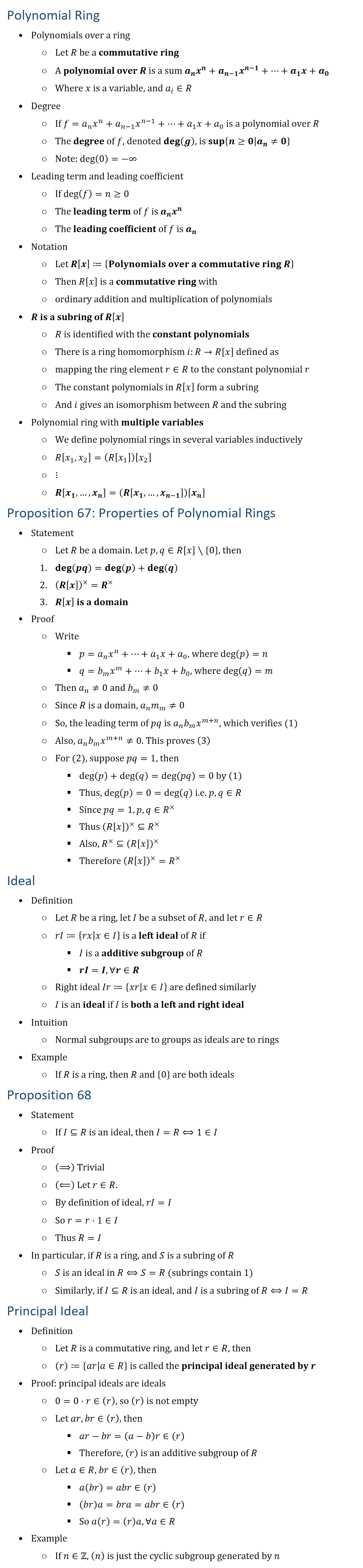
Polynomial Ring • Polynomials over a ring ○ Let R be a commutative ring ○ A polynomial over R is a sum a_n x^n+a_(n−1) x^(n−1)+…+a_1 x+a_0 ○ Where x is a variable, and a_i∈R • Degree ○ If f=a_n x^n+a_(n−1) x^(n−1)+…+a_1 x+a_0 is a polynomial over R ○ The degree of f, denoted deg(g), is sup{n≥0│a_n≠0} ○ Note: deg(0)=−∞ • Leading term and leading coefficient ○ If deg(f)=n≥0 ○ The leading term of f is a_n x^n ○ The leading coefficient of f is a_n • Notation ○ Let R[x]≔{Polynomials over a commutative ring R} ○ Then R[x] is a commutative ring with ○ ordinary addition and multiplication of polynomials • R is a subring of R[x] ○ R is identified with the constant polynomials ○ There is a ring homomorphism i:R→R[x] defined as ○ mapping the ring element r∈R to the constant polynomial r ○ The constant polynomials in R[x] form a subring ○ And i gives an isomorphism between R and the subring • Polynomial ring with multiple variables ○ We define polynomial rings in several variables inductively ○ R[x_1,x_2 ]=(R[x_1 ])[x_2 ] ○ ⋮ ○ R[x_1,…,x_n ]=(R[x_1,…,x_(n−1) ])[x_n ] Proposition 67: Properties of Polynomial Rings • Statement ○ Let R be a domain. Let p,q∈R[x]∖{0}, then 1. deg(pq)=deg(p)+deg(q) 2. (R[x])×=R× 3. R[x] is a domain • Proof ○ Write § p=a_n x^n+…+a_1 x+a_0, where deg(p)=n § q=b_m x^m+…+b_1 x+b_0, where deg(q)=m ○ Then a_n≠0 and b_m≠0 ○ Since R is a domain, a_n m_m≠0 ○ So, the leading term of pq is a_n b_m x^(m+n), which verifies (1) ○ Also, a_n b_m x^(m+n)≠0. This proves (3) ○ For (2), suppose pq=1, then § deg(p)+deg(q)=deg(pq)=0 by (1) § Thus, deg(p)=0=deg(q) i.e. p,q∈R § Since pq=1, p,q∈R^× § Thus (R[x])×⊆R× § Also, R×⊆(R[x])× § Therefore (R[x])×=R× Ideal • Definition ○ Let R be a ring, let I be a subset of R, and let r∈R ○ rI≔{rx│x∈I} is a left ideal of R if § I is a additive subgroup of R § rI=I, ∀r∈R ○ Right ideal Ir≔{xr│x∈I} are defined similarly ○ I is an ideal if I is both a left and right ideal • Intuition ○ Normal subgroups are to groups as ideals are to rings • Example ○ If R is a ring, then R and {0} are both ideals Proposition 68 • Statement ○ If I⊆R is an ideal, then I=R⟺1∈I • Proof ○ (⟹) Trivial ○ (⟸) Let r∈R. ○ By definition of ideal, rI=I ○ So r=r⋅1∈I ○ Thus R=I • In particular, if R is a ring, and S is a subring of R ○ S is an ideal in R⟺S=R (subrings contain 1) ○ Similarly, if I⊆R is an ideal, and I is a subring of R⟺I=R Principal Ideal • Definition ○ Let R is a commutative ring, and let r∈R, then ○ (r)≔{ar│a∈R} is called the principal ideal generated by r • Proof: principal ideals are ideals ○ 0=0⋅r∈(r), so (r) is not empty ○ Let ar,br∈(r), then § ar−br=(a−b)r∈(r) § Therefore, (r) is an additive subgroup of R ○ Let a∈R, br∈(r), then § a(br)=abr∈(r) § (br)a=bra=abr∈(r) § So a(r)=(r)a,∀a∈R • Example ○ If n∈Z, (n) is just the cyclic subgroup generated by n