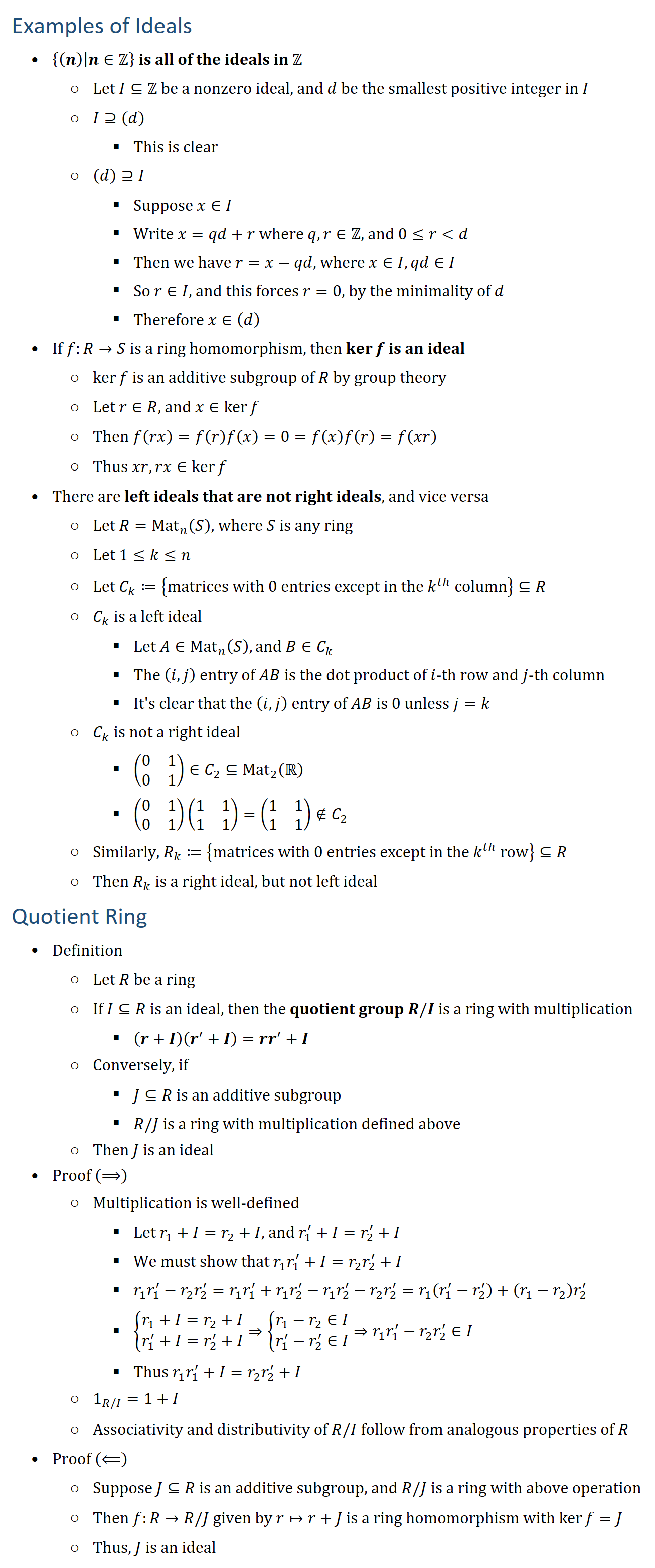
Examples of Ideals • {(n)│n∈Z is all of the ideals in Z ○ Let I⊆Z be a nonzero ideal, and d be the smallest positive integer in I ○ I⊇(d) § This is clear ○ (d)⊇I § Suppose x∈I § Write x=qd+r where q,r∈Z, and 0≤rd § Then we have r=x−qd, where x∈I,qd∈I § So r∈I, and this forces r=0, by the minimality of d § Therefore x∈(d) • If f:R→S is a ring homomorphism, then kerf is an ideal ○ kerf is an additive subgroup of R by group theory ○ Let r∈R, and x∈kerf ○ Then f(rx)=f(r)f(x)=0=f(x)f(r)=f(xr) ○ Thus xr,rx∈kerf • There are left ideals that are not right ideals, and vice versa ○ Let R=Mat_n (S), where S is any ring ○ Let 1≤k≤n ○ Let C_k≔{matrices with 0 entries except in the k^th column}⊆R ○ C_k is a left ideal § Let A∈Mat_n (S), and B∈C_k § The (i,j) entry of AB is the dot product of i-th row and j-th column § It s clear that the (i,j) entry of AB is 0 unless j=k ○ C_k is not a right ideal § (■8(0&1@0&1))∈C_2⊆Mat_2 (R § (■8(0&1@0&1))(■8(1&1@1&1))=(■8(1&1@1&1))∉C_2 ○ Similarly, R_k≔{matrices with 0 entries except in the k^th row}⊆R ○ Then R_k is a right ideal, but not left ideal Quotient Ring • Definition ○ Let R be a ring ○ If I⊆R is an ideal, then the quotient group R\I is a ring with multiplication § (r+I)(r′+I)=rr′+I ○ Conversely, if § J⊆R is an additive subgroup § R\J is a ring with multiplication defined above ○ Then J is an ideal • Proof (⟹) ○ Multiplication is well-defined § Let r_1+I=r_2+I, and r_1′+I=r_2′+I § We must show that r_1 r_1^′+I=r_2 r_2^′+I § r_1 r_1^′−r_2 r_2^′=r_1 r_1^′+r_1 r_2^′−r_1 r_2^′−r_2 r_2^′=r_1 (r_1′−r_2′ )+(r_1−r_2 ) r_2^′ § {█(r_1+I=r_2+I@r_1′+I=r_2′+I)┤⇒{█(r_1−r_2∈I@r_1′−r_2′∈I)┤⇒r_1 r_1^′−r_2 r_2^′∈I § Thus r_1 r_1^′+I=r_2 r_2^′+I ○ 1_(R/I)=1+I ○ Associativity and distributivity of R\I follow from analogous properties of R • Proof (⟸) ○ Suppose J⊆R is an additive subgroup, and R\J is a ring with above operation ○ Then f:R→R\J given by r↦r+J is a ring homomorphism with kerf=J ○ Thus, J is an ideal